
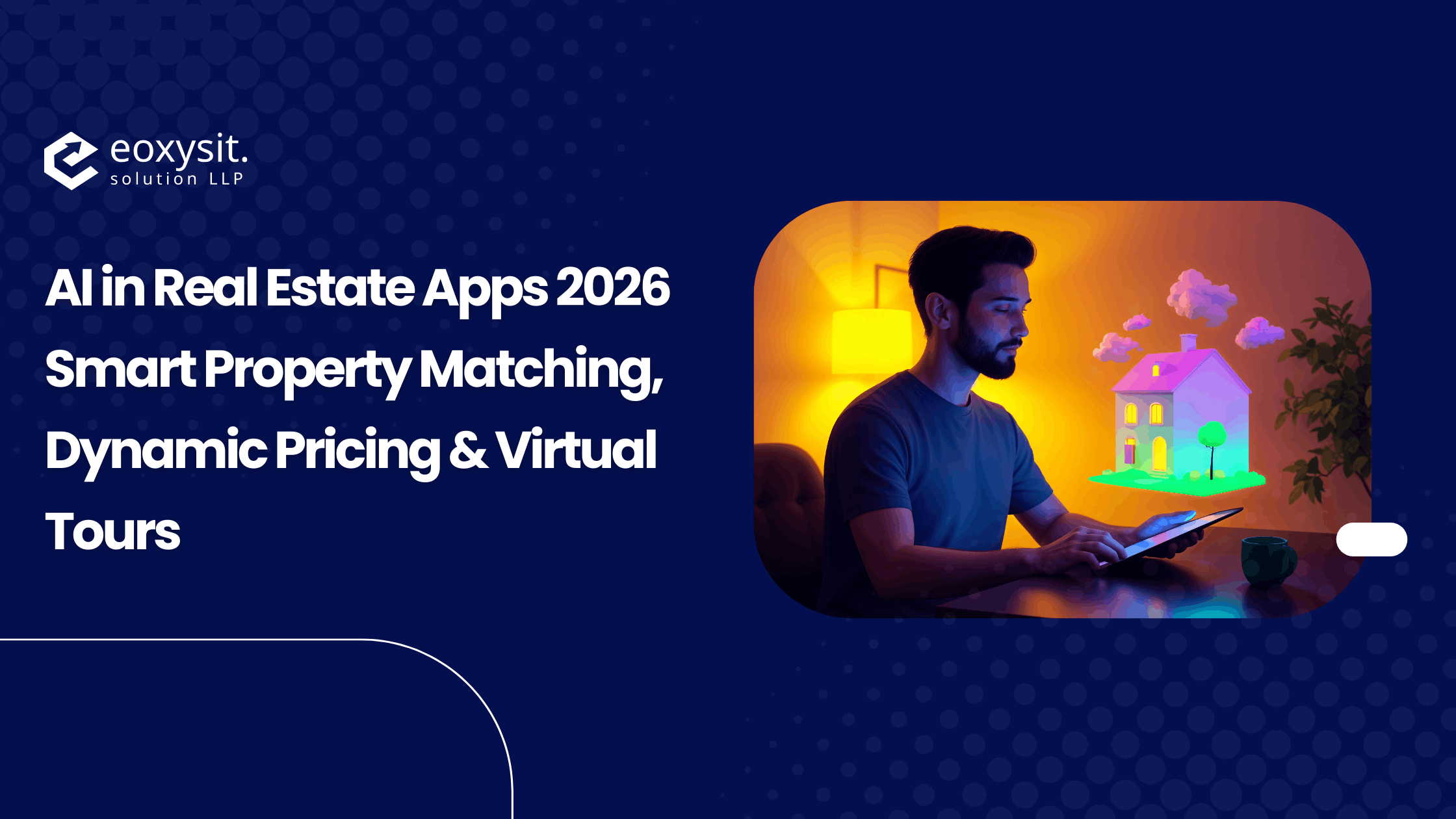
Real Estate Enters the AI Agent Era
Real estate and rental apps in 2026 are no longer just listing directories with filters and contact forms. AI has moved into the core of the experience—understanding buyer and tenant intent, matching them with the right properties, forecasting values, optimizing rent, and automating agent workflows.
Modern AI-powered platforms combine machine learning, computer vision, predictive analytics, and conversational interfaces to guide users end-to-end, not just show them options. Agents and property managers use AI to qualify leads, set accurate prices, reduce vacancy, and operate portfolios with far less manual effort.
This article breaks down how AI is changing real estate and rental apps in 2026, the concrete business benefits, and how Eoxys IT Solution can help you build a next-generation proptech product.
1. Intelligent Property Matching: Beyond Filters and Manual Search
From “Search & Scroll” to “Show Me My Best Options”
Historically, buyers, renters, and agents spent hours scrolling MLS feeds or portals with basic filters (price, beds, baths). In 2026, AI property recommendation engines analyze behavior, context, and preferences you never explicitly type in.
Modern apps track:
- What listings a user opens, ignores, saves, or revisits.
- How long they dwell on certain photos or features.
- Neighborhoods and price ranges where they keep circling back.
- Their life stage signals (first-time buyer, growing family, downsizing).
From this, AI infers hidden preferences such as:
- “Prefers quiet streets but near transit and parks.”
- “Leans toward newer construction over older charm.”
- “Likes south-facing light and large kitchens more than extra bedrooms.”
Realtor and agent-focused guides emphasize that AI produces insight reports summarizing client price positioning, neighborhood affinity, and feature priorities, which agents previously had to guess through manual conversations.
Smart Rental Matching and Tenant Fit
On the rental side, AI simplifies matching tenants to units:
- Budget, household size, and pet status.
- Commute patterns and lifestyle (nightlife vs family-friendly areas).
- Historical payment behavior and stability (where legally and ethically allowed).
Biz4Group reports that AI-powered predictive tenant matching can reduce vacancy rates by around 40%, improve tenant retention by 30%, and cut operational costs by up to 60% by automating screening, communication, and maintenance triage.
2. Dynamic Pricing, Valuation & Market Forecasting
AI-Driven Property Valuation
Instead of relying solely on intuition or a small set of comparables, AI valuation tools in 2026 consider:
- Historical transaction data and price trends.
- Micro-location signals: school ratings, amenities, walkability, crime, transit.
- Economic indicators and infrastructure projects.
- Rental yields and investor demand.
System Integrationʼs 2026 analysis highlights AI-powered property valuation and forecasting as one of the most impactful applications in real estate, enabling faster, data-backed pricing decisions for agents, developers, and investors.
Dynamic Rent & Short-Term Rental Optimization
In the rental space, AI engines adjust rent or nightly prices based on:
- Seasonal demand and local events.
- Competitor listings and occupancy.
- Length of stay, lead time, and historical vacancy patterns.
Biz4Group notes that AI for short-term rentals optimizes occupancy and revenue through smart pricing adjustments and gap reduction, while screening guests and automating communication. This is increasingly standard for Airbnb style and long term rental platforms alike.
3. Predictive Tenant Matching & Vacancy Reduction
Reducing Vacancies with Predictive Matching
Vacancy is one of the costliest problems in rental portfolios. AI can analyze:
- Tenant profiles and previous tenancies.
- Neighborhood dynamics and unit features.
- Local demand patterns and price sensitivity.
From this, predictive models:
- Suggest ideal tenants for each property.
- Identify likely long-term tenants vs short-stayers.
- Recommend lease terms and adjustments that maximize occupancy and renewal.
Biz4Groupʼs case data suggests up to 40% reduction in vacancy rates and 30% improvement in retention where AI matching and screening are deployed, along with significant savings on advertising and manual screening labor.
Fair Housing & Bias Controls
Serious implementations incorporate:
- Feature selection that avoids protected characteristics.
- Regular audits of outcomes to ensure fairness.
- Transparent decision criteria where required.
AI tenant matching tools emphasize compliance with Fair Housing laws and objective, non-discriminatory criteria in their marketing and documentation.
4. Virtual Tours, Vision AI & Remote Decision-Making
3D Tours and Immersive Experiences
By 2026, immersive property experiences are standard:
- 3D virtual tours let buyers and renters explore remotely.
- VR-compatible tours for headsets or mobile 360-degree views.
- “Day-night mode,” furniture staging, and renovation previews.
Reports on AI and digital tech in real estate note that virtual tours and interactive content significantly reduce time-wasting viewings and unlock cross-border buyer pools.
Computer Vision for Listing Quality and Compliance
AI also improves the supply side:
- Auto-selecting best photos based on clarity, brightness, and composition.
- Detecting missing shots (e.g., no kitchen or bathroom photo).
- Tagging features from images: hardwood floors, stainless appliances, natural light.
- Checking for guideline violations in images before publishing.
This boosts engagement and listing quality while saving agent time.
5. Conversational AI, Lead Handling & 24/7 Service
Chatbots as Always-On Assistants
Conversational AI in real estate apps:
- Answers property and neighborhood questions (schools, commute, amenities) instantly.
- Helps users book tours and request more info without waiting for a human response.
- Nurtures cold leads with drip conversations and follow-up prompts.
Crescendo and others highlight how large portals use AI chat to respond instantly, qualify leads, and direct them into agent pipelines, leading to higher conversion rates.
AI Assistants for Agents
Agent-facing features include:
- Drafting email/text response templates.
- Summarizing client behavior (“This buyer repeatedly opens listings in X area $20-30K below list price”).
- Generating scripts and talking points for outreach and follow-ups.
Realtor and agent guidance for 2026 emphasize that AI reduces response time, improves lead quality, and helps close more deals by removing manual friction in follow-up.
6. Agentic AI & Real Estate Operations
AI Agents as Digital Teammates
PropTech trend reports for 2026 highlight agentic AI—autonomous AI agents that execute multi step tasks—as a new frontier. These agents can:
- Monitor new listings and send matches to clients automatically.
- Watch client behavior in the app and trigger outreach when intent spikes.
- Prepare valuation reports, neighborhood briefs, and investment memos overnight.
MRI Softwareʼs 2026 outlook notes that real estate leaders should see agentic AI as strategic, not just experimental, and expect digital teammates that support operations, not just chat assistants.
Automation Across the Lifecycle
AI agents can operate across:
- Lead generation & scoring: prioritizing highest-intent contacts.
- Transaction workflows: nudging for documents, signatures, and status updates.
- Property management: scheduling inspections, handling maintenance requests, and automating rent reminders.
This reduces operational overhead and allows human staff to focus on high-value, relationship-driven work.
7. How This Translates into an App: Key Modules
A modern AI-first real estate or rental app typically includes:
- User-side app/web:
- Property browsing with AI recommendations.
- Smart search (“Show me 2BHK near metro with parks and schools”).
- Virtual tours and saved search alerts.
- Agent/landlord app/web:
- Listing management with AI-assisted descriptions and photo selection.
- Lead dashboard with AI-generated insight reports.
- Pricing and valuation tools.
- Admin/OPS panel:
- Portfolio analytics and market dashboards.
- Tenant matching and vacancy prediction widgets.
- AI services layer:
- Recommendation engines for buyers and tenants.
- Predictive valuation and rent optimization.
- Conversational assistants for both users and agents.
- Agentic workflows for follow-ups and operations.
Code Brew, Biz4Group, and others all stress that partnering with specialized AI app developers is essential, because building and orchestrating this stack requires cross-domain expertise ML, vision, NLP, real estate workflows).
8. Business Benefits for Platforms, Agents & Owners
For Marketplace/Platform Owners
- Higher engagement and time on app from smarter search and suggestions.
- Better conversion from views to inquiries and bookings.
- New monetization: premium analytics for agents/owners, featured AI-curated listings.
For Agents & Brokers
- 30-40% less time spent manually searching MLS and writing descriptions.
- More informed pricing advice and fewer price-cut events later.
- Always-on digital presence via branded apps with AI recommendations and updates.
For Landlords & Property Managers
- Vacancy reduction (up to 40% in some AI tenant matching examples).
- Lower operational cost through automation of screening, communication, and rent processes.
- Better tenant fit and higher renewal probability.
9. Building Your AI Real Estate or Rental App with Eoxys IT Solution
Eoxys IT Solution can be your end-to-end partner for an AI-powered real estate or rental platform:
What Eoxys Can Deliver
- Product strategy & UX tailored to your target: agencies, portals, rental managers, or investors.
- Mobile apps Android/iOS & web portals for buyers, renters, agents, and landlords.
- AI features, including:
- Property recommendation and smart search.
- Predictive tenant matching and screening logic.
- Valuation and dynamic pricing widgets.
- Conversational agents for leads and client support.
- Automated content creation (descriptions, summaries, reports).
FAQ
How is AI property matching different from filter-based search?
Filters only use the fields a user types in, such as price, beds and baths. AI recommendation engines also learn from behaviour: which listings someone opens, saves, ignores or revisits, how long they look at photos, and which neighbourhoods they keep returning to. The app then infers hidden preferences and ranks listings to match.
What data does AI property valuation use?
According to this guide, valuation tools look at historical transactions and price trends, micro-location signals such as school ratings, amenities, walkability and transit, economic indicators and infrastructure projects, plus rental yields and investor demand. The output should support an agent’s pricing decision with data, not replace the agent’s judgement.
How can AI tenant matching stay fair?
Serious implementations choose features that avoid protected characteristics, audit outcomes regularly to check fairness, and keep decision criteria transparent where the law requires it. Tenant-matching tools should be designed around Fair Housing rules and objective criteria, with a human able to review and override any recommendation or screening result.
How do I get a project estimate from Eoxys?
Share your goals, the systems involved and your timeline on the contact page. Eoxys IT Solution sends a real project estimate within 24 hours, with fixed-cost, dedicated and hourly options where they make sense. NDA on request. You can also read our portfolio first.
Related reading:

Shafeeq Khan is a web developer who creates modern, responsive, and user-friendly websites with clean code and creative design