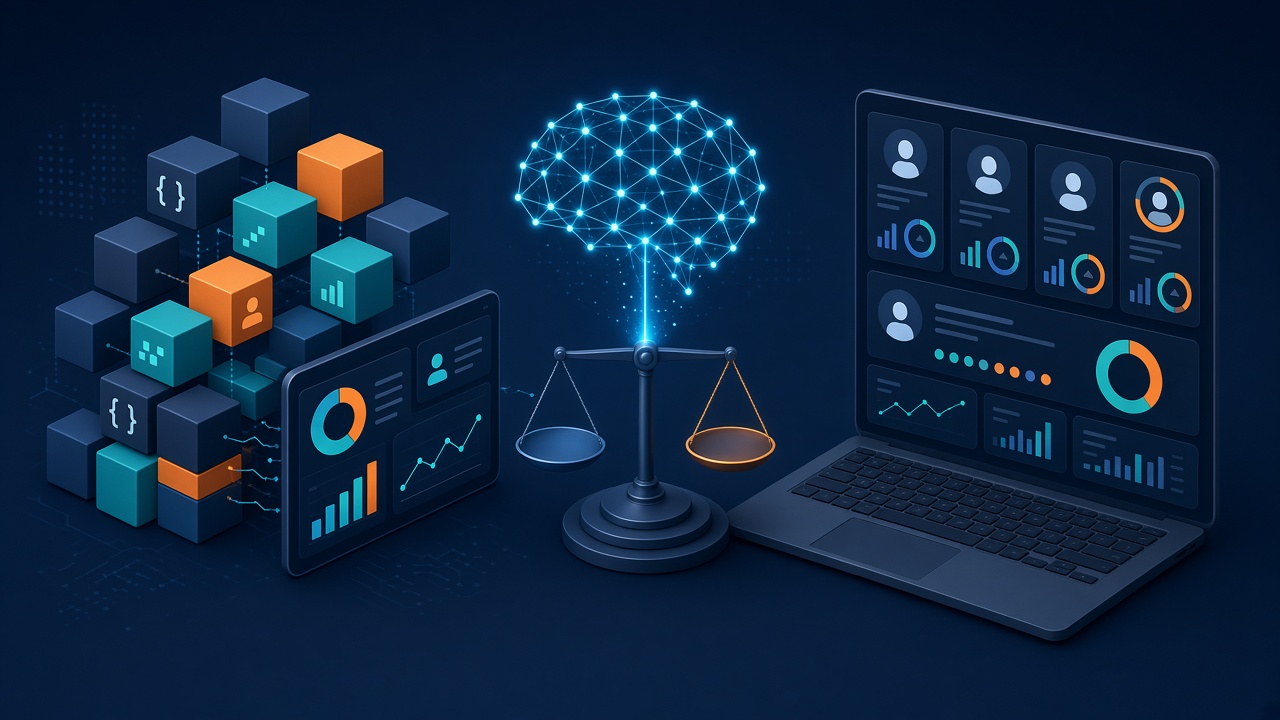
Recruiting is where most companies meet AI first. In SHRM’s 2025 Talent Trends research, 51% of organizations said they use AI to support recruiting, more than any other HR function, and AI use across HR tasks rose to 43% from 26% the year before. So the question for most founders and HR leaders isn’t whether to use AI in hiring. It’s whether to buy an off-the-shelf tool, build something custom, or combine the two.
At Eoxys IT Solution we’ve been building software since 2009, and we’ve worked on both sides of this decision: we help clients choose and integrate off-the-shelf tools, and we build custom AI and web platforms when off-the-shelf falls short. This guide covers what we’ve learned about making the build-vs-buy call for AI hiring software in 2026, including the compliance changes that now affect both options.
What “AI hiring software” actually covers in 2026
“AI hiring” is a broad label. Before you compare options, be specific about which jobs you want the software to do. The most common ones are:
- Job description and posting generation: drafting role descriptions and adapting them for different channels. SHRM found this is the most common recruiting use of AI (66% of organizations that use AI for recruiting).
- Resume parsing and screening: extracting skills and experience, then matching candidates to role requirements.
- Candidate sourcing: searching internal databases and external pools for people who fit.
- Conversational engagement: chatbots or agents that answer candidate questions, schedule interviews, and send updates.
- Assessment and interview support: structured question generation, interview summaries, and scoring rubrics.
- Fraud and identity checks: a fast-growing need. Gartner predicts that by 2028, one in four candidate profiles worldwide will be fake, and 6% of candidates in its survey admitted to interview fraud.
Some of these are commodity tasks that any decent tool handles well. Others, like scoring candidates against your own definition of a great hire, are where your competitive advantage and your legal risk both sit. That split should drive your decision.
The case for buying off-the-shelf
Buying a SaaS recruiting tool (or an applicant tracking system with AI features) makes sense when:
- Your hiring process is fairly standard. If you hire for common roles with typical stages, a mature product already encodes good-enough workflows.
- You need results this quarter. A subscription can be configured in days or weeks. A custom build takes longer.
- Your volume is modest. At low hiring volume, per-seat or per-job pricing usually beats the cost of building and maintaining software.
- You don’t have in-house engineering. Someone has to own a custom system after launch. Without that owner, buying is safer.
The trade-offs show up later: limited control over how candidates are scored, data that lives in someone else’s cloud, integrations that only go as deep as the vendor’s API, and pricing that grows with your headcount. You also inherit the vendor’s model choices, and you have to trust their bias testing.
The case for building custom
A custom or semi-custom AI hiring platform is worth the investment when:
- Your hiring is a differentiator. Staffing agencies, high-volume employers, and companies hiring for niche technical skills often need matching logic that generic tools can’t express.
- You need deep integration. If hiring data has to flow cleanly into your HRMS, payroll, onboarding, or a client portal, owning the stack removes a lot of glue code and manual work.
- You have strict data residency or privacy needs. Owning the infrastructure lets you decide where candidate data is stored, how long it’s kept, and which AI models can see it.
- You want to productize it. HR tech startups and agencies that plan to resell a hiring solution need IP they control.
The costs are real: upfront development, ongoing model and infrastructure spend, security work, and the responsibility for compliance documentation that a vendor would otherwise share with you.
Build vs buy at a glance
| Factor | Off-the-shelf | Custom build |
|---|---|---|
| Time to launch | Days to weeks | Typically months for a production-ready MVP |
| Upfront cost | Low (subscription) | Higher (design, development, testing) |
| Long-term cost | Grows with seats, jobs, or usage | Mostly hosting, AI usage, and maintenance |
| Scoring logic control | Limited to vendor settings | Full control and explainability |
| Data ownership | Governed by vendor contract | Yours, on infrastructure you choose |
| Integrations | Depends on vendor APIs | Built around your existing systems |
| Compliance effort | Shared, but you depend on vendor evidence | Fully yours, but fully auditable |
The compliance factor: new rules change the math
Regulation used to be a footnote in this decision. It isn’t anymore. Whichever route you choose, the employer using the tool carries obligations.
EU AI Act
AI used to recruit, filter applications, or evaluate candidates is classified as high-risk under Annex III of the EU AI Act. The Digital Omnibus on AI (Regulation (EU) 2026/1744) moved the start date for these high-risk obligations to 2 December 2027, according to the European Commission’s AI Act implementation timeline. The transparency rules in Article 50 were not delayed and have applied since 2 August 2026. When the high-risk rules take effect, Article 26 will require deployers to use these systems according to the provider’s instructions, assign competent human oversight, monitor how the system performs, keep logs, and tell workers’ representatives and affected workers before using a high-risk system in the workplace.
New York City Local Law 144
If you hire in New York City, Local Law 144 bars employers from using an automated employment decision tool unless it has had an independent bias audit within the past year. Employers must also publish a summary of the results and notify candidates. The audit has to calculate selection or scoring rates and impact ratios by sex, race/ethnicity, and intersectional categories.
India’s DPDP Act
For Indian employers, the Digital Personal Data Protection Rules, 2025 were notified on 13 November 2025, and most of the substantive obligations phase in over 18 months. Candidate data covers resumes, assessments, and interview recordings, so it needs proper notice, consent, security, and retention controls. Check the current timeline with your legal team, because MeitY has discussed shortening it.
What this means for build vs buy: if you buy, ask vendors for bias audit summaries, technical documentation, logging capabilities, and clear instructions for use. If you build, plan for explainable scoring, audit logs, human review steps, and demographic impact testing from day one. Adding these afterwards costs far more than designing them in.
A practical decision framework
When clients ask us which route to take, we work through these questions:
- How many hires a year, and how specialized are they? Low volume and generic roles point to buying. High volume or niche skills point to building or extending.
- Where is your advantage? If it’s in how you find and judge talent, own that logic. If it isn’t, rent it.
- What must the tool connect to? List your HRMS, ATS, payroll, calendar, and communication tools. Count how many integrations a vendor covers natively.
- Which jurisdictions do you hire in? The EU, New York City, and India each impose specific duties. Make sure the option you choose can produce the evidence regulators expect.
- Who owns it after launch? A custom system needs a team, internal or a partner, for updates, monitoring, and model changes.
The hybrid option most teams overlook
Many of our engagements end up in the middle: keep a proven ATS or HRMS for the core workflow, and build custom AI layers on top. Typical examples are a matching engine trained on your own job taxonomy, a candidate-facing conversational agent, or an identity-verification step for remote interviews. You get speed where the work is standard and control where it matters.
Keep humans in the loop, and earn candidate trust
Candidates are wary. Gartner’s 2025 survey of job applicants found that only 26% trust AI to evaluate them fairly. Whatever you choose, design the process so AI handles preparation (parsing, summarizing, scheduling, flagging) and people make the decisions. Tell candidates when AI is involved, explain what it assesses, and give them a way to ask for human review. That’s good ethics, it’s increasingly what the law requires, and it makes for a better hiring brand.
Frequently asked questions
Is it cheaper to build or buy AI hiring software?
Buying is almost always cheaper at first. Building can work out cheaper over several years for high-volume hiring, multi-client agencies, or companies that would otherwise pay for many seats across several tools. Compare total cost of ownership over three years, not just the launch cost.
Does the EU AI Act apply to companies outside Europe?
It can. The Act covers AI systems placed on the EU market or whose output is used in the EU, so a company outside Europe that screens candidates for EU-based roles should assume it may be in scope and get legal advice.
Can AI make final hiring decisions on its own?
We don’t recommend it. Fully automated rejection or selection creates legal and reputational risk in many jurisdictions. Use AI to rank, summarize, and flag, and keep a trained person accountable for each decision.
How long does a custom AI recruitment platform take to build?
It depends on scope. A focused MVP, such as resume matching plus a candidate chatbot integrated with your existing ATS, can take a few months. A full platform with assessments, analytics, and compliance tooling takes longer. A short discovery phase gives you a reliable estimate.
Related reading:
- AI Agents in 2026 From Helpful Assistants to Autonomous Digital Co-workers
- A Complete User Guide to Hiring Dedicated AI/ML Developers for Your Business Success
- Hire AI developers at Eoxys
Let’s choose the right path for your hiring
There’s no universal answer to build vs buy, but there is a right answer for your volume, roles, data, and regulatory exposure. At Eoxys IT Solution we help founders and HR teams assess their options, extend the tools they already use, or build custom AI hiring and HRMS platforms with compliance designed in from the start. Contact Eoxys IT Solution to talk through your hiring workflow, and we’ll recommend the approach that fits.

Shiv Kumawat is the CEO of Eoxys IT Solution LLP, the Jaipur-based IT and GenAI development company he has led since 2009. Eoxys builds custom AI, web and mobile applications for businesses worldwide. Shiv writes about AI app development, generative AI for business, and building software products that deliver real results. Connect with him on LinkedIn: https://www.linkedin.com/in/shiv-kumawat-eoxys/