 16+ Years Building Digital Products That Ship
 16+ Years Building Digital Products That Ship
A chatbot that gives a wrong answer is embarrassing. An AI agent that sends the wrong email, refunds the wrong order or deletes the wrong record is a real incident. As agents get tools, memory and permissions, AI agent security becomes a design job, not an afterthought.
The OWASP GenAI Security Project published the Top 10 for Agentic Applications for 2026 (OWASP), a shared list of the main risks in agent systems. This guide explains each risk in plain English, the controls we use on client builds and a checklist to run before launch. Checked on 5 November 2026.
Key takeaways
- OWASP’s agentic list runs from ASI01 Agent Goal Hijack to ASI10 Rogue Agents (OWASP). It builds on the OWASP Top 10 for LLM applications.
- Most agent risks come from three things: untrusted input, too much permission and too little oversight.
- Least privilege, human approval for consequential actions, isolation and full logging cover a large share of the list.
- For governance, NIST’s Generative AI Profile (AI 600-1) maps generative AI risks to actions across the AI lifecycle (NIST).
In this guide
- Why agents need their own security list
- The OWASP Agentic Top 10 in plain English
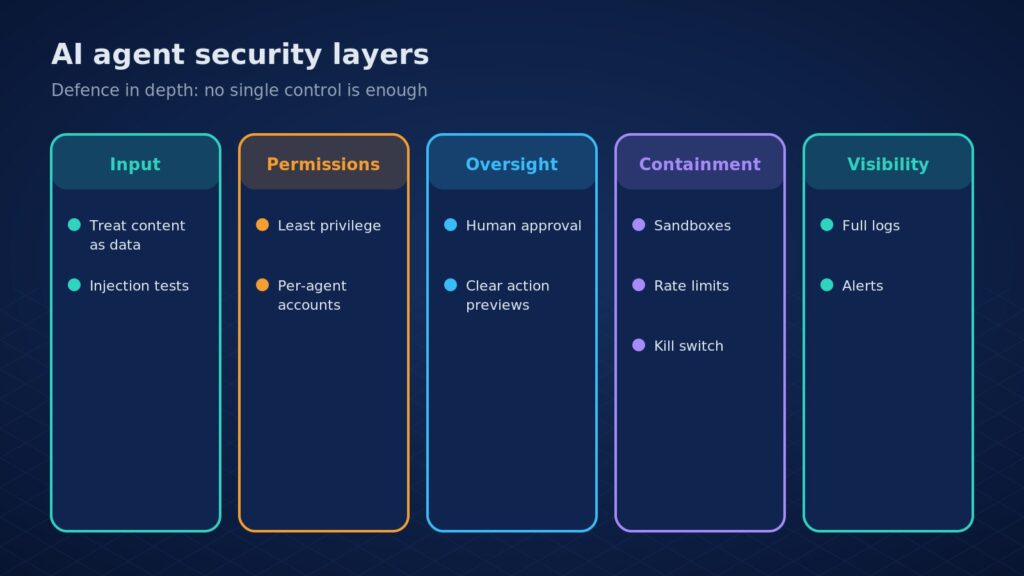
- Controls that cover most risks
- Pre-launch checklist
- Questions to ask a vendor
- FAQ
Why agents need their own security list
A plain LLM app reads input and writes text. An agent plans, calls tools, remembers past sessions, talks to other agents and acts with real credentials. Each of those adds a way for things to go wrong. A malicious line in an email, web page or PDF can steer the agent, and the agent’s permissions decide how much damage follows.
The OWASP Agentic Top 10 in plain English
| ID | Risk | What it means | Main controls |
|---|---|---|---|
| ASI01 | Agent Goal Hijack | Hidden instructions in content change what the agent is trying to do | Treat content as data; separate instructions; approval for actions |
| ASI02 | Tool Misuse and Exploitation | The agent uses a legitimate tool in a harmful way | Narrow tools, input validation, rate limits |
| ASI03 | Identity and Privilege Abuse | The agent acts with more access than it needs, or borrows a user’s | Per-agent identities, least privilege, short-lived tokens |
| ASI04 | Agentic Supply Chain Vulnerabilities | Compromised tools, plugins, MCP servers or models | Vet and pin dependencies; review third-party servers |
| ASI05 | Unexpected Code Execution | The agent runs code it should not | Sandboxes, no shell by default, allowlists |
| ASI06 | Memory and Context Poisoning | Bad data saved to memory affects later sessions | Validate what is stored; expire and review memory |
| ASI07 | Insecure Inter-Agent Communication | Messages between agents are spoofed or tampered with | Authenticate agents; sign and validate messages |
| ASI08 | Cascading Failures | One error spreads across connected agents and systems | Circuit breakers, limits, isolation between steps |
| ASI09 | Human-Agent Trust Exploitation | People approve harmful actions because the agent sounds confident | Clear approval screens showing exactly what will happen |
| ASI10 | Rogue Agents | An agent acts outside its intended scope | Monitoring, kill switches, scoped permissions |
Building an AI agent, or worried about one you already run? Eoxys reviews agent designs against the OWASP agentic list and fixes permissions, approvals and logging. Get a real project estimate within 24 hours. NDA on request.
Controls that cover most risks
Least privilege for every tool
Give each agent its own service account and only the permissions its task needs. Read-only by default; write access only where required; no admin tokens. This limits the damage from ASI02, ASI03 and ASI10.
Human approval for consequential actions
Payments, refunds, emails to customers, deletions and submissions should need a person to approve. Anthropic’s computer-use guidance makes the same point: ask a human to confirm decisions with meaningful real-world consequences (Anthropic). Show the exact action, not a summary, to counter ASI09.
Isolation
Run code and browser actions in sandboxes or containers with limited network access. This contains ASI05 and ASI08. Our guide to computer use agents covers sandbox setup.
Treat all content as untrusted
Emails, web pages, documents, tool outputs and other agents’ messages are data. Keep system instructions separate, filter inputs and never let content alone trigger a high-risk action.
Logging and monitoring
Log every prompt, tool call, approval and result. Alert on unusual patterns, such as many actions in a short time or tools the agent rarely uses. Keep a kill switch.
Supply chain review
Pin versions of models, libraries and MCP servers, and review third-party servers before connecting them. Our MCP server development guide covers authentication and scoping.
Pre-launch checklist
- List every tool the agent can call and the permission each needs.
- Remove any permission the task does not need.
- Add human approval for payments, deletions, external emails and submissions.
- Run code and browsing in a sandbox.
- Test prompt injection with hostile emails, pages and documents.
- Validate and expire anything saved to memory.
- Authenticate agent-to-agent messages.
- Set rate limits and a kill switch.
- Turn on full logging and alerts.
- Write an incident plan: who switches it off and how.
Questions to ask a vendor
| Question | Good answer |
|---|---|
| How do you handle prompt injection? | Layered: input filtering, separated instructions, approvals for actions, testing |
| What permissions will the agent have? | A written list per tool, read-only by default |
| Which actions need human approval? | Named list, agreed with you |
| Where does code run? | Sandboxed with limited network |
| What gets logged and who can see it? | Every action, retained per your policy, accessible to you |
See our guides to custom vs off-the-shelf agents and hiring an AI automation engineer if you are still choosing how to build.
FAQ
What is the OWASP Top 10 for Agentic Applications?
It is a list of the ten main security risks in AI agent systems, published by the OWASP GenAI Security Project for 2026. It covers risks such as goal hijacking, tool misuse, privilege abuse, supply chain issues, code execution, memory poisoning, inter-agent communication, cascading failures, trust exploitation and rogue agents.
What is the biggest AI agent security risk?
Untrusted content steering the agent, listed as ASI01 Agent Goal Hijack, combined with excessive permissions. A hidden instruction in an email or web page matters most when the agent can act on it. Limiting permissions and requiring human approval for consequential actions reduces the impact sharply.
Do small businesses need to worry about agent security?
Yes, even more so, because small teams often connect agents to email, CRM and payment tools with broad access. Start simple: separate accounts, read-only access by default, human approval for anything that sends, pays or deletes, and logs you actually review.
Can Eoxys secure our AI agent?
Yes. Our AI developers review agent designs against the OWASP agentic list, tighten permissions, add approvals, sandboxes and logging, and test for prompt injection. Get a real project estimate within 24 hours.
Work with Eoxys
Eoxys IT Solution LLP has built websites, apps and AI products since 2009, with 700+ projects delivered. See the work on our portfolio, or explore our AI and machine learning solutions.
We design and build AI agents with least privilege, human approval and full logging from day one. Get a real project estimate within 24 hours. NDA on request. Prefer to talk? Call +91 96678 22661.
Related reading:
- MCP Server Development in 2026: Connect Your App to AI Agents
- Computer-Use AI Agents: Automate Old Software Without an API
- Custom AI Agent vs Off-the-Shelf Tools: How to Decide
Sources
Checked on 5 Nov 2026 against OWASP GenAI Security Project, NIST and Anthropic documentation.
- OWASP: Top 10 for Agentic Applications for 2026
- OWASP: Top 10 for LLM Applications
- NIST AI 600-1: Generative AI Profile
- Anthropic: Computer use tool security considerations

Shafeeq Khan is a web developer who creates modern, responsive, and user-friendly websites with clean code and creative design