 16+ Years Building Digital Products That Ship
 16+ Years Building Digital Products That Ship

A fitness app in the UK lives or dies on two quiet moments: the first week, when a new member decides whether the plan feels made for them, and the renewal date, when they decide whether to keep paying. Everything in between, from workout videos to wearable sync, is there to win those two moments. That is also where most of the budget for a fitness app in the UK goes, because subscriptions, health data and store billing all carry rules you must build for. This guide shows what it costs in 2026, with hours, rates and the UK rules to plan around.
Key takeaways
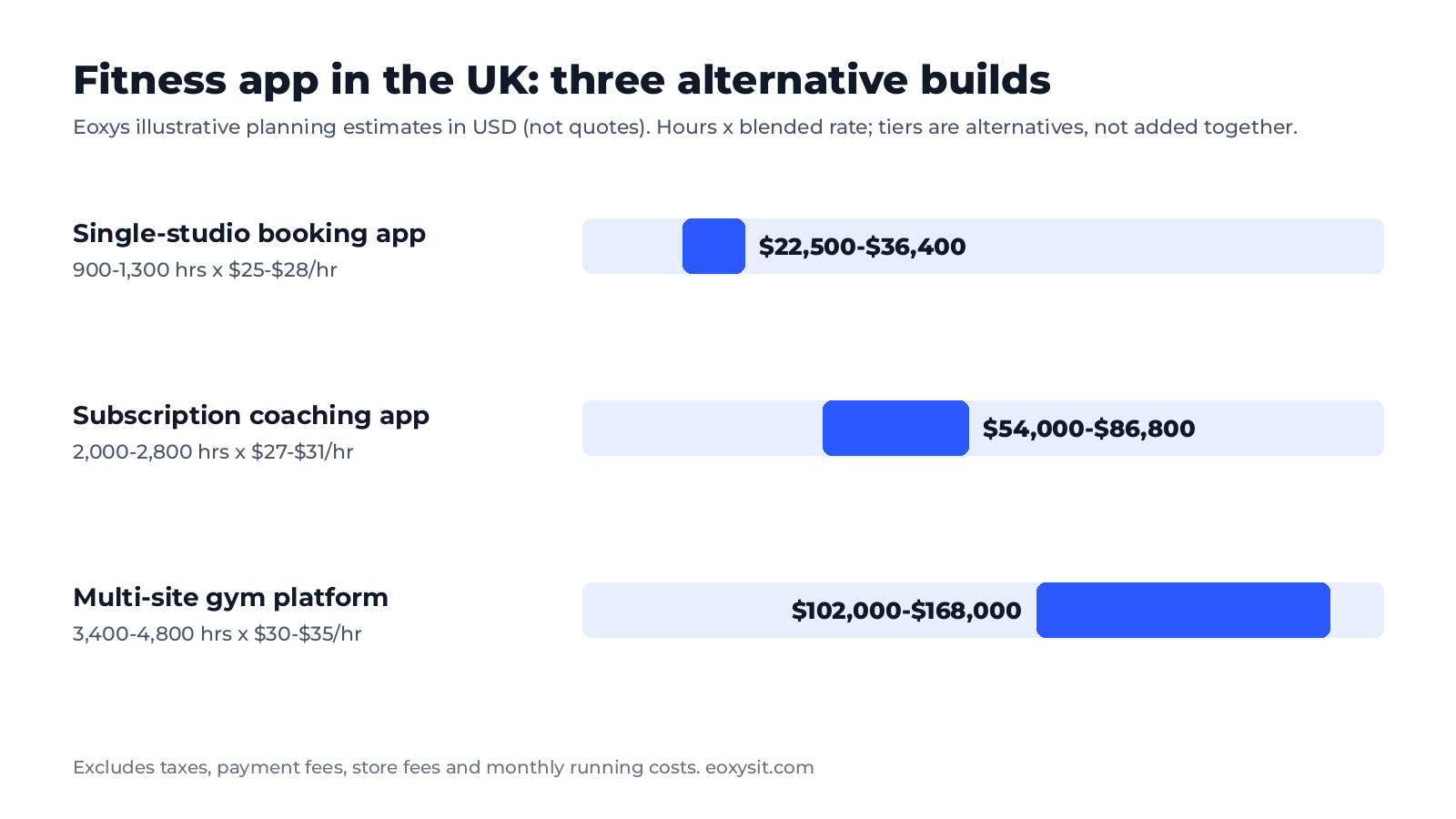
- Eoxys plans a UK fitness app at about $22,500–$36,400 for a single-studio booking and workout app, $54,000–$86,800 for a subscription coaching app with video and wearables, and $102,000–$168,000 for a multi-site gym platform. These are illustrative estimates, not quotes.
- Each tier is delivery hours × a blended rate of $25–$35 per hour, delivered offshore from India.
- New UK subscription rules apply to consumer subscriptions entered into from 1 January 2027, so sign-up, reminder and cancellation flows belong in the first release.
- Health and fitness data can be special category data under UK GDPR, which affects consent screens, storage and analytics.
- Budget separately for VAT, store commission, card fees and monthly running costs.
In this guide: Quick answer · Core features and edge cases · Estimated costs and rates · Hours by module · Ongoing monthly costs · UK-specific costs · What changes the budget · Keeping the first release lean · Why build with Eoxys · FAQ
Quick answer
Plan $22,500–$36,400 (about £17,200–£27,800) for a class booking and workout app for one gym or studio, $54,000–$86,800 (about £41,300–£66,400) for a subscription coaching app with a video library, wearable sync and a trainer panel, and $102,000–$168,000 (about £78,000–£128,500) for a multi-site gym platform with memberships, live classes and a personal-trainer marketplace. Pound figures use about £0.765 per US dollar, worked out from the ECB euro reference rates for 23 Nov 2026; the pound floats, so recheck on the day you budget. All three are Eoxys illustrative planning estimates for alternative builds. They are not quotes and do not include VAT.
Core features and the edge cases that drive cost
Every fitness app has a login, workouts, a progress screen and a payment button. The budget difference comes from the exceptions. Price these, not just the happy path.
- Class booking: a class is full, then someone cancels 30 minutes before. You need a waitlist that offers the spot, a cut-off rule and a late-cancel or no-show policy the front desk can override.
- Subscriptions: a member signed up on iPhone, then wants to cancel on the website. Your system must know which store or gateway owns the subscription and show the right cancel path every time.
- Failed renewals: a card expires on renewal day. Plan retries, a grace period, a clear message and what happens to class bookings already made.
- Wearable sync: a watch records a run twice, or a user revokes Health permission. The app must de-duplicate workouts and keep working without the data.
- Workout video: a member trains in a basement gym with no signal. Downloads for offline use, resume points and video quality that adapts to the connection matter more than another filter.
- Trainer changes: a coach leaves mid-programme. Clients, chat history and plans must move to a new coach without losing data.
- Injury and health notes: a client shares a medical condition in chat. That data needs the same protection as health records, not the same storage as marketing data.
Estimated development costs and rates
Every figure below is delivery hours × a blended hourly rate. The hours cover discovery, UI/UX design, Flutter or React Native apps, backend and admin, testing, release and project management. Our base developer rate for delivery from India is $25 per hour. The blend rises towards $35 as a project needs more senior architect, QA automation and DevOps time. Offshore delivery from our Jaipur team is how we keep the rate lower than onshore agency pricing. The three tiers are alternative builds, so do not add them together.
Tier 1: Single-studio booking and workout app
$22,500–$36,400, from about 900–1,300 hours at $25–$28 per hour. You get a member app for iOS and Android, a class timetable with booking, waitlist and cancellation rules, memberships and class packs paid by card, a simple workout log, push reminders and a staff web panel for classes, members and check-ins. This suits one gym, studio or boutique brand that wants its own app instead of a generic booking listing.
Tier 2: Subscription coaching app with video and wearables
$54,000–$86,800, from about 2,000–2,800 hours at $27–$31 per hour. This adds an on-demand video library with offline downloads, personalised programmes, Apple Health and Health Connect sync, in-app subscriptions on both stores plus web checkout, a trainer panel with check-ins and chat, progress photos, and an admin with churn and renewal reports. This is the usual scope for a coach, creator or fitness brand selling a monthly plan.
Tier 3: Multi-site gym platform
$102,000–$168,000, from about 3,400–4,800 hours at $30–$35 per hour. On top of Tier 2, plan for several sites with their own timetables and staff, membership tiers that work across sites, live-streamed classes, a personal-trainer marketplace with payouts, door or turnstile access integration, corporate memberships and a head-office reporting layer. Confirm access-control hardware and any existing gym-management software in discovery before you fix this price.
Planning a fitness or gym app for the UK? Get a real project estimate within 24 hours. NDA on request.
Hours by module (Tier 2 example)
Ask every bidder for hours by module. It is the quickest way to see whether a low quote has left out the subscription logic, wearable sync or testing. Here is how a Tier 2 coaching app breaks down in our planning.
| Module | Hours | What is included |
|---|---|---|
| Discovery and UX/UI design | 200–280 | Workshops, user journeys, onboarding quiz, design system, clickable prototype |
| Member app (iOS and Android) | 520–720 | Onboarding, programmes, workout player, progress, profile, notifications |
| Video library and streaming | 180–260 | Upload, encoding, adaptive playback, offline downloads, resume points |
| Wearables and health data | 160–240 | Apple HealthKit, Android Health Connect, consent screens, de-duplication |
| Subscriptions and payments | 200–280 | App Store and Google Play billing, web checkout, trials, renewals, cancellation flow |
| Trainer panel | 220–300 | Programme builder, client check-ins, chat, notes |
| Admin panel and reports | 160–220 | Members, content, plans, renewals and churn reports |
| Backend and APIs | 180–260 | Accounts, roles, data model, audit log, integrations |
| QA and accessibility testing | 120–160 | Device testing, subscription test cases, accessibility checks |
| DevOps, release and project management | 60–80 | Environments, store submission, monitoring, weekly demos |
| Total | 2,000–2,800 | At $27–$31 per hour = $54,000–$86,800 |
Ongoing monthly costs
Running costs grow with members and video minutes, so budget them separately from the build. As an Eoxys illustrative allowance, plan roughly $300–$1,500 per month for cloud hosting, video delivery, push and email at launch scale, then check each item against the vendor’s own price page:
- Cloud and database: usage-based, see AWS pricing or Firebase pricing.
- Video: encoding, storage and minutes watched, see Mux pricing as one example.
- Card payments: Stripe lists 1.5% + 20p for standard UK cards and 2.5% + 20p for EU cards.
- Store accounts: the Apple Developer Program is $99 a year and Google Play charges a one-time $25 registration fee.
- Support retainer (optional): 20–40 hours a month × $25–$28 per hour = $500–$1,120 for fixes, OS updates and small features.
UK-specific costs to plan for
Currency and VAT
The standard UK VAT rate is 20%. Your prices, receipts and reports need to show VAT correctly for memberships, class packs and digital plans; confirm the treatment of each product with your accountant. Because the pound floats against the dollar, agree the contract currency with your supplier up front.
New subscription rules from 1 January 2027
The Consumer Subscription Contracts (Cancellation and Information) Regulations 2026, made under the Digital Markets, Competition and Consumers Act 2024, are set to come into force on 1 January 2027 and apply to consumer subscriptions entered into from then. Expect clearer information before sign-up and a straightforward way to end the contract. In the app, that means plan summaries before payment, renewal reminders, a cancel flow that is not buried, and records of what the member saw. Budget about 60–120 extra hours if your current app was not built this way.
App Store and Google Play billing
Apple’s App Review Guidelines let real-time one-to-one services such as fitness training use payment methods other than in-app purchase (3.1.3(d)), but one-to-few and one-to-many live services must use in-app purchase. Physical services used outside the app, such as a gym membership, must use other methods like card entry (3.1.3(e)). Apple’s Small Business Program cuts commission to 15% for developers with up to $1 million in proceeds. For UK users, Google Play lists a 10% service fee plus a 5% billing fee on auto-renewing subscriptions. Map every product to the right billing path in discovery; it changes both your margin and your build.
Health data under UK GDPR
Heart rate, injuries, weight and similar data can be special category data, which needs a lawful basis plus an extra condition, usually explicit consent for a consumer app. Most organisations that use personal data must also pay the ICO data protection fee. Apple’s guideline 5.1.3 bars using HealthKit and other health and fitness data for advertising or data mining. Build separate consent screens, keep health data apart from marketing tools and plan a data protection impact assessment.
Younger users
If under-18s are likely to use the app, for example a junior football or swim club, the ICO’s Children’s code applies. That usually means high-privacy defaults, location off by default and age-appropriate explanations, which add design and testing time.
Wearables on iOS and Android
Apple Health data comes through HealthKit and Android data through Health Connect. Each has its own permission model and store review questions, so treat wearable sync as two integrations, not one.
What changes the budget
- Number of apps and panels: member app, trainer app, front desk and head office each add design, build and testing.
- Integrations: existing gym-management software, door access, payroll or a CRM can each be a milestone of their own.
- Live video: live classes with chat cost far more than on-demand video.
- Multi-site rules: different timetables, prices and staff per site multiply the admin logic.
- Design depth: custom animations and a branded workout player take more hours than standard components.
To compare bids fairly, send every supplier the same brief and the same sample day, such as “a member books a 7 am class, joins the waitlist for 6 pm, then cancels the subscription on the web”. Ask for hours by module and who owns the store, gateway and cloud accounts.
How to keep the first release lean
- Discovery (2–3 weeks): journeys, billing map, data protection plan, fixed scope.
- MVP (10–14 weeks): one app, core programmes or booking, one billing path, admin.
- Pilot (4–6 weeks): one site or a small member group; measure week-one activity and renewals.
- Scale: add wearables, video, more sites or the trainer marketplace based on pilot data.
Timelines are Eoxys estimates and depend on how fast content, store accounts and payment accounts are ready. For a regulated health product rather than a fitness app, see our telemedicine app cost guide for the USA. For another subscription-and-order market, see the food delivery app cost guide for the UAE.
Why build with Eoxys
- Since 2009: Eoxys IT Solution has delivered 700+ projects from Jaipur, India, with a team of 55+.
- Health and fitness experience: our portfolio includes Fitgate, a fitness app on Google Play with personalised workouts, and BioVeda Wellness.
- Cross-platform builds: Flutter or React Native apps from one codebase, plus web portals and admin panels through our mobile and web application development team.
- Flexible engagement: fixed cost, a dedicated team or hourly.
- You own it: the source code, store accounts, payment gateway, video and cloud accounts stay in your company’s name.
FAQ
How much does a fitness app cost in the UK?
Eoxys plans about $22,500–$36,400 for a single-studio booking app, $54,000–$86,800 for a subscription coaching app with video and wearables, and $102,000–$168,000 for a multi-site gym platform. Each figure is delivery hours × a $25–$35 blended rate. They are illustrative estimates, not quotes, and exclude VAT and running costs.
How long does it take to build?
Plan roughly 3–4 months for a Tier 1 app, 5–7 months for a Tier 2 coaching app and 8–12 months for a multi-site platform, including discovery and store review. These are Eoxys estimates. Content, payment accounts and decisions on billing paths usually set the real pace.
What will it cost each month after launch?
As an illustrative allowance, plan $300–$1,500 a month for cloud, video and messaging at launch scale, plus card fees, store commission on in-app sales, the $99 Apple fee each year, and an optional support retainer of $500–$1,120 a month. Check each vendor’s current price page before you budget.
Do I have to use Apple in-app purchase?
It depends on what you sell. Digital plans and group live classes generally need in-app purchase, one-to-one live training can use other methods, and gym memberships used outside the app must use card or similar payments. Map each product against Apple’s guideline 3.1 before you design the checkout.
Who owns the store, payment and cloud accounts?
You should. Open the Apple, Google Play, Stripe, video and cloud accounts in your company’s name and give your supplier access. With Eoxys, source code and every third-party account stay with you, so you can change supplier or bring the work in-house without rebuilding.
How can I test a supplier before signing?
Pay for a short discovery sprint with a fixed output: user journeys, a billing map, hours by module and a clickable prototype. Ask to see live apps in their portfolio and talk to the people who would build yours. A good supplier will challenge your scope rather than accept it.
Is a white-label fitness app cheaper?
A white-label app is usually cheaper to start, but you pay a monthly licence, share the vendor’s roadmap and may not own the member data or code. A custom build costs more up front and suits brands that want their own programmes, pricing and long-term control.
How do I get an estimate for my fitness app?
Send a short brief through our contact page: who the members are, what you sell, which sites or coaches are involved and any software you already use. We reply with a real project estimate within 24 hours, and we can sign an NDA on request.
Ready to plan your UK fitness app? Get a real project estimate within 24 hours, NDA on request. Or call +91 96678 22661 and visit eoxysit.com.
Related reading
- Telemedicine App Development Cost in the USA (2026)
- AI MVP Development Cost in 2026: What You Pay and Why
Sources
Checked on 24 Nov 2026 against GOV.UK, legislation.gov.uk, UK Parliament, the ICO, the ECB, Apple, Google and Stripe.
- GOV.UK: VAT rates
- legislation.gov.uk: Consumer Subscription Contracts (Cancellation and Information) Regulations 2026 (draft)
- UK Parliament: Consumer Subscription Contracts Regulations 2026, coming into force 1 January 2027
- ICO: Special category data
- ICO: Data protection fee
- ICO: Children’s code guidance
- ECB: Euro foreign exchange reference rates
- Apple: App Review Guidelines (3.1.3, 5.1.3)
- Apple: App Store Small Business Program
- Google Play Console: Service fees
- Stripe UK pricing
- Android Developers: Health Connect

Shafeeq Khan is a web developer who creates modern, responsive, and user-friendly websites with clean code and creative design