 16+ Years Building Digital Products That Ship
 16+ Years Building Digital Products That Ship

A telemedicine visit in the USA only works when four things line up: the clinician is licensed in the state where the patient is sitting, the video and chat run on vendors that will sign a HIPAA business associate agreement, the prescription goes out through a channel the law allows, and the bill is right for the payer. Most of the cost of a telemedicine app in the USA sits in those checks, not in the video screen. This guide shows what it costs to build in 2026, with hours, rates and the US rules to budget for.
Key takeaways
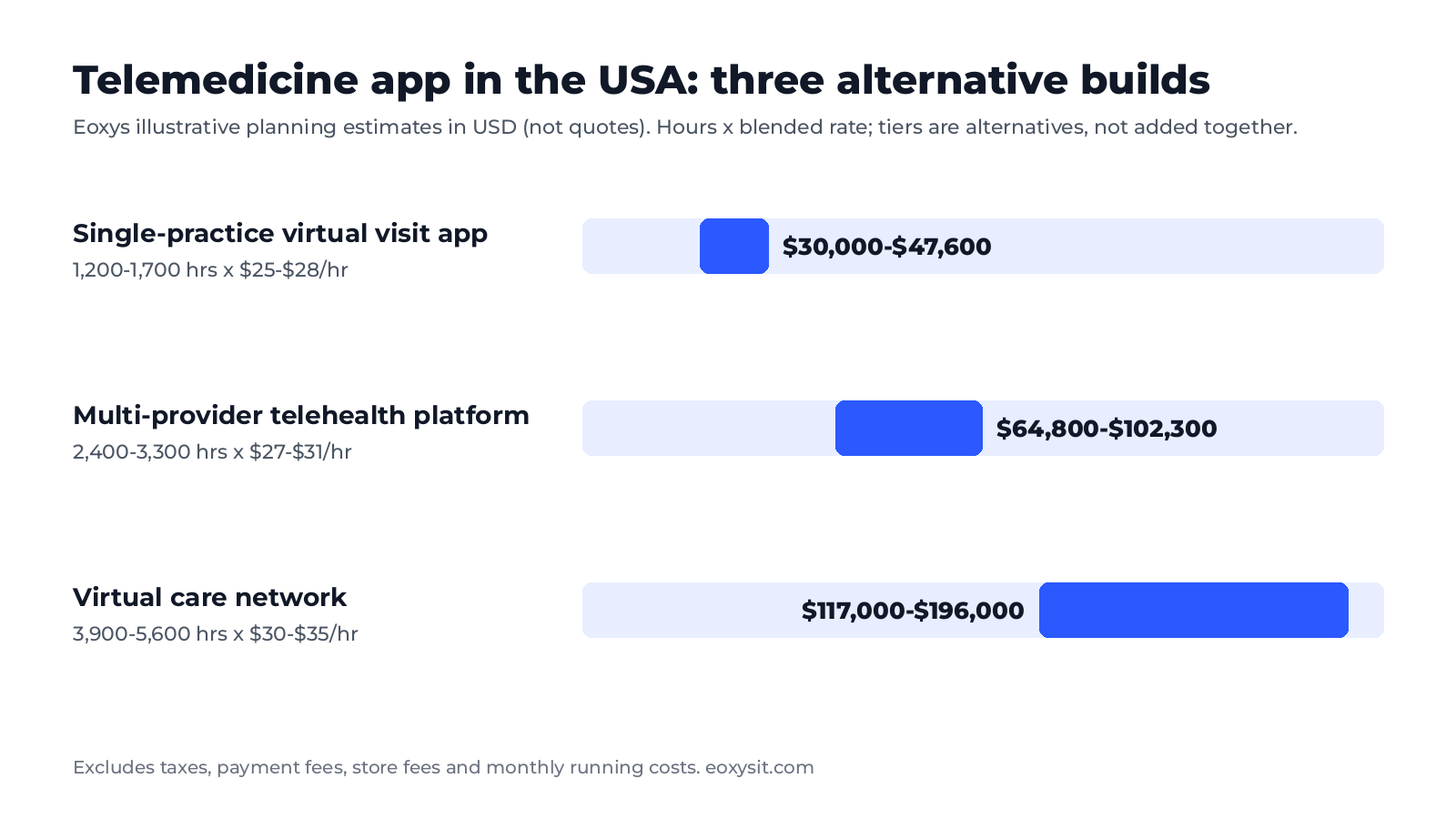
- Eoxys plans a US telemedicine app at about $30,000–$47,600 for a single-practice virtual visit app, $64,800–$102,300 for a multi-provider telehealth platform and $117,000–$196,000 for a virtual care network. These are illustrative estimates, not quotes.
- Each tier is delivery hours × a blended rate of $25–$35 per hour, delivered offshore from India.
- HIPAA-ready vendors, state licensing logic and e-prescribing rules add scope that a generic “video call app” quote leaves out.
- Budget separately for card fees, store fees, video minutes and monthly running costs.
In this guide: Quick answer · Core features and edge cases · Estimated costs and rates · Hours by module · Ongoing monthly costs · US-specific costs · What changes the budget · Keeping the first release lean · Why build with Eoxys · FAQ
Quick answer
Plan $30,000–$47,600 for a single-practice virtual visit app with a patient app, a provider portal, scheduling, video and card payments. Plan $64,800–$102,300 for a multi-provider telehealth platform with state-based clinician routing, e-prescribing and payouts. Plan $117,000–$196,000 for a virtual care network with EHR integration, several specialties, employer or health-plan accounts and remote monitoring. All three are Eoxys illustrative planning estimates in US dollars for alternative builds. They are not quotes and do not include taxes, payment fees or running costs.
Core features and the edge cases that drive cost
Every telehealth app has the same feature list on paper. The cost difference comes from how each feature behaves when something goes wrong. Price these exceptions, not just the happy path.
- Patient location and licensing: the patient books from home in one state but joins the call while travelling in another. The app must confirm location at visit time and only offer clinicians licensed there.
- Intake and consent: a patient skips the consent form or uploads an unreadable insurance card. Intake needs required fields, retakes and a clear block before the visit starts.
- Video visits: the patient’s connection drops mid-visit. Plan reconnect, a fallback to an audio-only call where the clinic allows it, and a visit record that survives the drop.
- Waiting room and no-shows: the clinician runs late or the patient never joins. Queues need timeouts, rebooking, no-show fees and messages that do not leak health details.
- Prescriptions: a clinician wants to prescribe a controlled medication to a patient never seen in person. The app must route this through the rules in force on that date, not a hard-coded assumption.
- Payments and refunds: a card is charged but the visit is cancelled by the clinic. Refunds, provider pay and the finance export must all match.
- Messaging and records: patients send photos and results between visits. Messages need secure storage, audit logs and a way to attach them to the chart.
Estimated development costs and rates
Every figure below is delivery hours × a blended hourly rate. The hours cover discovery, UI/UX design, Flutter or React Native apps, backend and admin, testing, release and project management. Our base developer rate for delivery from India is $25 per hour. The blend rises towards $35 as a project needs more senior architect, QA automation, security and DevOps time. Offshore delivery from our Jaipur team is how we keep the rate lower than onshore agency pricing. The three tiers are alternative builds, so do not add them together.
Tier 1: Single-practice virtual visit app
$30,000–$47,600, from about 1,200–1,700 hours at $25–$28 per hour. You get a patient app for iOS and Android, a web portal for clinicians and front-desk staff, appointment booking, digital intake and consent, one-to-one video visits, secure chat, card payments and visit notes. This suits a single clinic or a small group practice moving its own patients online in one or a few states.
Tier 2: Multi-provider telehealth platform
$64,800–$102,300, from about 2,400–3,300 hours at $27–$31 per hour. This adds clinician onboarding with licence records by state, routing patients to a clinician licensed where they are, on-demand and scheduled visits, e-prescribing through a certified partner, lab orders, provider payouts, ratings, detailed audit logs and an operations dashboard. This is the usual scope for a new direct-to-consumer telehealth brand or a specialty group covering several states.
Tier 3: Virtual care network
$117,000–$196,000, from about 3,900–5,600 hours at $30–$35 per hour. On top of Tier 2, plan for EHR integration over FHIR APIs, several specialties with their own visit types, employer or health-plan accounts, remote patient monitoring devices, insurance eligibility checks, analytics, and stronger security testing and monitoring. Validate partner APIs, payer requirements and expected visit volume before you fix this price.
Planning a telemedicine app for US patients? Get a real project estimate within 24 hours. NDA on request.
Hours by module (Tier 2 example)
Ask every bidder for hours by module. It is the quickest way to see whether a low quote has left out the provider side, prescribing or testing. Here is how a Tier 2 platform breaks down in our planning.
| Module | Hours (estimate) | What is included |
|---|---|---|
| Discovery and UI/UX | 200–270 | Visit flows, accessible screens, clickable prototype, acceptance tests |
| Patient app (iOS and Android) | 450–620 | Sign-up, intake and consent, booking, payments, visit history, messages |
| Clinician app and web portal | 400–550 | Schedule, waiting room, visit notes, prescriptions, licence profile |
| Video visits and secure messaging | 280–380 | Video SDK, reconnect, audio-only fallback, chat with files |
| Scheduling, intake and state routing | 260–360 | Availability, time zones, patient location check, licence-based matching |
| E-prescribing and lab integration | 200–280 | Certified e-prescribing partner, pharmacy search, lab orders and results |
| Payments, billing and payouts | 170–240 | Card payments, no-show fees, refunds, clinician payouts, superbills |
| Admin, audit logs and reporting | 180–250 | Roles, access logs, visit and revenue reports, support tools |
| Security controls and DevOps | 120–170 | Encryption, backups, monitoring, HIPAA-eligible cloud setup |
| QA and store release | 140–180 | Test plans, device testing, App Store and Google Play submission |
| Total | 2,400–3,300 | Matches the Tier 2 range above |
Ongoing monthly costs
As a working allowance, plan $800–$4,000 per month for software operations at launch volumes: HIPAA-eligible cloud hosting and database, backups, monitoring, video minutes, SMS reminders and email. This is an Eoxys planning estimate. Video minutes grow with every visit, so this line rises with usage. It does not include payment fees, insurance, marketing or clinical staff.
- Card payments: Stripe’s standard US rate is 2.9% + 30¢ per successful domestic card transaction. Your gateway and plan may differ.
- App stores: the Apple Developer Program costs 99 USD per membership year, and Google Play has a US$25 one-time registration fee.
- Cloud and communications vendors: use services covered by a business associate agreement. AWS publishes its list of HIPAA-eligible services, and Twilio says HIPAA customers handling PHI must sign its Business Associate Addendum. Check each vendor’s pricing on the plan that includes the BAA.
- Support retainer (optional): 20 hours a month at $30 per hour is $600, or 40 hours is $1,200, with a 4-hour response for critical issues.
US-specific costs to plan for
HIPAA and business associate agreements
HHS states that telehealth by covered providers and health plans must comply with the HIPAA Rules and use technology vendors that will enter into business associate agreements. In the build, that means encryption, role-based access, audit logs, session timeouts and a vendor list where every service touching patient data is covered. If you are a direct-to-consumer app outside HIPAA, the FTC’s Health Breach Notification Rule can still apply to health apps, so plan breach notices and honest data-sharing settings either way.
State licensing and patient location
Clinicians are licensed state by state. The Interstate Medical Licensure Compact offers a voluntary, expedited pathway to licensure for qualified physicians in member states, but it does not remove the need to track licences. Budget for a licence table per clinician, a patient-location check at booking and at visit start, and routing that never offers an unlicensed match.
E-prescribing and controlled substances
Electronic prescribing of controlled substances must meet DEA rules in 21 CFR part 1311, including two-factor authentication for the prescriber, which is why most teams integrate a certified e-prescribing partner rather than build this themselves. The DEA’s fourth temporary extension lets DEA-registered practitioners prescribe Schedule II–V medications by telemedicine without a prior in-person visit only through 31 December 2026. Build prescribing rules as settings you can change, not code you must rewrite.
Medicare telehealth rules
If you plan to bill Medicare, HHS says patients can receive non-behavioral telehealth in their home through 31 December 2027, and audio-only delivery is allowed through the same date. Billing codes, place-of-service values and audio-only flags then need to flow from the visit record into claims. Cash-pay apps can skip this module at launch.
Accessibility
Providers that receive HHS funding must make web content and mobile apps meet WCAG 2.1 Level AA under 45 CFR 84.84, from 11 May 2027 for recipients with 15 or more employees and from 10 May 2028 for smaller ones. Even if this does not apply to you, accessible screens, captions and large-text support cost far less when designed in than when retrofitted.
App Store payment and health data rules
Apple’s App Review Guideline 3.1.3(d) lets apps that sell real-time person-to-person services, with medical consultations as a named example, use payment methods other than in-app purchase, so one-to-one visits can be paid by card. Group classes or one-to-many sessions must use in-app purchase. Guideline 5.1.3 also limits how health data can be used, for example no advertising use of HealthKit data.
What changes the budget
- Number of apps and panels: patient, clinician, front desk, admin and employer portals each add design, build and testing time.
- Integrations: EHR, e-prescribing, labs, insurance eligibility and wearables are each a separate integration with its own testing.
- States and specialties: more states means more licence logic; more specialties means more visit types and intake forms.
- Payment model: cash-pay is simplest; insurance billing and employer contracts add claims data and invoicing.
- Security depth: penetration testing, detailed audit trails and monitoring add hours but are hard to skip for patient data.
To compare bids fairly, send every supplier the same written brief and the same sample day, for example “a patient in one state books a visit, joins from another, gets a prescription and a refund”. Ask each one for hours by module like the table above.
How to keep the first release lean
- Discovery (2–4 weeks): visit flows, states, vendor list with BAAs, prescribing scope and a clickable prototype.
- MVP (10–16 weeks): booking, intake, video, chat, card payments and the clinician portal for one specialty.
- Pilot (4–8 weeks): a small group of clinicians and patients, with weekly fixes and support review.
- Scale (ongoing): e-prescribing, more states, EHR integration and insurance billing as real demand shows up.
These weeks are Eoxys planning estimates for a Tier 1 or early Tier 2 scope and depend on how fast your clinical and legal decisions are made.
Why build with Eoxys
- Building software since 2009 from Jaipur, India, with 700+ projects delivered and a 55+ person team.
- Healthcare-related work in our portfolio includes DentalDrive (cloud backup for dental practices), DDSHARED (encrypted file sharing for dental practices with role-based permissions and audit trails), Homeland RX (pharmacy price comparison) and FitGate (fitness and nutrition).
- Mobile and web application development with Flutter for one codebase on iOS and Android, or a dedicated developer team.
- Fixed-cost, dedicated-team or hourly engagement, with offshore delivery that keeps the blended rate at $25–$35 per hour.
- You own the code and every third-party account: App Store, Google Play, cloud, video, payments and e-prescribing.
- Talk to us on +91 96678 22661.
FAQ
How much does a telemedicine app cost in the USA?
In Eoxys planning, about $30,000–$47,600 for a single-practice virtual visit app, $64,800–$102,300 for a multi-provider telehealth platform and $117,000–$196,000 for a virtual care network. Each is hours × a $25–$35 blended rate. These are illustrative estimates, not quotes, and exclude payment fees and running costs.
How long does it take to build a telehealth app?
Plan roughly 3–5 months from discovery to a pilot for a Tier 1 or lean Tier 2 scope, based on our phased plan. Integrations such as e-prescribing, EHR and insurance billing add time. A larger virtual care network is usually released in stages over several more months.
Does a telemedicine app have to be HIPAA compliant?
If you are a covered provider or health plan, or build for one, yes: HHS says telehealth must comply with the HIPAA Rules and use vendors that sign business associate agreements. Direct-to-consumer health apps outside HIPAA can still fall under the FTC Health Breach Notification Rule. Confirm your status with a healthcare lawyer.
What are the monthly costs after launch?
As an Eoxys planning allowance, $800–$4,000 a month for hosting, video minutes, SMS, backups and monitoring at launch volumes, plus card fees, store fees and any support retainer. Video and messaging costs grow with visits, so model them per visit before you set prices.
Who owns the app and third-party accounts?
You should. Open the App Store, Google Play, cloud, video, payment and e-prescribing accounts in your company’s name and sign each BAA yourself. Your developer works inside those accounts with access you can revoke. Eoxys hands over the source code and credentials at the end of the engagement.
How do I test a development partner before signing?
Start with a paid discovery phase or a small module, such as booking and intake. Check how the team handles audit logs, access roles and vendor BAAs, ask for hours by module, and review working builds every one or two weeks rather than waiting for a final demo.
Is a white-label telehealth app cheaper?
It can be cheaper to start, but check licence fees per clinician or visit, whether the vendor signs a BAA, and how much of your workflow it can change. A custom build costs more up front, while you own the code, data model and roadmap.
How do I get an estimate for my telemedicine app?
Send your visit types, states, integrations and launch date through our contact page. We reply with a real project estimate within 24 hours, broken down by module, and we sign an NDA on request.
Ready to plan your US telemedicine app? Get a real project estimate within 24 hours, NDA on request, or call +91 96678 22661.
Related reading:
- AI in Doctor Appointment & Telehealth Apps 2026: Smart Triage, Scheduling & Virtual Care
- Taxi App Development Cost in Saudi Arabia (2026)
- Food Delivery App Development Cost in the UAE (2026)
Sources
Checked on 22 Nov 2026 against HHS, the FTC, the DEA (Federal Register), eCFR, the IMLC, Apple, Google, Stripe, AWS and Twilio pages.
- Telehealth.HHS.gov: HIPAA Rules for telehealth technology
- Telehealth.HHS.gov: Medicare payment policies
- Federal Register: FTC Health Breach Notification Rule (2024)
- Federal Register: Fourth temporary extension of telemedicine flexibilities (DEA and HHS)
- eCFR: 21 CFR part 1311, electronic prescriptions
- eCFR: 45 CFR 84.84, web and mobile accessibility
- Interstate Medical Licensure Compact
- Apple: App Review Guidelines
- Apple Developer Program: what’s included and fees
- Google Play Console: registration fee
- Stripe pricing
- AWS: HIPAA eligible services reference
- Twilio: HIPAA

Shafeeq Khan is a web developer who creates modern, responsive, and user-friendly websites with clean code and creative design