 16+ Years Building Digital Products That Ship
 16+ Years Building Digital Products That Ship
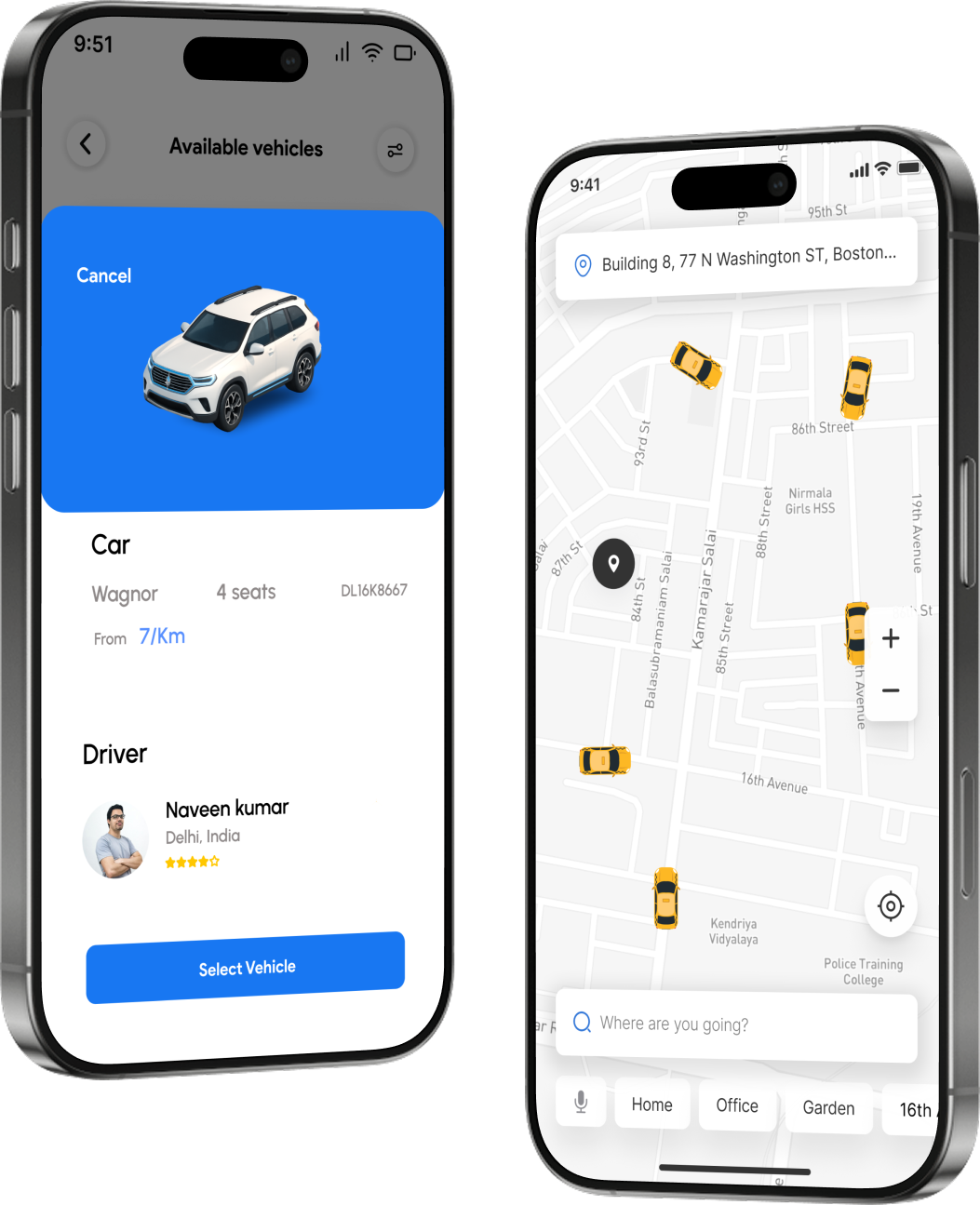
A ride in Saudi Arabia only counts as a completed trip when four things hold at once: a licensed, verified Saudi driver accepts it, the fare the rider saw matches what is charged on mada or a card, the pickup pin is right for a compound gate or a mall entrance, and the platform can show the regulator what happened. Most of the cost of a taxi app in Saudi Arabia sits in those checks, not in the booking screens. This guide shows what it costs to build in 2026, with hours, rates and the local rules to budget for.
Key takeaways
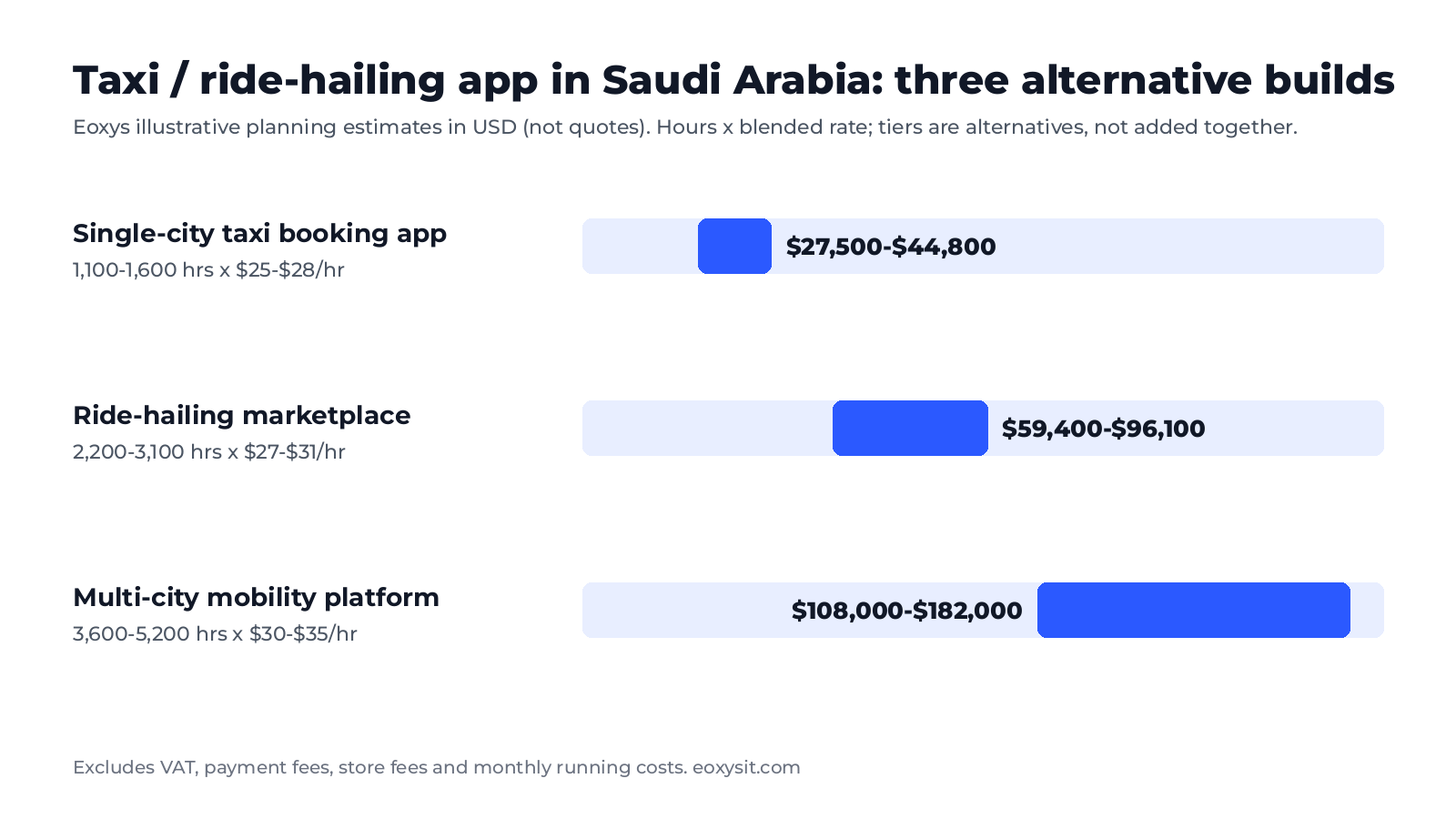
- Eoxys plans a Saudi taxi or ride-hailing app at about $27,500–$44,800 for a single-city booking app, $59,400–$96,100 for a ride-hailing marketplace and $108,000–$182,000 for a multi-city mobility platform. These are illustrative estimates, not quotes.
- Each tier is delivery hours × a blended rate of $25–$35 per hour, delivered offshore from India.
- Budget separately for 15% VAT, payment fees, store fees and monthly running costs.
- Transport General Authority (TGA) licensing, driver verification, Arabic right-to-left screens and the Personal Data Protection Law all add scope you should price from day one.
In this guide: Quick answer · Core features and edge cases · Estimated costs and rates · Hours by module · Ongoing monthly costs · Saudi-specific costs · What changes the budget · Keeping the first release lean · Why build with Eoxys · FAQ
Quick answer
Plan $27,500–$44,800 (about SAR 103,000–168,000) for a single-city taxi or limousine booking app with rider, driver and admin apps, $59,400–$96,100 (about SAR 223,000–360,000) for a ride-hailing marketplace with live dispatch, dynamic pricing and driver payouts, and $108,000–$182,000 (about SAR 405,000–683,000) for a multi-city platform with corporate accounts, scheduled rides and fleet tools. SAR figures use the official rate of SAR 3.75 per US dollar. All three are Eoxys illustrative planning estimates for alternative builds. They are not quotes and do not include VAT.
Core features and the edge cases that drive cost
Every ride app has the same feature list on paper. The cost difference comes from how each feature behaves when something goes wrong. Price these exceptions, not just the happy path.
- Driver onboarding: a driver uploads an expired licence or the vehicle papers do not match. The app needs document checks, an approval queue and a way to block trips until the record is fixed.
- Identity at trip start: the person driving is not the person registered. Plan a selfie or face check hook before shifts and a clear flow when it fails.
- Matching and dispatch: the nearest driver ignores the request or cancels on the way. Dispatch needs timeouts, re-offers, cancellation rules and a manual override for the operations team.
- Pickup pins: GPS drifts in dense districts, compounds and airports. Riders need saved places, gate or entrance notes and in-app calling that hides both phone numbers.
- Fares and changes: the route changes mid-trip or the rider adds a stop. The final fare must be explained line by line on the receipt, with VAT shown.
- Payments: a mada payment is authorised but the trip is cancelled. Refunds and cancellation fees must match in the rider app, driver earnings and the finance export.
- Safety and support: riders and drivers need trip sharing, an SOS action and a support ticket tied to the trip ID, in Arabic and English.
Estimated development costs and rates
Every figure below is delivery hours × a blended hourly rate. The hours cover discovery, UI/UX design, Flutter or React Native apps, backend and admin, testing, release and project management. Our base developer rate for delivery from India is $25 per hour. The blend rises towards $35 as a project needs more senior architect, QA automation and DevOps time. Offshore delivery from our Jaipur team is how we keep the rate lower than onshore agency pricing. The three tiers are alternative builds, so do not add them together.
Tier 1: Single-city taxi or limousine booking app
$27,500–$44,800, from about 1,100–1,600 hours at $25–$28 per hour. You get a rider app and a driver app for iOS and Android, a web admin, fixed or metered fares, one payment gateway with mada and cards, Arabic and English, and basic trip history. This suits an existing taxi or limousine operator moving its own fleet from phone bookings to an app. Dispatch is simple nearest-driver matching, and reporting covers trips, cancellations and daily takings.
Tier 2: Ride-hailing marketplace
$59,400–$96,100, from about 2,200–3,100 hours at $27–$31 per hour. This adds independent driver onboarding with document checks, a real-time dispatch engine with re-offers, dynamic pricing and promo codes, driver wallets and payouts, ratings, safety tools, VAT-ready receipts and the hooks needed to connect with TGA systems. This is the usual scope for a new ride-hailing brand launching in one city such as Riyadh, Jeddah or Dammam.
Tier 3: Multi-city mobility platform
$108,000–$182,000, from about 3,600–5,200 hours at $30–$35 per hour. On top of Tier 2, plan for several cities with their own pricing, corporate accounts with monthly invoicing, scheduled and airport rides, several vehicle classes, fleet owner panels, fraud rules and monitored operations at peak hours. Validate partner APIs and expected trip volume before you fix this price.
Planning a taxi or ride-hailing app for Riyadh, Jeddah or Dammam? Get a real project estimate within 24 hours. NDA on request.
Hours by module (Tier 2 example)
Ask every bidder for hours by module. It is the quickest way to see whether a low quote has left out the driver app, dispatch logic or testing. Here is how a Tier 2 marketplace breaks down in our planning.
| Module | Hours (estimate) | What is included |
|---|---|---|
| Discovery and UI/UX (Arabic and English) | 180–240 | Trip flows, mirrored right-to-left layouts, clickable prototype, acceptance tests |
| Rider app (iOS and Android) | 420–580 | Booking, pickup notes, fare estimate, live tracking, payments, ratings, trip sharing |
| Driver app | 380–540 | Onboarding and documents, identity check hook, shifts, trip offers, navigation handoff, earnings |
| Dispatch and real-time engine | 330–470 | Matching, timeouts and re-offers, cancellations, live location over sockets |
| Pricing, receipts and VAT | 200–290 | Fare rules, dynamic pricing, promo codes, VAT-ready receipts, e-invoice data |
| Payments and driver payouts | 210–300 | Gateway with mada, Apple Pay and cards, wallet options, refunds, driver settlements |
| Admin and operations panel | 220–310 | Driver approvals, zones, fares, support tools, reports, manual dispatch |
| Regulator integration and reporting | 80–120 | Data exchange with TGA systems as required, audit logs, exports |
| QA, DevOps and release | 180–250 | Device and payment testing, load test, environments, CI/CD, store submissions |
| Total | 2,200–3,100 | × $27–$31 per hour = $59,400–$96,100 |
Ongoing monthly costs
As a working allowance, plan $500–$3,000 per month for software operations at launch volumes: cloud hosting and database, backups, monitoring, OTP SMS, push notifications and maps. This is an Eoxys planning estimate. Ride apps send frequent location updates, so this line grows faster with trip volume than in most apps. It does not include payment fees, taxes, insurance, marketing or staff.
- Maps, routing and ETAs: usage-based. Check current rates on Google Maps Platform pricing and cache routes where the terms allow.
- Payment fees: SAMA’s e-commerce pricing rules allow acquirers to charge merchants up to 1.75% on mada card purchases, and some gateways publish lower rates, for example Tap’s 1% mada fee capped at SAR 200. Card rates are usually higher, so get written rates from two or three gateways.
- App stores: the Apple Developer Program costs $99 a year and a Google Play developer account is a one-time $25. You need both for the rider and driver apps.
- Support retainer (optional): if you want Eoxys to handle fixes, updates and small changes, 20 hours a month at $30 per hour is $600, or 40 hours is $1,200.
Saudi-specific costs to plan for
Currency, VAT and e-invoicing
The riyal is pegged at SAR 3.75 to the US dollar, so USD budgets convert cleanly. The standard VAT rate is 15%, administered by ZATCA. ZATCA’s e-invoicing (FATOORA) rules require compliant electronic invoices, and Phase 2 integration with ZATCA’s systems is rolled out to taxpayers in waves. Ask your tax adviser how this applies to rider receipts, driver commissions and corporate invoices, and build the invoice data model once.
TGA licensing and driver rules
Ride-hailing through apps is regulated by the Transport General Authority. The implementing regulation for app-based passenger transport (Arabic, published on the Istitlaa platform) requires a licence, a commercial registration that covers the activity, a registered trademark for the app, and an electronic platform that is connected and integrated with TGA’s systems. It also sets driver and vehicle conditions. In February 2026 TGA said ride-hailing work through apps is restricted to Saudi citizens and added facial recognition checks for drivers. Confirm the current rules with TGA or a Saudi adviser, then budget the integration and verification work in the driver app and admin.
Payments: mada, Apple Pay and wallets
mada is the national payment network owned by the Saudi Central Bank, and mada cards can be added to Apple Pay. Apple Pay is available in Saudi Arabia, so plan mada, Apple Pay and Visa or Mastercard at launch, and add wallets such as STC Pay through your gateway if your riders ask for them. Rides are services used outside the app, so Apple’s App Review Guidelines (3.1.3(e)) expect you to take payment with methods such as Apple Pay or cards, not in-app purchase.
Arabic and right-to-left screens
Arabic is not a translation file added at the end. Maps controls, fare breakdowns, trip timelines and chat all need mirrored layouts. Apple’s right-to-left design guidance and Flutter’s internationalisation support make this manageable when it is planned from the first design sprint. In our Tier 2 table it sits inside discovery, UI and both apps.
Personal data protection
A ride app holds live location, trip history, phone numbers and driver identity documents. SDAIA publishes the Personal Data Protection Law, its implementing regulation and the rules on transferring personal data outside the Kingdom. Budget for a privacy notice, consent records, retention rules, access logs and a decision on where your servers sit before you choose a cloud region.
What changes the budget
- Number of apps and panels: rider, driver, admin, fleet owner and corporate portal each add hours.
- Dispatch model: nearest-driver matching is far cheaper than batching, scheduled rides and airport queues.
- Integrations: regulator systems, gateways, SMS, fleet telematics or ERP links each need build and test time.
- Cities and vehicle classes: each city with its own fares, zones and rules adds configuration and QA.
- Design depth: a custom brand and motion design cost more than a clean, proven layout.
To compare bids fairly, send every vendor the same one-page brief and a sample busy evening: twenty requests, one driver who cancels on the way, one wrong pickup pin, one failed mada payment and one rider who adds a stop. Ask each vendor to show how their build handles those cases and how many hours they have priced for each.
How to keep the first release lean
- Discovery (about 2–3 weeks): map the real trip flow, confirm the licensing path, choose your gateway and agree on acceptance tests.
- MVP build (about 12–18 weeks for Tier 1 or 2): ship the smallest complete loop, from request to match, trip, payment, receipt and refund.
- Pilot (about 4–6 weeks): run one city or a set of districts, and track cancellations, failed payments and support tickets.
- Scale: add cities, vehicle classes, corporate accounts or AI features only when pilot data shows they are needed.
Timelines are Eoxys estimates and depend on how fast licences, gateway accounts and store listings are ready. If you want smarter dispatch or demand forecasting later, our guide to AI in taxi apps covers what is worth building.
Why build with Eoxys
- Since 2009: Eoxys IT Solution has delivered 700+ projects from Jaipur, India, with a team of 55+.
- On-demand and booking experience: our work includes QEVU (on-demand taxi booking, formerly Posh Rides) and OKBaju (on-demand home services) from our portfolio.
- Cross-platform builds: Flutter or React Native apps from one codebase, plus web admin panels through our mobile and web application development team.
- Flexible engagement: fixed cost, a dedicated team or hourly.
- You own it: the source code, store accounts, gateway, maps and cloud accounts stay in your company’s name.
Prefer to talk? Call us on +91 96678 22661.
FAQ
How much does a taxi app cost in Saudi Arabia?
Eoxys plans about $27,500–$44,800 for a single-city booking app, $59,400–$96,100 for a ride-hailing marketplace and $108,000–$182,000 for a multi-city platform. That is roughly SAR 103,000–683,000 across the three. These are illustrative estimates based on hours × blended rate, not quotes, and exclude VAT and running costs.
How long does it take to build a ride-hailing app?
Plan about 2–3 weeks of discovery and 12–18 weeks of build for Tier 1 or Tier 2, then a 4–6 week pilot. A multi-city platform takes longer and is best delivered in phases. Licence approvals, gateway onboarding and store review can add weeks, so start them during discovery.
What are the ongoing costs after launch?
Allow about $500–$3,000 a month for cloud, maps, SMS, push and monitoring at launch volumes, as an Eoxys planning estimate. Payment fees are a percentage of each fare, Apple charges $99 a year and Google $25 once. An optional Eoxys support retainer is 20 hours for $600 or 40 hours for $1,200 a month.
Do I need a TGA licence before launch?
Yes, app-based passenger transport in Saudi Arabia needs a TGA licence, and the regulation expects your platform to connect with TGA systems. Drivers must also meet TGA conditions, including the Saudi citizen requirement. Confirm the current steps with TGA or a local adviser. We build the platform and integration; licensing stays with your company.
Who should own the store, gateway, maps and cloud accounts?
Your company should. Open the Apple, Google Play, payment gateway, Google Maps and cloud accounts in your own name and invite the developer as a user. That way you keep your apps, payment history and data if you ever change vendors. Eoxys works this way by default and hands over the source code.
How do I test a development partner before signing?
Send the same brief to every vendor and ask for hours by module, a sample busy-evening walkthrough and live apps they have built. A short paid discovery sprint is the safest test: you get flows, a prototype and a fixed estimate, and you can judge communication before committing to the full build.
Is a white-label taxi script cheaper?
It can be cheaper up front, but check Arabic RTL quality, who owns the code, whether it supports mada and VAT receipts, and whether it can connect to TGA systems. Changing a script you do not control can cost more than a focused custom build. Our Tier 1 scope is a sensible middle path for an existing fleet.
How do I get an estimate for my taxi app?
Share your city, fleet model, the apps you need and any must-have integrations through our contact page. We reply with a real project estimate within 24 hours, broken down by module and hours, and we can sign an NDA before you share details.
Ready to plan your Saudi ride-hailing app? Get a real project estimate within 24 hours, NDA on request, or call +91 96678 22661.
Related reading:
- Food Delivery App Development Cost in the UAE (2026)
- AI in Taxi Apps – Revolutionizing Urban Mobility in 2026
Sources
Checked on 21 Nov 2026 against SAMA, ZATCA, TGA (Istitlaa), SDAIA, Apple, Google and gateway pricing pages.
- SAMA: Commitment to the SAR 3.75 exchange rate
- SAMA: mada
- SAMA Rulebook: mada cards for online purchases
- ZATCA: About VAT
- ZATCA: E-invoicing roll-out phases
- Istitlaa: TGA implementing regulation for app-based passenger transport (Arabic)
- Saudi Gazette: TGA introduces facial recognition verification for ride-hailing drivers (1 Feb 2026)
- SDAIA: Laws and regulations, including the PDPL
- Apple: App Review Guidelines
- Apple: Human Interface Guidelines, right to left
- Apple: Countries and regions that support Apple Pay
- Apple Developer Program: what’s included and fees
- Google Play Console: registration fee
- Google Maps Platform pricing
- Tap Payments: mada fees in Saudi Arabia
- Flutter: Internationalizing Flutter apps

Shafeeq Khan is a web developer who creates modern, responsive, and user-friendly websites with clean code and creative design