 16+ Years Building Digital Products That Ship
 16+ Years Building Digital Products That Ship

A clinic booking in Qatar only works when the patient lands in a real slot with a doctor who is licensed and on shift, the app knows whether the visit is covered by the patient’s insurer or paid by card, and the reminder arrives in the language the patient reads, Arabic or English. Most of the cost of a doctor appointment app in Qatar sits in those rules: slot logic, insurance details, health-data permissions and teleconsultation limits. This guide shows what it costs to build in 2026, with hours, rates and the Qatar-specific items to budget for.
Key takeaways
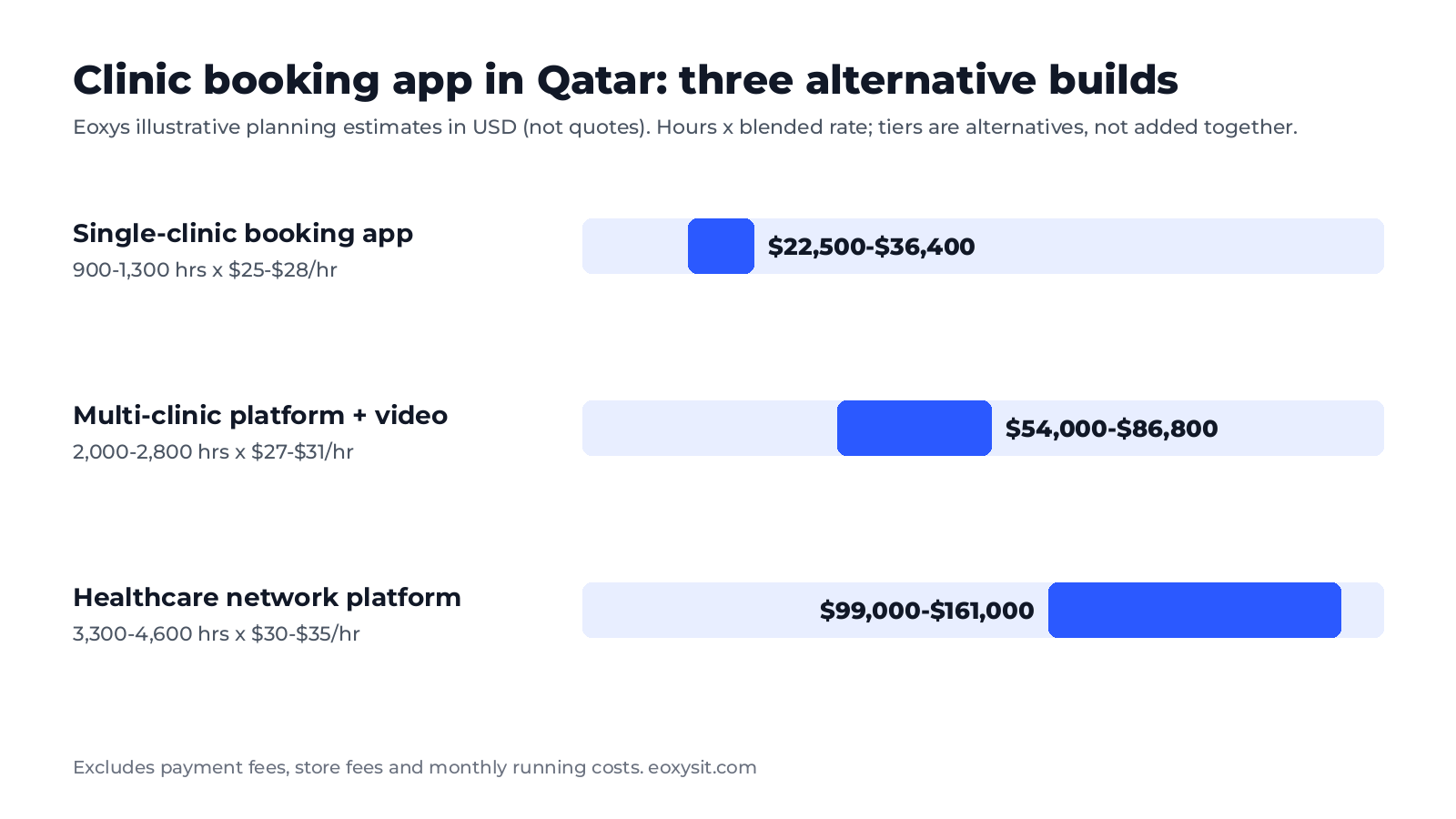
- Eoxys plans a Qatar doctor appointment app at about $22,500–$36,400 for a single-clinic booking app, $54,000–$86,800 for a multi-clinic platform with video consultations and $99,000–$161,000 for a healthcare network platform. These are illustrative estimates, not quotes.
- Each tier is delivery hours × a blended rate of $25–$35 per hour, delivered offshore from India.
- The Qatari riyal is pegged at QR 3.64 per US dollar, and Qatar has not applied VAT, so currency and tax are simpler than in most markets.
- Health data is special-nature personal data under Qatar’s data law, and teleconsultations must come from Qatar-licensed practitioners at licensed facilities. Both shape the build.
In this guide: Quick answer · Core features and edge cases · Estimated costs and rates · Hours by module · Ongoing monthly costs · Qatar-specific costs · What changes the budget · Keeping the first release lean · Why build with Eoxys · FAQ
Quick answer
Plan $22,500–$36,400 (about QR 81,900–132,500) for a single-clinic booking app with a patient app, a doctor and front-desk portal and an admin panel. Plan $54,000–$86,800 (about QR 196,600–316,000) for a multi-clinic platform with video consultations, insurance details and payments. Plan $99,000–$161,000 (about QR 360,400–586,000) for a healthcare network platform with clinic-system integrations and several facilities. QAR figures use the fixed rate of QR 3.64 per US dollar set by the Qatar Central Bank. All three are Eoxys illustrative planning estimates for alternative builds. They are not quotes.
Core features and the edge cases that drive cost
Every clinic booking app looks similar in a demo. The cost difference comes from how each feature behaves when the doctor, the slot or the patient’s cover does not match the booking. Price these exceptions, not just the happy path.
- Slots and doctor rosters: a doctor is called into surgery or goes on leave. You need roster sync, bulk rescheduling, automatic patient messages and a waitlist that offers freed slots to the next patient.
- No-shows and late arrivals: a patient misses the slot. Plan reminders, confirm-or-cancel prompts, a no-show policy, and deposits only where the clinic wants them.
- Insurance or self-pay: the patient picks an insurer the clinic does not accept for that specialty. Booking needs insurer and policy details per clinic and per service, and a clear switch to self-pay before the visit.
- Family accounts: a parent books for a child or an older relative. Profiles need dependants, consent captured from the right person, and stricter handling of children’s data.
- Video consultation limits: a patient asks for a sick-leave note in a video visit. The app must know which services can be offered remotely and route others to an in-person slot.
- Language: a patient switches from English to Arabic halfway through. Screens, SMS and push templates, PDFs and doctor names must work in both directions.
- Records and documents: a patient uploads a lab report from another clinic. Plan secure upload, file types, size limits and who can see each file.
Estimated development costs and rates
Every figure below is delivery hours × a blended hourly rate. The hours cover discovery, UI/UX design, Flutter or React Native apps, backend and admin, testing, release and project management. Our base developer rate for delivery from India is $25 per hour. The blend rises towards $35 as a project needs more senior architect, QA automation, security and DevOps time. Offshore delivery from our Jaipur team is how we keep the rate lower than onshore agency pricing. The three tiers are alternative builds, so do not add them together.
Tier 1: Single-clinic booking app
$22,500–$36,400, from about 900–1,300 hours at $25–$28 per hour. You get a patient app for iOS and Android in Arabic and English, a web portal for doctors and front-desk staff, an admin panel, doctor profiles and rosters, slot booking, reminders by push and SMS, family profiles, insurance details captured at booking, card and Apple Pay payments, and visit history. This suits one clinic or a small polyclinic that wants its own booking app.
Tier 2: Multi-clinic platform with video consultations
$54,000–$86,800, from about 2,000–2,800 hours at $27–$31 per hour. This adds several branches or partner clinics, search by specialty, location, language and insurer, a scheduling engine with waitlists, one-to-one video consultations with secure chat, consent records, deposits and refunds, document upload, a doctor app or portal with notes, and reporting per clinic.
Tier 3: Healthcare network platform
$99,000–$161,000, from about 3,300–4,600 hours at $30–$35 per hour. On top of Tier 2, plan for integration with the clinics’ practice-management or EMR systems, insurer workflows, lab and pharmacy orders, remote monitoring data, corporate or employer accounts, role-based access across facilities, detailed audit logs and monitored operations. Validate clinic partners and integration access before you fix this price.
Planning a clinic booking app for Doha? Get a real project estimate within 24 hours. NDA on request.
Hours by module (Tier 2 example)
Ask every bidder for hours by module. It is the quickest way to see whether a low quote has left out the doctor portal, rescheduling or Arabic. Here is how a Tier 2 platform breaks down in our planning.
| Module | Hours (estimate) | What is included |
|---|---|---|
| Discovery and UI/UX | 150–210 | Booking, rescheduling and video flows in Arabic and English, clickable prototype, acceptance tests |
| Patient app (iOS and Android) | 420–580 | Sign-up, family profiles, search, booking, reminders, payments, visit history, documents |
| Doctor and front-desk portal | 260–360 | Rosters, day view, check-in, notes, rescheduling, video visit launch |
| Scheduling engine | 260–360 | Slots per doctor and branch, waitlists, no-show rules, bulk reschedule, notifications |
| Video consultations and secure chat | 200–280 | One-to-one video, chat, consent capture, session records |
| Payments, deposits and refunds | 150–210 | Card and Apple Pay, deposits, refunds, receipts, reconciliation per clinic |
| Insurance details and coverage rules | 120–170 | Insurer list per clinic and service, policy capture, self-pay switch |
| Arabic/English, RTL and messaging | 110–150 | Right-to-left layouts, bilingual templates for SMS, push and PDFs |
| Admin and reporting panel | 180–250 | Clinics, doctors, services, users, audit views, reports |
| QA, security, DevOps and release | 150–230 | Device, RTL and payment testing, access controls, CI/CD, store submissions |
| Total | 2,000–2,800 | × $27–$31 per hour = $54,000–$86,800 |
Ongoing monthly costs
As a working allowance, plan $500–$2,500 per month for software operations at launch volumes: cloud hosting and database, encrypted file storage, backups, monitoring, SMS reminders, push notifications and video minutes. This is an Eoxys planning estimate. Video minutes grow with every consultation, so this line rises with usage. It does not include payment fees, marketing or clinical staff.
- Video: usage-based. Check current per-minute pricing with your provider, for example Twilio Video pricing, and confirm where it stores session data.
- Maps and clinic locations: usage-based. See Google Maps Platform pricing; a single clinic may only need a static map.
- Payment fees: a percentage per transaction, set by your acquiring bank or gateway. Get written rates from two or three Qatari providers before you choose.
- App stores: the Apple Developer Program costs $99 a year and a Google Play developer account is a one-time $25.
- Support retainer (optional): if you want Eoxys to handle fixes, updates and small changes, 20 hours a month at $30 per hour is $600, or 40 hours is $1,200.
Qatar-specific costs to plan for
Currency and tax: QAR peg, no VAT today
The Qatar Central Bank keeps the riyal at a fixed parity of QR 3.64 per US dollar, so a USD budget converts predictably. On tax, the General Tax Authority states that Qatar has not applied VAT. Your invoices and receipts do not need a VAT line today, but keep tax as a configurable field in the billing module so a future change does not mean a rebuild. Ask your accountant about any other taxes that apply to your business.
Health data under Qatar’s data protection law
Qatar’s Law No. 13 of 2016 on personal data privacy treats health data as personal data of a special nature, which can only be processed with permission from the competent authority. The National Cyber Security Agency publishes the law, a PDPPL guidance booklet, a special-nature processing guideline and a permission request form, plus a record-of-processing template. Budget discovery time for a data map, consent screens, role-based access, encryption, audit logs and a breach-handling process, and get legal advice on the permission before launch.
Teleconsultation rules from the Ministry of Public Health
The Department of Healthcare Professions’ Circular DHP/2024/04 on telemedicine allows remote care by practitioners licensed in Qatar through an employer, delivered from a licensed healthcare facility in Qatar. It requires informed consent, and it says sick leave must not be granted through a telemedicine consultation. For your app this means a licence field and facility link for every doctor, a consent step before each video visit, and service rules that route some requests to in-person slots.
Health insurance details at booking
Qatar’s Law No. 22 of 2021 brought in mandatory private health insurance for expatriates, paid by employers, and the Ministry of Public Health’s mandatory health insurance scheme requires visitors who need a prior entry visa to buy a visitors’ policy. Many patients will therefore arrive with an insurer, a policy number and a network. Capture these at booking and show clearly which clinics and services accept which insurers. Direct claim integrations with insurers are a separate, Tier 3 cost.
Payments: cards, Apple Pay and Fawran
Apple lists ten Qatar banks and card issuers that support Apple Pay, including QNB, Commercial Bank of Qatar, QIB and Doha Bank, so card and Apple Pay checkout covers most patients. The Qatar Central Bank also runs FAWRAN, a 24/7 instant payment service that uses a mobile number or alias instead of an IBAN, which can suit deposits or corporate payments. Under Apple’s App Review Guidelines, in-person appointments are services used outside the app (3.1.3(e)), and real-time one-to-one medical consultations may use payment methods other than in-app purchase (3.1.3(d)).
Arabic and English
Most clinic apps in Qatar need both languages from day one. Apple’s right-to-left design guidance covers mirrored layouts, and Flutter has built-in internationalisation support. Budget for bilingual doctor profiles, specialty names, reminders and PDFs, and test every screen in both directions.
What changes the budget
- Number of clinics and doctors: each branch adds rosters, services, insurers and reports.
- Video consultations: adding video brings consent, session records and per-minute costs.
- Integrations: practice-management, EMR, lab and insurer systems are each a separate integration with its own testing.
- Payment model: pay-at-clinic is cheapest to build; deposits, refunds and corporate billing add hours.
- Security and audit: fine-grained roles across facilities and detailed audit trails add design and QA time.
To compare bids fairly, send every vendor the same one-page brief and a sample busy Sunday: forty bookings, one doctor called away at 10 am, three no-shows, one insured patient whose insurer the clinic does not accept for that specialty, one parent booking for a child and one patient who switches to Arabic. Ask each vendor to show how their build handles those cases and how many hours they have priced for each.
How to keep the first release lean
- Discovery (about 2–3 weeks): map the real booking day, the data you hold, consent and permission needs, insurers and payment provider, and agree on acceptance tests.
- MVP build (about 10–16 weeks for Tier 1 or 2): ship the smallest complete loop, from search to booking, reminder, check-in, payment and visit record.
- Pilot (about 4–6 weeks): launch with one clinic or a few specialties, and track no-shows, reschedules, insurance mix-ups and support tickets.
- Scale: add video, more branches, integrations or AI triage only when pilot data shows they are needed.
Timelines are Eoxys estimates and depend on how fast payment accounts, permissions and store listings are ready. If you plan smart triage or scheduling later, our guide to AI in doctor appointment and telehealth apps covers what is worth building.
Why build with Eoxys
- Since 2009: Eoxys IT Solution has delivered 700+ projects from Jaipur, India, with a team of 55+.
- Healthcare-related work: our portfolio includes DentalDrive (cloud backup for dental practices) and DDSHARED (encrypted file sharing for dental practices with role-based permissions and audit trails).
- Cross-platform builds: Flutter apps from one codebase in Arabic and English, plus web portals, through our mobile and web application development team.
- Flexible engagement: fixed cost, a dedicated team or hourly.
- You own it: the source code, store accounts, payment, video and cloud accounts stay in your company’s name.
Prefer to talk? Call us on +91 96678 22661.
FAQ
How much does a doctor appointment app cost in Qatar?
Eoxys plans about $22,500–$36,400 for a single-clinic booking app, $54,000–$86,800 for a multi-clinic platform with video and $99,000–$161,000 for a healthcare network platform. That is roughly QR 81,900–586,000 across the three. These are illustrative estimates based on hours × blended rate, not quotes, and exclude running costs.
How long does it take to build a clinic booking app?
Plan about 2–3 weeks of discovery and 10–16 weeks of build for Tier 1 or Tier 2, then a 4–6 week pilot. A healthcare network platform with EMR and insurer integrations takes longer and is best delivered in phases. Data permissions, payment onboarding and store review can add weeks, so start them early.
What are the ongoing costs after launch?
Allow about $500–$2,500 a month for cloud, storage, SMS, push, video and monitoring at launch volumes, as an Eoxys planning estimate. Payment fees are a percentage of each transaction, Apple charges $99 a year and Google $25 once. An optional Eoxys support retainer is 20 hours for $600 or 40 hours for $1,200 a month.
Do I need permission to process health data in Qatar?
Health data is personal data of a special nature under Law No. 13 of 2016, and processing it needs permission from the competent authority. The National Cyber Security Agency publishes a guideline and a permission request form. Plan this in discovery and confirm the details with a Qatari legal adviser.
Can doctors run video consultations through the app?
Yes, if they are licensed in Qatar through an employer and consult from a licensed healthcare facility, under MOPH Circular DHP/2024/04. The patient’s informed consent is required, and sick leave cannot be issued from a video consultation. Build licence records, consent and service rules into the app.
Who should own the store, payment, video and cloud accounts?
Your company should. Open the Apple, Google Play, payment, video and cloud accounts in your own name and invite the developer as a user. That way you keep your apps, payment history and patient data if you ever change vendors. Eoxys works this way by default and hands over the source code.
How do I test a development partner before signing?
Send the same brief to every vendor and ask for hours by module, a walkthrough of a busy clinic day with a cancelled doctor and an insurance mismatch, and live apps they have built. A short paid discovery sprint is the safest test: you get flows, a prototype and a fixed estimate.
How do I get an estimate for my clinic booking app?
Share your clinics, specialties, languages, whether you need video, your insurers and any systems you use through our contact page. We reply with a real project estimate within 24 hours, broken down by module and hours, and we can sign an NDA before you share details.
Ready to plan your Qatar clinic booking app? Get a real project estimate within 24 hours, NDA on request, or call +91 96678 22661.
Related reading:
- Telemedicine App Development Cost in the USA (2026)
- Real Estate App Development Cost in the UAE (2026)
Sources
Checked on 27 Nov 2026 against the Qatar Central Bank, General Tax Authority, National Cyber Security Agency, Ministry of Public Health, Qatar News Agency, US International Trade Administration, Apple, Google, Flutter and Twilio pages below.
- Qatar Central Bank: Monetary policy tools (QR 3.64 peg)
- General Tax Authority: Investors guide (VAT not applied)
- NCSA: Personal data privacy library (Law No. 13 of 2016, guidance, special-nature processing)
- MOPH DHP: Circular DHP/2024/04 on telemedicine
- MOPH: Mandatory health insurance scheme for visitors
- US International Trade Administration: Qatar new healthcare insurance law
- Qatar News Agency: QCB launches FAWRAN instant payment service
- Apple: Apple Pay participating banks (Qatar)
- Apple: App Review Guidelines
- Apple: Human Interface Guidelines, right to left
- Flutter: Internationalizing Flutter apps
- Apple Developer Program: what’s included and fees
- Google Play Console: registration fee
- Google Maps Platform pricing
- Twilio Video pricing

Shafeeq Khan is a web developer who creates modern, responsive, and user-friendly websites with clean code and creative design