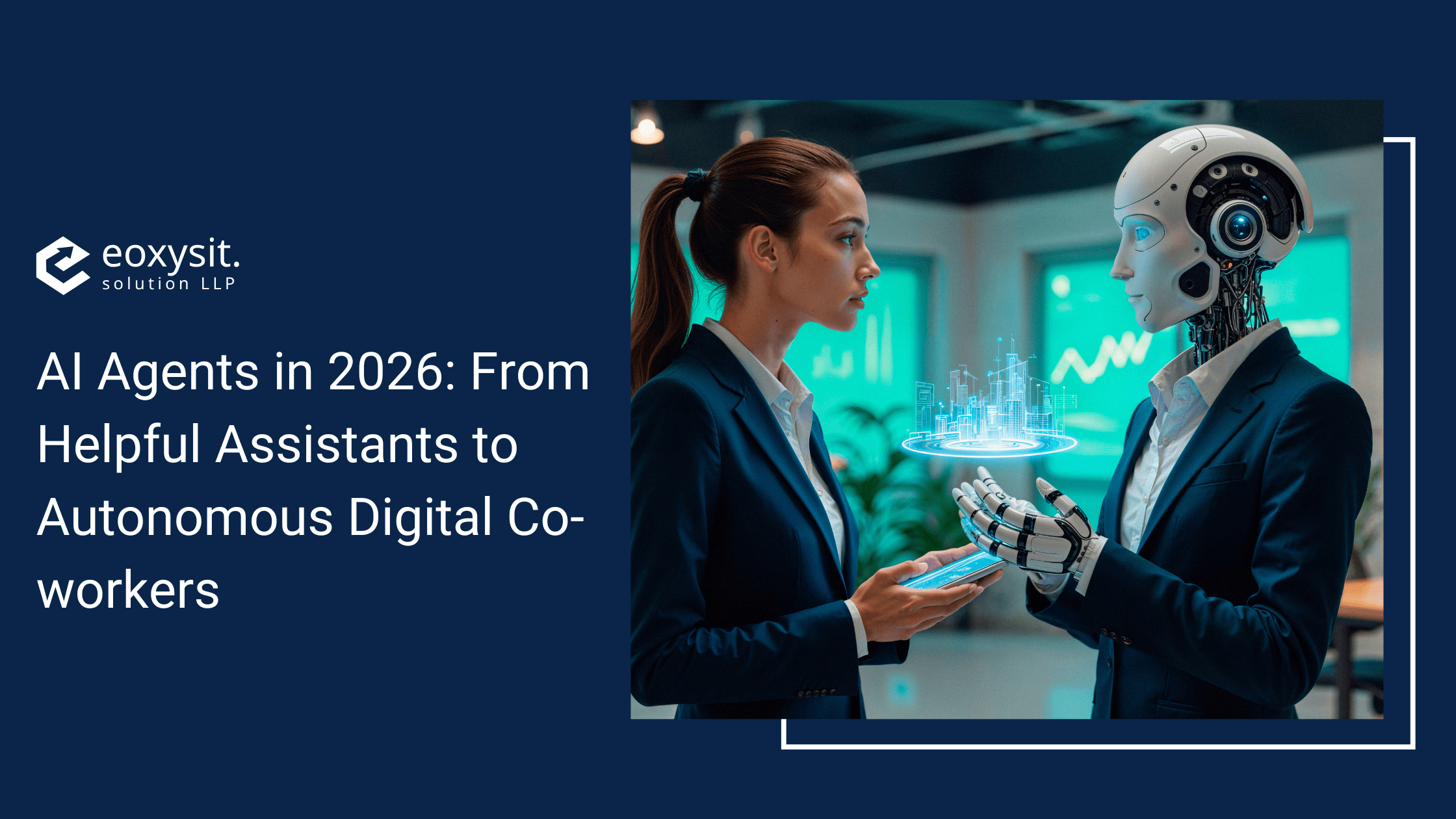
Artificial intelligence is entering a new phase in 2026 AI agents are moving from experimental pilots to mainstream, always on digital co-workers that plan, decide, and execute work across tools and teams. Unlike classic chatbots or copilots that wait for prompts, these agents pursue
goals, call APIs, and coordinate multi-step workflows—often with minimal human supervision.
What Exactly Is an AI Agent in 2026?
AI agents are goal-driven systems built on large language models and other AI components that can:
- Understand high-level instructions in natural language.
- Break those goals into steps and choose relevant tools.
- Act inside business systems CRM, ERP, HRMS, ITSM, etc.).
- Learn from feedback and adapt behavior over time.
Analysts describe this as a shift “from AI that assists to AI that achieves,” where enterprise platforms no longer just answer questions but autonomously complete tasks and optimize processes.
Gartner now predicts that around 40% of enterprise applications will include task-specific AI agents by 2026, up from less than 5% just a year earlier. Some forecasts estimate up to one billion AI agents running inside enterprises as ITSM, operations, and workplace tools embed agents at scale.
Why 2026 Is a Breakout Year for Agents
Several forces are converging to make 2026 the “agentic AI” tipping point:
- Mature LLMs and tool APIs: Enterprise platforms have exposed richer APIs and events, so agents can reliably act across CRM, ERP, HR, support, and devops tools.
- Hyper-automation demand: Businesses want end-to-end automation, not just isolated scripts—agents can coordinate complex workflows across departments.
- Open protocols and ecosystems: Initiatives such as Google Cloudʼs Agent2Agent A2A) protocol enable cross platform agents (e.g., Google + Salesforce) to collaborate over shared standards.
- Low-code orchestration: New low-code platforms let non-technical teams configure and deploy agents, accelerating adoption far beyond data science teams.
IDC now expects that by 2030, 45% of organizations will orchestrate AI agents at scale, embedding them deeply across their business functions.
5 Big AI Agent Trends to Watch in 2026
1. Agents Become Autonomous Inside Enterprise Workflows
Most early “AI automations” simply triggered simple scripts. In 2026, agents increasingly plan, act, and adjust in real time. They donʼt just follow static rules; they:
- Monitor data streams.
- Decide what matters.
- Take the next best action automatically.
For example, a retention agent might continuously track product usage signals, segment at-risk customers, generate outreach sequences, and open tickets for human follow-up when needed.
2. Multi-Agent Collaboration and Orchestrated Teams
Companies are moving from single agents to multi-agent systems—networks of specialized agents that cooperate on complex workflows. Typical patterns include:
- A “research agent” gathering data.
- A “planning agent” designing a sequence of actions.
- A “delivery agent” executing those steps across tools.
Googleʼs 2026 trends report notes that agentic workflows will become a core part of business processes, with multiple agents collaborating to run entire processes from start to finish. Cisco similarly predicts “multi-agent collaboration and orchestration” as a key driver of new workplace automation and customer experience models.
3. Deep Domain and Physical-World Integration
Agents are rapidly becoming more domain-specific, using retrieval and domain models tailored for areas like support, cybersecurity, research, and software engineering. Organizations are building networks of specialized agents instead of generic tools, often powered by internal knowledge bases and vertical models.
The next leap is integration with the physical world via robotics and IoT AI agents that guide machines, robots, or devices in warehouses, hospitals, or factories. This expands agents from screen-based workflows to real-world operations.
4. From Copilots to “Proactive Colleagues”
The 2023-2024 “copilot” wave taught people to ask AI for help; the 2026 agent wave will normalize AI that acts without waiting for prompts. Analysts describe “next generation assistants” that:
- Anticipate needs.
- Plan responses.
- Execute solutions, looping in humans only when needed.
McKinsey and MIT observers see agents as the next platform shift after mobile apps and chatbots, with digital platforms evolving into “autonomous enterprises” that anticipate change rather than simply reacting.
5. Governance, Safety, and Responsible Autonomy
As autonomy increases, so does the need for governance frameworks that manage risk without killing innovation. Recommended guardrails include:
- Clear scopes and permissions for agents.
- Approval flows for high-impact actions (e.g., payments, mass outreach).
- Continuous monitoring, audit logs, and rollback capabilities.
- “Human in the loop” for complex or sensitive decisions.
EYʼs Agentic AI 2026 report and several vendor whitepapers highlight ethics, transparency, and accountable design as non-negotiable foundations for scaling agents in regulated sectors.
How AI Agents Will Transform Workplaces by 2026
Productivity and Cost
Case studies compiled in 20252026 show agents driving major productivity gains:
- A Salesmate analysis notes that agentic AI is growing at 40-50% CAGR as organizations deploy agents across sales, support, supply chain, and finance to cut costs and speed up decisions.
- USAII and other analysts highlight agents as a key path toward “invisible AI,” where automation runs quietly in the background rather than needing constant prompts.
One forecast suggests that by 2026, AI agents will be deeply embedded in enterprise systems, with 40% of apps using task specific agents, especially in IT service management and digital workplaces.
Decision-Making and Strategy
By combining analytics with autonomous action, agents deliver continuous, contextual insights and act on them in real time. Instead of quarterly reviews, enterprises gain:
- Live operational dashboards.
- Agents that adjust campaigns, routes, or allocations instantly.
- Early warning systems for risk, churn, or demand spikes.
Deloitte and USAII both expect agentic AI to shift enterprises from static automation to dynamic, self-optimizing operations.
Employee Experience and Roles
Cisco and other workplace-tech experts envision hybrid teams of human and AI agents where:
- AI agents handle routine queries, triage, and routing.
- Human agents focus on empathy, negotiation, and complex problem-solving.
This will reshape staffing models, with new roles in “AI operations,” “agent orchestrators,” and “AI governance officers” emerging as core capabilities by 2026-2028.
Practical Use Cases Across Functions
Analyst reports and early adopters highlight common high-ROI use cases:
- Customer Support: AI agents automatically classify, prioritize, and resolve routine tickets, escalating only complex cases.
- Sales & Marketing: Research agents enrich leads, draft contextual outreach, and manage sequences tied to behavioral triggers.
- HR & Talent: Agents screen candidates, schedule interviews, orchestrate onboarding tasks, and answer policy questions in internal chat.
- Finance & Risk: Agents monitor transactions, flag anomalies, run compliance checks, and prepare portfolio or risk reports.
- IT & DevOps: Agents triage incidents, generate runbooks, and perform standard remediation steps in ITSM environments—one report even frames 2026 as the start of “one billion ITSM agents.”
How to Start with Agentic AI in 2026
Experts and vendor playbooks tend to recommend a staged approach:
- Get your data and APIs ready
Clean interfaces, events, and permissions in core systems CRM, HRMS, ITSM, ERP) so agents have reliable actions to call. - Start with narrow, high-volume workflows
Target repetitive, text-heavy processes where errors are low-risk: FAQ support, lead enrichment, meeting prep, basic HR ops. - Keep humans in the loop first
Let agents propose actions and drafts. Humans review and approve until confidence and performance stabilize. - Gradually increase autonomy
Promote mature workflows to “auto execute unless flagged,” while maintaining override and rollback paths. - Establish governance and measurement
Define KPIs (time saved, error rates, satisfaction), set up audit trails, and create a cross-functional governance group.
Risks, Limits, and What to Watch
Even as excitement builds, analysts warn about several risks:
- Over-reliance on agents for decisions without sufficient human oversight.
- Security and data leakage if agents are given over-broad access or interact with external tools without strict policies.
- Quality and hallucinations in tasks that require precise factual accuracy and domain nuance.
Thoughtful design—narrow scopes, strong identity and access controls, feedback loops, and diverse training data—remains critical to avoid costly misfires.
Conclusion: From Tools to Teammates
AI in 2023-2024 showed that large models could answer questions and draft content; 2025 embedded copilots into everyday software; 2026 is when agents start to feel like digital teammates. Analysts across Google, Deloitte, Forbes, MIT, and others converge on a similar picture: agents will become a foundational enterprise capability, orchestrating workflows, coordinating across systems, and working alongside people to deliver “connected intelligence” at scale.
Organizations that start now—instrumenting systems, piloting focused agents, and building strong governance—will be positioned to ride this wave instead of being disrupted by it.
If your products or operations still treat AI as a feature instead of a co-worker, 2026 is the year to rethink that relationship.
FAQ
What is an AI agent, and how is it different from a chatbot?
An AI agent is a goal-driven system built on large language models that understands high-level instructions, breaks them into steps, chooses tools and acts inside business systems such as CRM, ERP or HRMS. A classic chatbot or copilot waits for a prompt and answers. An agent pursues a goal and coordinates multi-step workflows.
What are the main risks of deploying AI agents?
The risks this guide lists are over-reliance on agents without enough human oversight, security and data leakage when agents get over-broad access or use external tools without strict policies, and hallucinations on tasks that need precise facts. Narrow scopes, strong identity and access controls, and feedback loops reduce these risks.
How should a company start with AI agents?
Start with a focused pilot instead of a broad rollout. Instrument your systems, pick one workflow, keep a human in the loop and gradually raise autonomy for mature workflows, with override and rollback paths. Define KPIs such as time saved and error rates, keep audit trails, and set up a cross-functional governance group.
How do I get a project estimate from Eoxys?
Share your goals, the systems involved and your timeline on the contact page. Eoxys IT Solution sends a real project estimate within 24 hours, with fixed-cost, dedicated and hourly options where they make sense. NDA on request. You can also read our portfolio first.
Related reading:
- Agentic AI: The Evolution of Business Automation in 2025
- Composable AI Stacks in 2026 How Smart Companies Will Build, Orchestrate, and Scale AI
- AI and machine learning development services
- Build vs Buy AI Hiring Software: A 2026 Decision Guide
- How Much Does It Cost to Build an AI Agent in 2026?
- AI Agent Observability: How to Trace and Debug Your Agents
- Custom AI Agent vs Off-the-Shelf Tools: How to Decide

Shafeeq Khan is a web developer who creates modern, responsive, and user-friendly websites with clean code and creative design