When an AI app gives wrong or generic answers, the usual question is RAG vs fine-tuning: should you connect the model to your documents, or train it on your examples? They solve different problems, and picking the wrong one wastes weeks.
This guide explains what each approach fixes, what has changed in 2026 (including OpenAI winding down its self-serve fine-tuning platform), what it costs, and how to decide. All facts were checked against official documentation on 29 October 2026.
Key takeaways
- RAG gives the model your knowledge at answer time. Use it when answers depend on facts that change or that the model never saw.
- Fine-tuning changes how the model behaves: format, tone, classification. It is not a good way to teach facts that change.
- OpenAI says it is “winding down the fine-tuning platform”; eligible existing customers can create training jobs until 6 January 2027 (OpenAI).
- Fine-tuning is still offered on Google Vertex AI (Gemini models), Amazon Bedrock and open-weight models, so it remains an option, just a narrower one.
In this guide
- The difference in one table
- When RAG is the right choice
- When fine-tuning is the right choice
- What changed in 2026
- Cost comparison
- How to decide
- FAQ
The difference in one table
| RAG (retrieval-augmented generation) | Fine-tuning | |
|---|---|---|
| What it changes | What the model knows when it answers | How the model behaves |
| Best for | Policies, product data, manuals, tickets | Fixed output formats, tone, classification, narrow tasks |
| Updating | Re-index documents, often in minutes | Retrain on new examples |
| Citations | Can show which document an answer came from | No built-in source trail |
| Data needed | Your existing documents | Curated input and output examples |
| Main risk | Poor retrieval returns the wrong passage | Model drifts or overfits; tied to one base model |
When RAG is the right choice
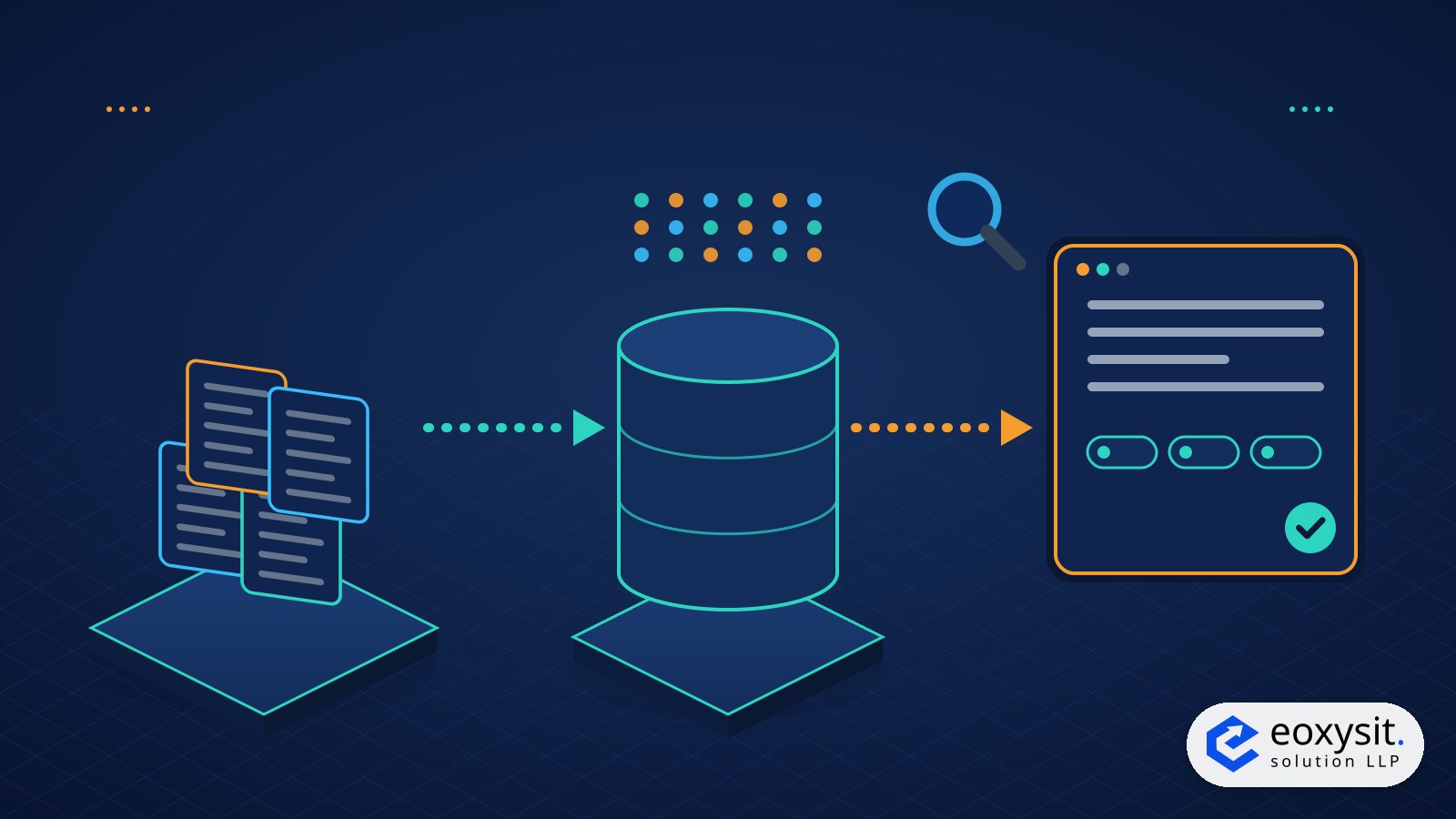
RAG retrieves relevant passages from a knowledge base and adds them to the prompt. Anthropic describes it as a method that “retrieves relevant information from a knowledge base and appends it to the user’s prompt” (Anthropic).
- Answers must match current prices, policies or stock.
- Users need to see the source document.
- Content is private and permission-controlled per user or team.
- You have many documents but few labelled examples.
Retrieval quality is the main lever. In Anthropic’s own tests, its Contextual Retrieval method reduced failed retrievals by 49%, and by 67% when combined with reranking (Anthropic, Sep 2024). Anthropic also notes that a knowledge base under about 200,000 tokens (around 500 pages) can sometimes go straight into the prompt with no RAG at all.
When fine-tuning is the right choice
OpenAI’s guide says fine-tuning can “enable a model to consistently format responses in a certain way or handle novel inputs” (OpenAI model optimization). Its supervised fine-tuning guide lists classification, nuanced translation, generating content in a specific format, and correcting instruction-following failures as good fits.
- The model keeps ignoring a strict format even with good prompts.
- You need a smaller, cheaper model to do one narrow task well.
- You have at least dozens of high-quality example pairs.
On data size, OpenAI says the minimum is 10 examples, that it sees improvements from 50 to 100, and recommends starting with 50 well-crafted demonstrations (OpenAI).
What changed in 2026
OpenAI’s fine-tuning documentation now states: “OpenAI is winding down the fine-tuning platform. The platform is no longer accessible to new users.” Eligible existing customers can create training jobs until 6 January 2027, and fine-tuned models stay available until their base model shuts down. gpt-4.1 and gpt-4.1-mini, and their fine-tuned versions, shut down on 14 January 2027 (OpenAI, deprecations).
If you rely on a fine-tuned OpenAI model, plan a migration now. Our GPT-4o API shutdown migration guide covers the testing steps. Fine-tuning remains available elsewhere: Google Vertex AI lists supervised tuning for Gemini models including Gemini 3.5 Flash and 3.5 Flash-Lite, and Amazon Bedrock offers supervised fine-tuning, reinforcement fine-tuning and distillation.
Not sure whether your app needs RAG, fine-tuning or just better prompts? Eoxys reviews your use case and data, then recommends the simplest approach that works. Get a real project estimate within 24 hours. NDA on request.
Cost comparison
| Cost item | RAG | Fine-tuning |
|---|---|---|
| Setup | Document clean-up, chunking, indexing, evaluation | Dataset creation and labelling, training runs, evaluation |
| Platform example | OpenAI file search: storage $0.10 per GB per day (first 1 GB included), $2.50 per 1,000 tool calls (OpenAI pricing) | OpenAI lists o4-mini training at $100 per hour for existing fine-tuning customers (OpenAI pricing) |
| Per answer | Model tokens plus retrieved text in the prompt | Model tokens; often fewer prompt tokens |
| Upkeep | Keep documents current; watch retrieval quality | Retrain when the base model retires or data changes |
For a full build budget, including evaluation and monitoring, see our AI agent cost guide and AI agent observability.
How to decide
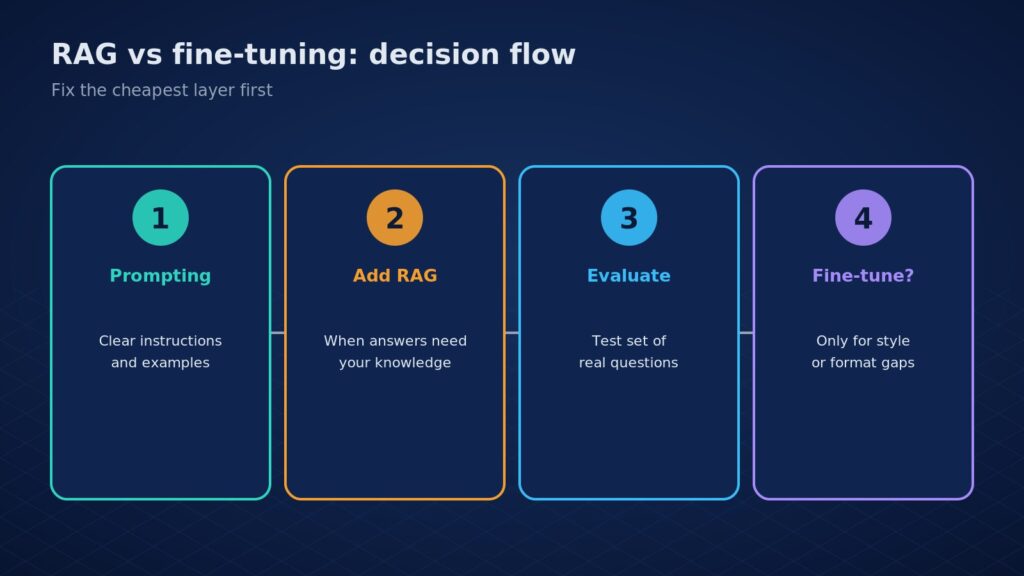
- Step 1: fix the prompt and build an evaluation set of real questions.
- Step 2: if answers lack your facts, add RAG.
- Step 3: if format or behaviour is still wrong after good prompts and RAG, test fine-tuning on a platform that still supports it.
- Step 4: combine both only when evaluation shows a clear gain.
Data handling matters in both cases, especially for personal data under India’s DPDP Act. See our DPDP compliance guide for AI apps. Eoxys builds RAG systems and custom models as part of its AI and machine learning services.
FAQ
Is RAG better than fine-tuning?
Neither is better in general. RAG is better for knowledge that changes or must be cited. Fine-tuning is better for consistent format or behaviour on a narrow task. Many business apps only need good prompts and RAG. Test both against the same set of real questions before you spend on training.
Can I still fine-tune OpenAI models?
Only if you are an eligible existing customer. OpenAI says its fine-tuning platform is no longer open to new users, and training jobs can be created until 6 January 2027 unless the base model shuts down earlier. New projects should plan around RAG, prompting or another provider’s tuning service, such as Vertex AI or Amazon Bedrock.
Can I use RAG and fine-tuning together?
Yes. A fine-tuned model can still receive retrieved documents in its prompt. Use both only when testing shows the combination beats RAG alone, because you then maintain a training set and a retrieval index. Keep the evaluation set fixed so results stay comparable.
Can Eoxys build a RAG system for my business?
Yes. We build RAG chatbots and AI features on your documents, with evaluation and access controls, so each user only retrieves documents they are allowed to see. Get a real project estimate within 24 hours, with an NDA on request.
Work with Eoxys
Eoxys IT Solution LLP has built websites, apps and AI products since 2009, with 700+ projects delivered. See the work on our portfolio, or explore our AI and machine learning solutions.
We design RAG and model customisation for business apps, starting with the simplest approach that passes your tests. Get a real project estimate within 24 hours. NDA on request. Prefer to talk? Call +91 96678 22661.
Related reading:
- How Much Does It Cost to Build an AI Agent in 2026?
- GPT-4o API Shutdown: Migrate Your App Before 14 January 2027
- Custom AI Agent vs Off-the-Shelf Tools: How to Decide
Sources
Checked on 29 Oct 2026 against OpenAI’s fine-tuning, model optimization, pricing and deprecations pages, Google Cloud Vertex AI and Amazon Bedrock documentation, and Anthropic’s Contextual Retrieval post.
- OpenAI: Supervised fine-tuning
- OpenAI: Model optimization
- OpenAI: Deprecations
- OpenAI: API pricing
- Google Cloud: Tune Gemini models
- AWS: Customize models in Amazon Bedrock
- Anthropic: Introducing Contextual Retrieval

Shafeeq Khan is a web developer who creates modern, responsive, and user-friendly websites with clean code and creative design