 16+ Years Building Digital Products That Ship
 16+ Years Building Digital Products That Ship
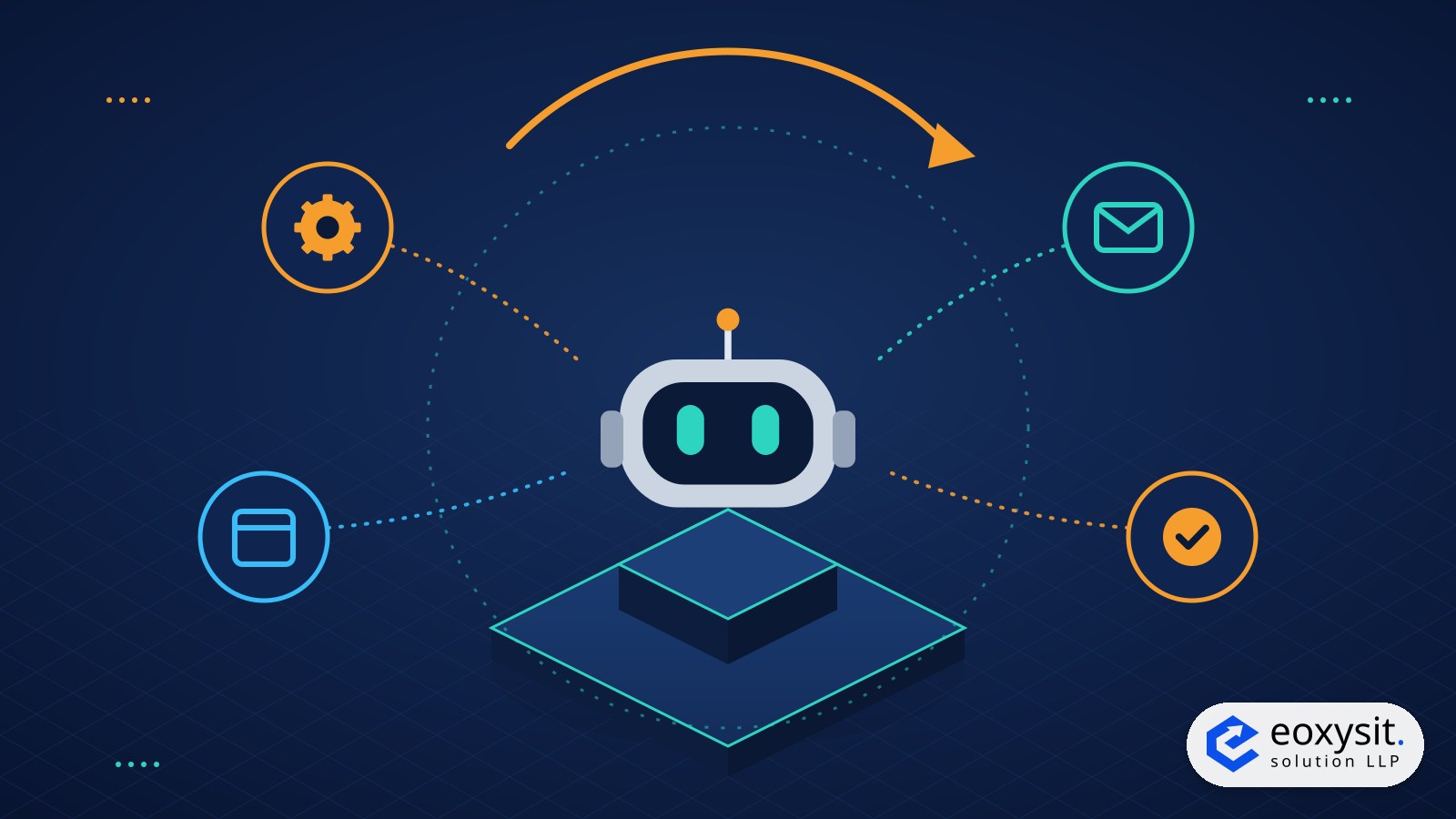
Your customers and staff increasingly work inside ChatGPT, Claude, Copilot or an IDE agent. If those assistants cannot reach your product, someone else’s product gets used instead. MCP server development is how you fix that: you publish a Model Context Protocol (MCP) server that lets AI agents search, read and act on your system with permission.
This guide explains what MCP is, what the new 2026-07-28 specification changed, how to design a server that is safe and useful, and what drives cost. Facts were checked on 5 November 2026 against the official specification.
Key takeaways
- MCP is an open protocol that uses JSON-RPC 2.0 messages between hosts, clients and servers to give AI applications tools and context (MCP specification).
- The 2026-07-28 release made the core stateless: the initialize handshake and the Mcp-Session-Id header are gone, and each request carries its own version and capabilities (MCP blog).
- A new
server/discovercall lets clients ask a server for its capabilities up front (MCP specification). Stateless servers sit behind a normal load balancer. - Most of the work is not the protocol. It is choosing the right tools, permissions, auth and logging for your data.
In this guide
- What an MCP server is
- What changed in the 2026-07-28 spec
- Business use cases
- How to design tools
- Security checklist
- What drives cost
- FAQ
What an MCP server is
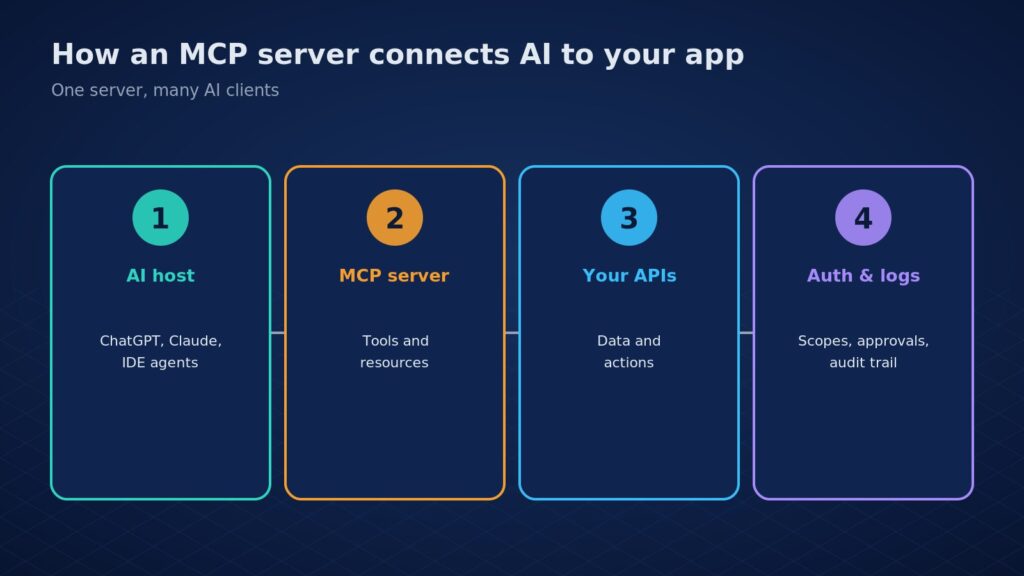
The MCP specification describes three roles: hosts (AI applications such as a chat app or IDE), clients (connectors inside the host) and servers (services that provide context and capabilities). Servers expose tools the model can call, resources it can read and prompts users can pick (MCP specification).
Think of an MCP server as an API designed for AI agents. Instead of building a separate plugin for every assistant, you build one server and any MCP-compatible host can use it.
What changed in the 2026-07-28 spec
The maintainers called the stateless core “the highlight of this release” (MCP blog). The main changes:
| Change | What it means for your server |
|---|---|
| No initialize handshake or Mcp-Session-Id | Each request stands alone, so any instance can answer it |
| Optional server/discover RPC | Clients can fetch capabilities before calling tools |
| Mcp-Method and Mcp-Name HTTP headers | Gateways can route and authorise on headers |
| Cacheable list results | Clients can cache tool catalogues |
| Authorization hardening | RFC 9207 issuer validation; move away from dynamic client registration |
| Formal deprecation policy | At least 12 months’ notice before breaking removals |
If you built an MCP server in 2025, plan a migration: remove session handling, add discovery, and test with updated SDKs. The release notes say the TypeScript, Python, Go and C# SDKs were updated to match.
Business use cases
| Business | Example MCP tools | Who uses it |
|---|---|---|
| SaaS product | Search records, create a ticket, update a status | Your customers, inside ChatGPT or Claude |
| E-commerce | Check stock, order status, start a return | Shoppers and support agents |
| Internal operations | Query the ERP, draft a purchase order | Staff using a company AI assistant |
| Data or content business | Search an archive, fetch a licensed document | Researchers and analysts |
OpenAI’s developer docs show how an MCP server powers apps and plugins inside ChatGPT (OpenAI). Our guide to building a ChatGPT app for your business covers the product side, and the official MCP Registry, currently in preview, is where public servers publish their metadata.
Want your product inside ChatGPT and Claude? Eoxys designs and builds secure MCP servers on top of your existing APIs. Get a real project estimate within 24 hours. NDA on request.
How to design tools
Start from user tasks, not endpoints
Do not expose every API endpoint. List the 5 to 10 tasks users actually ask an assistant to do, and build one clear tool for each. Fewer, well-named tools are chosen correctly more often.
Write descriptions for the model
Each tool’s name, description and input schema is what the model reads to decide when to call it. State what it does, when not to use it, and what each field means.
Separate reading from writing
Make read-only tools the default. Put actions that change data, spend money or send messages behind explicit confirmation in the host.
Return compact, structured results
Return only the fields the model needs, with IDs it can use in follow-up calls. Large responses cost tokens and confuse the model. If your agent needs multiple steps, see our guide to choosing an agent architecture.
Security checklist
An MCP server gives an AI model access to real systems, so treat it like a public API plus an untrusted user. OWASP’s Top 10 for LLM applications lists prompt injection and excessive agency among the main risks (OWASP).
- Use OAuth so each user acts with their own permissions, never a shared admin key.
- Scope tools tightly: read-only by default, allow-lists for write actions.
- Treat all tool inputs, and any text your tools return from users or the web, as untrusted.
- Rate-limit and log every call with user, tool, inputs and result.
- Validate tokens and issuers as the 2026-07-28 authorization rules require.
- Review third-party MCP servers before connecting them to your own agents.
What drives cost
| Scope | Typical work | Cost drivers |
|---|---|---|
| Read-only server on an existing API | 5 to 10 search and read tools, OAuth, logging | API quality, auth model |
| Read and write server | Actions with confirmations, audit trail, tests | Number of actions, approval rules |
| Server plus ChatGPT or Claude app | UI components, listing, review | Design, store requirements |
| Enterprise deployment | SSO, gateway, monitoring, data residency | Security review, compliance |
If your app has no clean API yet, that comes first, and our guide to adding AI to an existing app explains the gateway pattern. For a full agent build budget, see the cost to build an AI agent.
FAQ
What is an MCP server?
An MCP server is a service that exposes tools, resources and prompts to AI applications using the Model Context Protocol. A host such as ChatGPT, Claude or an IDE agent connects to it, reads the tool descriptions, and calls those tools on the user’s behalf, with the permissions the user has granted.
What changed in MCP in 2026?
The 2026-07-28 specification made the protocol stateless. It removed the initialize handshake and the Mcp-Session-Id header, added an optional server/discover call, moved method and tool names into HTTP headers for routing, made list results cacheable and tightened authorization. Older servers need migration work.
Is an MCP server the same as an API?
It usually sits on top of your API. The API serves your apps; the MCP server presents a smaller set of task-based tools with descriptions written for AI models, adds user-level OAuth and logging, and follows the MCP message format so any compatible AI host can use it.
How long does it take to build an MCP server?
A read-only server on a well-documented API can be a few weeks of work, including auth, testing and logging. Write actions, approval flows, a ChatGPT app interface or enterprise security reviews add time. Scope depends on your API, so we estimate after reviewing it.
Can Eoxys build our MCP server?
Yes. We design the tool set, build the server on your API, add OAuth, logging and tests, and help you publish it for ChatGPT, Claude or internal agents. See our AI development services. Get a real project estimate within 24 hours.
Work with Eoxys
Eoxys IT Solution LLP has built websites, apps and AI products since 2009, with 700+ projects delivered. See the work on our portfolio, or explore our AI and machine learning solutions.
We build MCP servers, AI agents and integrations that connect your product to the assistants your users already use. Get a real project estimate within 24 hours. NDA on request. Prefer to talk? Call +91 96678 22661.
Related reading:
- Build a ChatGPT Plugin for Your Business: What DevDay Changed
- How Much Does It Cost to Build an AI Agent in 2026?
- How to Add AI to an Existing App Without Rebuilding It
Sources
Checked on 5 Nov 2026 against the MCP 2026-07-28 specification, the MCP blog and Registry docs, OpenAI developer docs and OWASP.
- Model Context Protocol specification, version 2026-07-28
- MCP blog: The 2026-07-28 Specification
- MCP specification: Discovery (server/discover)
- The MCP Registry (preview)
- OpenAI Developers: Build an MCP server
- OWASP Top 10 for LLM Applications

Shafeeq Khan is a web developer who creates modern, responsive, and user-friendly websites with clean code and creative design