 16+ Years Building Digital Products That Ship

 16+ Years Building Digital Products That Ship
Your data scientist built a model that works in a notebook. Three months later it is still not in production, or it is live but nobody knows when its accuracy started slipping. That gap is the reason companies hire an MLOps engineer: someone who turns models into reliable, monitored software.
This guide covers when you actually need the role, the skills to test, what MLOps engineers earn in India according to Glassdoor, and how in-house hiring compares with a dedicated developer. Figures were checked on 5 November 2026 and link to their sources.
Key takeaways
- Hire an MLOps engineer when models must be retrained, deployed and monitored regularly, not for a one-off prototype.
- Glassdoor shows an average total pay of ₹16,32,500 a year for MLOps engineers in India, with the 25th to 75th percentile at ₹8.66 lakh to ₹22 lakh, based on 78 salaries (Glassdoor).
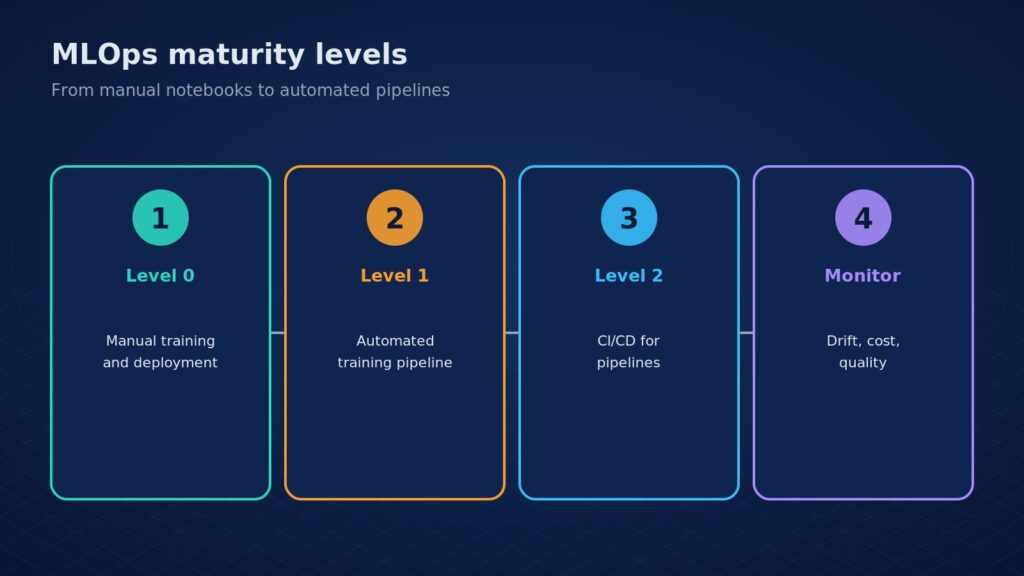
- Google Cloud describes three maturity levels, from a fully manual process to automated CI/CD for ML pipelines (Google Cloud). Know your target level before writing the job description.
- For LLM and agent products, MLOps now includes evaluation sets, prompt and model versioning, cost tracking and tracing.
In this guide
- What an MLOps engineer does
- When you need one
- Skills to test
- Salary and cost in India
- In-house vs dedicated vs freelance
- Interview questions
- FAQ
What an MLOps engineer does
An MLOps engineer owns the path from a trained model to a dependable production service. A widely cited NeurIPS paper from Google engineers, “Hidden Technical Debt in Machine Learning Systems”, argued that the model code is only a small part of a real ML system, with data pipelines, configuration, serving and monitoring making up the rest (NeurIPS 2015). MLOps is the discipline that manages that rest.
- Builds training and deployment pipelines so models can be retrained without manual steps.
- Versions data, features, models and, for LLM apps, prompts.
- Serves models behind APIs with autoscaling, rollbacks and access control.
- Monitors accuracy, drift, latency and cost, and triggers retraining or alerts.
- Works with security and compliance teams on logging and data handling.
When you need one
Google Cloud’s MLOps guide describes level 0 as a manual, script-driven process, level 1 as ML pipeline automation with continuous training, and level 2 as automated CI/CD for the pipelines themselves (Google Cloud). Use it to decide who to hire.
| Your situation | Maturity target | Who to hire |
|---|---|---|
| One prototype, no production users | Level 0 | Your ML or AI developer can deploy it |
| Model in production, retrained monthly | Level 1 | An MLOps engineer, often part-time |
| Several models or frequent releases | Level 2 | A full-time MLOps engineer or platform team |
| LLM or agent product with real users | Level 1 plus evaluation and tracing | MLOps engineer with LLMOps experience |
If your product is mainly an AI agent that calls APIs, you may need an AI agent developer first and MLOps skills second. If you mostly automate business workflows, an AI automation engineer may fit better.
Skills to test
Pipelines and orchestration
Experience building training and batch pipelines with a workflow tool, including data validation steps and pipeline triggers. Ask how they handle a failed run halfway through.
Model serving and infrastructure
Containers, Kubernetes or managed serving on AWS, Google Cloud or Azure, autoscaling and GPU cost control. They should explain how they roll back a bad model.
Tracking and versioning
Experiment tracking and a model registry, plus versioned datasets. For LLM apps, versioned prompts and model settings, so you can reproduce yesterday’s answer.
Monitoring and evaluation
Drift and accuracy monitoring for classic ML, and evaluation sets, tracing and cost dashboards for LLM features. Our guide to AI agent observability shows what good LLM monitoring looks like.
Risk and governance
Access control, audit logs and data retention. NIST’s Generative AI Profile (AI 600-1) is a useful checklist of risks to monitor for generative AI systems (NIST).
Need models in production, not in notebooks? Eoxys provides dedicated AI and MLOps engineers who work in your repos and your cloud. Get a real project estimate within 24 hours. NDA on request.
Salary and cost in India
Glassdoor’s India data for the MLOps engineer title, checked on 5 November 2026:
| Measure | Glassdoor figure |
|---|---|
| Average base pay | ₹14.8 lakh a year |
| Typical base range | ₹8 lakh to ₹20 lakh a year |
| Average total pay | ₹16,32,500 a year |
| 25th to 75th percentile (total) | ₹8,66,250 to ₹22,00,000 |
| 90th percentile (total) | Up to ₹33,00,000 |
| Sample size | 78 salaries |
Salary is only part of the cost. Add recruitment time, benefits, cloud and tooling access, and the months before a new hire knows your stack. For senior people with LLM serving experience, expect to be above the median.
In-house vs dedicated vs freelance
| Option | Best for | Trade-offs |
|---|---|---|
| In-house hire | Long-term ML platform ownership | Slow to hire; you carry the full cost and retention risk |
| Dedicated engineer from a partner | Getting to level 1 or 2 quickly, with a monthly contract | Needs good handover and documentation |
| Freelancer | A defined task, such as setting up a registry | Harder to get on-call and long-term ownership |
Many teams start with a dedicated developer to build the pipelines and monitoring, then hire in-house once the platform is stable. Our guide to hiring AI developers in India covers contracts, IP and time zones.
Interview questions
- Walk me through how you would retrain and redeploy this model every week without manual steps.
- A model’s accuracy dropped 10% last week. How would you find out why?
- How do you version a prompt and model setting for an LLM feature?
- How would you cut GPU or API costs by a third without hurting quality?
- What would you log for an AI feature that handles personal data?
FAQ
What is the difference between an ML engineer and an MLOps engineer?
An ML engineer mainly builds and improves models: features, training and evaluation. An MLOps engineer makes those models run reliably in production through pipelines, serving, versioning and monitoring. Small teams often combine both roles, but as models multiply, the production work usually needs a dedicated person.
How much does an MLOps engineer earn in India?
Glassdoor shows an average total pay of ₹16,32,500 a year, with a typical range of ₹8.66 lakh to ₹22 lakh between the 25th and 75th percentiles and up to ₹33 lakh at the 90th. These are self-reported figures from 78 salaries, so check current offers in your city too.
Do I need MLOps for an LLM or chatbot product?
Yes, once it has real users. You still need versioning, deployment, monitoring and cost control, plus evaluation sets that test answers before each release and tracing that shows how an answer was produced. The tooling differs from classic ML, but the discipline is the same.
Can I hire a dedicated MLOps engineer from Eoxys?
Yes. We provide dedicated AI and MLOps engineers on monthly contracts who work in your repositories and cloud accounts, with an NDA and IP assignment. Tell us your models, stack and target maturity level. Get a real project estimate within 24 hours.
Work with Eoxys
Eoxys IT Solution LLP has built websites, apps and AI products since 2009, with 700+ projects delivered. See the work on our portfolio, or explore our AI and machine learning solutions.
We build ML pipelines, model serving and LLM monitoring, or provide a dedicated engineer to do it inside your team. Get a real project estimate within 24 hours. NDA on request. Prefer to talk? Call +91 96678 22661.
Related reading:
- Hire AI Developers in India: Models, Vetting and Red Flags
- Hire an AI Agent Developer: Skills, Cost and When You Need One
- AI Agent Observability: How to Trace and Debug Your Agents
Sources
Checked on 5 Nov 2026 against Glassdoor India salary data, Google Cloud’s MLOps architecture guide, the NeurIPS 2015 paper and NIST AI 600-1.
- Glassdoor: MLOps Engineer salaries in India
- Google Cloud: MLOps continuous delivery and automation pipelines in machine learning
- Sculley et al.: Hidden Technical Debt in Machine Learning Systems (NeurIPS 2015)
- NIST AI 600-1: Generative AI Profile

Shafeeq Khan is a web developer who creates modern, responsive, and user-friendly websites with clean code and creative design