
If you plan to hire AI developers in India, the hard part is not finding people. It is telling a team that can ship a reliable AI feature apart from one that can only demo a chatbot. Almost every agency now lists GenAI, agents and RAG on its website, and from the outside the proposals look the same.
This guide is for founders, CTOs and product heads in the US, UK, Middle East and India who are weighing an Indian AI development partner. It covers the engagement models, what to check before you sign, the red flags we see buyers miss, and how to keep cost under control.
Key takeaways
- India’s AI talent pool is large and growing: a Deloitte and nasscom report projects it rising from 600,000–650,000 to more than 1.25 million between 2022 and 2027.
- Skilled AI engineers are still scarce. In a nasscom and Indeed study, 58% of employers cited low applicant volume and 50% a skills mismatch.
- Pick the engagement model by how clear your scope is: fixed cost for a defined build, a dedicated team for an evolving product, hourly for short, open-ended work.
- Vet partners on shipped AI work, a paid pilot, security and data-protection answers, and who actually writes your code.
- Red flags include fixed quotes with no discovery, no evaluation plan for model quality, and no clear IP and data clauses in the contract.
In this guide
- Why companies hire AI developers in India
- Engagement models compared
- How to vet an AI development partner
- Red flags to walk away from
- What drives the cost
- FAQ
Why companies hire AI developers in India
The short answer: depth of engineering talent, lower cost than US or Western European hiring, and a working day that overlaps well with the UK and the Gulf. The Deloitte and nasscom report also expects India’s AI market to grow 25–35% a year through 2027, which is why so many teams are building AI skills here.
Headcount is not the same as experience, though. The nasscom and Indeed study found that 40% of employers now prefer demonstrable AI skills or certifications over a degree. That is the right instinct for buyers too: judge a partner on AI systems they have shipped, not on the size of their bench.
Time zones are workable if you plan for them. India Standard Time is UTC+5:30 all year with no daylight saving, so a UK morning lands in the Indian afternoon, Dubai is only 1.5 hours behind, and US East Coast teams usually meet in their morning, which is the Indian evening. Good partners run an async-first rhythm with a short daily overlap call.
Engagement models compared
Choose the model by how well you can describe the work today. Most AI projects start with a small fixed-scope pilot and then move to a dedicated team once the feature proves its value.
| Model | How you pay | Best for | Watch out for |
|---|---|---|---|
| Fixed cost | Agreed price for an agreed scope and milestones | A defined build, such as a support chatbot on your help centre or a document-extraction pipeline | Scope changes become change requests, so a short discovery phase first is essential |
| Dedicated team | Monthly fee per engineer, working only on your product | An evolving AI product or a long roadmap where priorities shift every sprint | You need a product owner on your side who sets priorities and reviews work |
| Hourly / time and material | Billed hours against a cap you set | Audits, prototypes, model or prompt tuning, and integration fixes | Without a weekly cap and clear tickets, hours drift |
| Freelancer | Hourly or per task on a marketplace | Small, well-defined tasks with low risk | One person is a single point of failure, with no QA, DevOps or security backup |
Eoxys offers the first three. Our dedicated developer model suits teams that want engineers embedded in their sprint process, while fixed-cost projects suit buyers who need a firm budget before they start.
Comparing AI partners in India right now? Send us your use case and we will tell you which engagement model fits and what it would take. Get a real project estimate within 24 hours. NDA on request.
How to vet an AI development partner
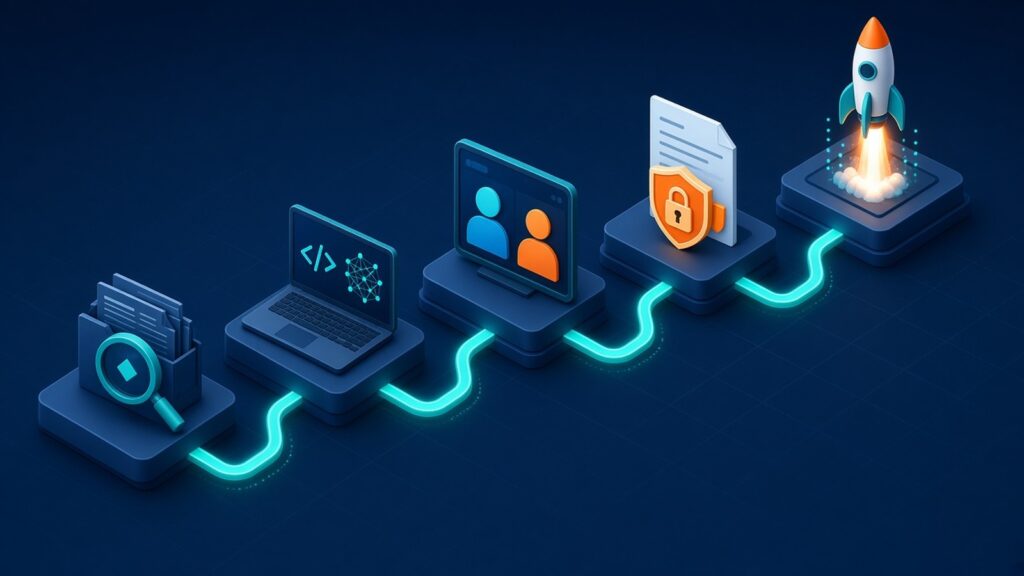
The short answer: ask for proof of shipped AI work, run a small paid pilot, and test how they think about quality, security and data. A good partner will welcome all three, and these steps take a few weeks, not months.
| What to check | What a good answer looks like |
|---|---|
| Shipped AI work | Live apps or case studies with a clear problem, their role and the stack used, not just a logo wall |
| Who does the work | Named engineers you can interview, and a written rule on replacing team members |
| Quality and evaluation | A plan to measure answer accuracy with a test set before and after launch, plus human review for risky outputs |
| Security | Concrete defences against prompt injection and data leakage, ideally mapped to the OWASP Top 10 for LLM applications |
| Data protection | Clear answers on where data is stored, which model vendors see it, and how it is deleted. For Indian users, ask about the DPDP Act |
| Model choice | A reasoned pick of model and vendor for your use case and budget, not one default for everything. See our model comparison |
| Contract | IP assignment to you on payment, code in your repository from day one, NDA, and a handover clause |
Run a paid pilot first
A two-to-four-week pilot on one real workflow tells you more than any proposal. Agree a narrow goal, such as answering questions from 200 of your own support articles, plus a test set and a pass mark. Then judge the code, the communication and the evaluation report, not just the demo.
Meet the people, not only the sales lead
Ask to speak to the engineer and the project manager who would run your work. Ask them to walk through a past AI project: what failed, how they measured quality, and what they would do differently. Vague answers here are a strong signal.
Red flags to walk away from
Most bad outcomes are visible before the contract is signed. These are the warning signs worth acting on.
- A fixed quote after one call. An AI build without discovery means the risks are unpriced. You pay later in change requests or cut corners.
- Promises of a set accuracy or guaranteed results. Model quality depends on your data. Honest partners promise a measurement plan, not a number.
- No evaluation or monitoring plan. If nobody can explain how wrong answers will be caught after launch, they will reach your customers first.
- Your data goes to unnamed tools. Every model API, vector database and logging service that sees customer data should be listed and under contract.
- Code stays on the vendor’s servers. You should own the repository, cloud accounts and API keys, or at least have full access to them.
- The team changes after signing. Senior people in the pitch and juniors on the project is a common pattern. Put named roles in the contract.
- Case studies that cannot be checked. Ask for live links, references or reviews on third-party sites.
What drives the cost
Rates vary widely by experience and location. As a global benchmark, Upwork reports typical machine learning engineer rates of $50–$120 an hour for beginner to intermediate work and $120–$200+ for advanced engineers, based on historical contracts worldwide. Indian teams usually price below that, but the rate is only one part of the total cost.
| Cost driver | Why it moves the price |
|---|---|
| Scope clarity | A clear workflow, sample data and success criteria shorten discovery and reduce rework |
| Data readiness | Cleaning, labelling and connecting data often takes longer than building the AI feature itself |
| Integrations | Every system the AI must read from or act on, such as a CRM, ERP or payment gateway, adds build and test time |
| Quality bar | Customer-facing or regulated use needs evaluation sets, guardrails and human review, which take time to build |
| Model and hosting | API token costs or GPU hosting are ongoing bills on top of development, and they scale with usage |
| Team mix | A complete team (AI engineer, backend, QA, DevOps, project manager) costs more per month than a single developer but ships faster with fewer surprises |
For a deeper look at budgeting, read AI Integration Costs in 2025: What Businesses Should Expect. The cheapest quote rarely gives the lowest total cost once rework and delays are counted.
Frequently asked questions
Is it safe to share my data and code with an Indian development company?
It can be, with the right controls. Sign an NDA, keep code in your own repository, give least-privilege access, and list every vendor that touches your data. India’s DPDP Act also sets duties for companies that process personal data. Ask partners how they meet it.
Should I hire a freelancer or an AI development company?
A freelancer can suit a small, low-risk task. For a product feature that customers rely on, a company gives you QA, DevOps, security review and cover when someone is away. It also gives you one accountable party and a contract that covers IP and handover.
How long does it take to start working with an Indian AI team?
Most partners can start a discovery or pilot within one to two weeks of a signed agreement, depending on team availability. A useful first milestone is a working pilot on one workflow in a few weeks, followed by a production plan based on what the pilot proved.
How do I get an accurate estimate?
Share the workflow you want to automate, the systems involved, sample data if you can, and your timeline. Eoxys reviews it and sends a real project estimate within 24 hours, with fixed-cost, dedicated and hourly options where they make sense. NDA on request.
Work with an AI team that has shipped real products
Eoxys IT Solution has built software from Jaipur since 2009, with 700+ projects delivered for clients across fintech, health and wellness, e-commerce, EdTech and real estate. One client review on our site, from the CTO of ZIP International, says the team “were adaptable and worked all types of hours of the day to get the project completed and delivered.” See our portfolio for the work behind it.
Whether you need a chatbot or AI agent, a custom AI and machine learning solution, or a team of dedicated AI developers, get a real project estimate within 24 hours. NDA on request.
Related reading:
- DPDP Compliance for AI Apps: What to Fix Before May 2027
- GPT-6.1 Sol vs Claude Sonnet 5.5: Which Model for Your App?
- AI Agents in 2026: From Helpful Assistants to Autonomous Digital Co-workers
Sources
- Deloitte India: Bridging the AI talent gap, Deloitte and nasscom report (20 Aug 2024)
- nasscom and Indeed: India’s AI Talent Inflection Point: From Skill Gaps to Competitive Advantage
- Upwork: Machine learning engineer cost and hourly rates
- OWASP: Top 10 for LLM Applications
- MeitY: Digital Personal Data Protection Act, 2023

Shiv Kumawat is the CEO of Eoxys IT Solution LLP, the Jaipur-based IT and GenAI development company he has led since 2009. Eoxys builds custom AI, web and mobile applications for businesses worldwide. Shiv writes about AI app development, generative AI for business, and building software products that deliver real results. Connect with him on LinkedIn: https://www.linkedin.com/in/shiv-kumawat-eoxys/