
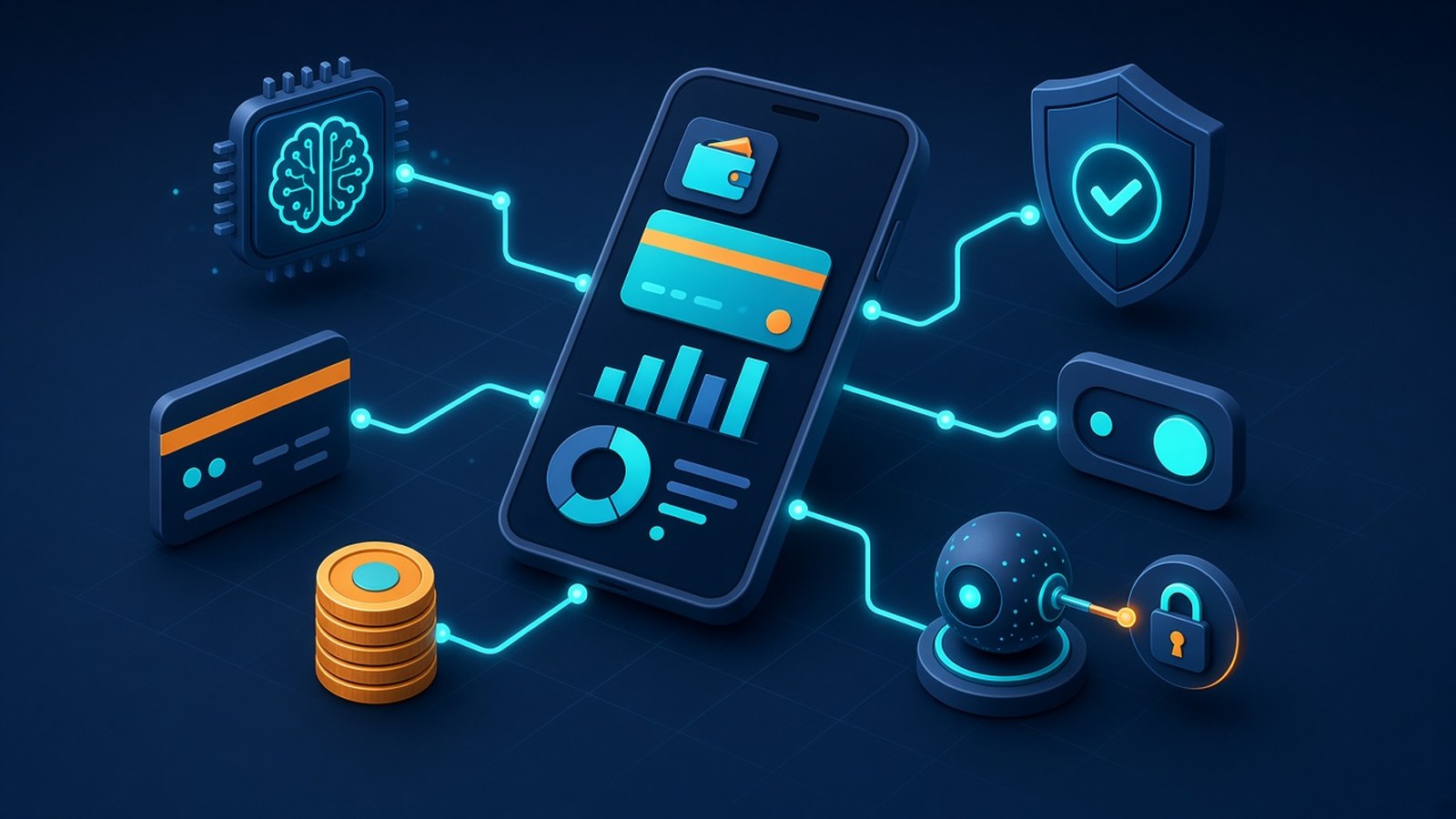
On 13 October 2026, American Express published a framework to stop AI agents from making purchases a customer never approved, as TechCrunch reported. Five days earlier, Crossmint launched a toolkit that lets AI agents pay with a card and check out at online stores through one integration. AI in finance is moving from answering questions to moving money.
If you run or plan a payments, lending or personal-finance product, that changes what is worth building. This guide covers practical AI for fintech apps: the use cases that pay off now, the guardrails regulators and card networks expect, and a realistic way to build them.
Key takeaways
- The safest wins are support assistants, document checks, fraud and anomaly alerts, and spend insights. They help users without letting AI make final money decisions alone.
- AI agents that pay on a customer’s behalf are arriving. Amex now ties each agent purchase to an approved intent and a token, and that pattern is a good template for your own app.
- In India, the RBI FREE-AI report (Aug 2025) and the RBI’s draft model risk guidance (June 2026) point to board-approved AI policies, model inventories and human oversight.
- In the EU, AI that scores the creditworthiness of individuals is high-risk under the AI Act, with those obligations applying from 2 December 2027. Fraud detection is excluded.
- Design the audit trail, approvals and data controls first. Adding them later costs more than building them in.
In this guide
- What changed for fintech AI this month
- AI use cases for fintech apps
- Letting AI agents pay: the intent pattern
- Rules to plan for in India, the EU and the US
- How to build it: a phased plan
- Risks and limits
- FAQ
What changed for fintech AI this month
Three things happened in the past two weeks that matter for anyone building AI for fintech apps. First, Amex added an Intent Intelligence Framework to its Agentic Commerce Experiences developer kit. According to TechCrunch, a Create Intent API captures what the customer asked for (merchant, maximum budget, product preferences), the customer authenticates and signs off, and the agent then gets a token-based payment credential instead of the real card number. Amex lists its Intent Intelligence specification as available since 14 April 2026, with agent registration still under development.
Second, on 8 October Crossmint launched its Agent Commerce Toolkit, which combines card storage, Visa Intelligent Commerce and Mastercard Agent Pay credentials, and merchant checkout in one API. Third, banks are openly debating who pays when an agent gets it wrong. American Banker reports that Lead Bank has proposed a liability waterfall in which the consumer is not liable when an agent exceeds its delegated authority, and cites a Bain projection that annual US agentic commerce spending could reach up to $500 billion by 2030.
What this means for your product: if your app holds money, cards or credit lines, customers and partners will soon ask whether AI agents can act on it, and how you prove what the customer actually approved.
AI use cases for fintech apps
The best first projects keep a person or a hard rule in charge of the final money decision. The table ranks common use cases by how much risk the AI carries.
| Use case | What the AI does | Risk level | Who makes the final call |
|---|---|---|---|
| Support assistant | Answers balance, failed-payment, refund-status and KYC questions from your own data and policies | Low to medium | AI answers; disputes and exceptions go to staff |
| Document and KYC checks | Reads IDs, bank statements and invoices, extracts fields and flags mismatches | Medium | Staff approve flagged cases |
| Fraud and anomaly alerts | Scores transactions and logins, explains why an alert fired | Medium | Rules engine and analysts |
| Spend insights and bill reminders | Categorises spending, predicts upcoming bills, nudges users | Low | The user |
| Collections and reminders | Drafts polite, compliant reminder messages and payment plans | Medium | Staff approve templates and offers |
| Agent-initiated payments | Lets a user’s AI agent pay within approved limits | High | The customer approves the intent; the issuer checks the token |
| Credit scoring | Estimates creditworthiness of individuals | High (regulated) | Credit policy, with human review and explanations |
We built the Zip Cash fintech app in Flutter with a Laravel back end, covering adding cash, withdrawals, bill payments and USD cards. Products like this are where a support assistant and spend insights fit naturally, because the data and the user’s intent are already in the app. For a wider look at the sector, see our earlier post on AI in finance and our explainer on AI fraud detection.
Planning AI features for a payments, lending or wallet app? Tell us what the app does today and what you want AI to handle. Get a real project estimate within 24 hours. NDA on request.
Letting AI agents pay: the intent pattern
If you want AI agents to make payments, the safe approach is to capture the customer’s intent first, turn it into a limited credential, and check every purchase against it. You do not need to be a card network to apply this pattern in your own wallet, marketplace or B2B payments app.

| Control | How it works in your app | What it prevents |
|---|---|---|
| Explicit intent | Store the request as structured fields: merchant or category, item, maximum amount, expiry | Agents guessing or drifting from the request |
| Customer approval | Strong authentication (biometric or OTP) before the intent becomes active | Purchases the customer never saw |
| Scoped credential | Issue a token tied to that intent instead of exposing card or account details | Card data leaks and reuse beyond the limit |
| Pre-payment check | Compare the cart with the intent before authorising; block mismatches | Wrong items, wrong merchant, over-budget orders |
| Audit log | Record who approved what, which agent acted and when | Unresolvable disputes and fraud claims |
Amex’s own example in the TechCrunch interview is a customer asking for white Nike sneakers in size 9 while the agent tries to buy Adidas shoes: with intent captured up front, that purchase can be stopped. If you sell online, our guide to getting your store ready for AI shopping agents covers the merchant side.
Rules to plan for in India, the EU and the US
Regulation of AI in finance is still forming, but the direction is clear: know which models you use, keep humans in charge of high-impact decisions, and be able to explain outcomes.
| Region | What applies | Status (checked 14 Oct 2026) | What it means for your app |
|---|---|---|---|
| India | RBI FREE-AI report: 7 Sutras and 26 recommendations | Committee report, 13 Aug 2025; not a binding direction | Expect asks for a board-approved AI policy, AI inventory and incident handling from bank and NBFC partners |
| India | RBI draft Guidance on Model Risk Management | Draft, released 24 Jun 2026; comments closed 24 Jul 2026 | Covers all models used by banks, NBFCs and others, including third-party and AI/ML models. Vendors should supply documentation and validation support |
| India | DPDP Act and Rules | Most business duties from 13 May 2027 | Consent, purpose limits and deletion for personal data used by AI |
| EU | AI Act Annex III, point 5(b) | High-risk duties apply from 2 Dec 2027 | Credit scoring of individuals is high-risk; fraud detection is excluded |
In the US, there is no single AI law for fintech, so existing lending, privacy and consumer-protection rules apply to AI features as they do to any other software. Check with your compliance counsel, especially for credit decisions and adverse-action explanations. This post is general guidance, not legal advice.
How to build it: a phased plan
Start with one low-risk feature, prove it on real data, then move closer to money movement. Timelines below are typical estimates, not commitments, and depend on your systems and approvals.
- Phase 1: discovery (about 2 to 3 weeks). Pick one workflow, map the data it needs, define success metrics and list the decisions AI may never make alone.
- Phase 2: assistant or insight feature (about 6 to 10 weeks). Build a support assistant or spend-insight module inside your Flutter or React Native app, grounded on your own policies and transaction data, with hand-off to staff.
- Phase 3: risk features. Add document checks and anomaly alerts with analyst review queues, evaluation sets and drift monitoring.
- Phase 4: agent actions. Only after the audit trail, approvals and limits are proven, allow agents to start payments within scoped intents.
A typical stack is a mobile front end, a Laravel or Node.js back end, an LLM API with retrieval over your knowledge base, your payment provider’s tokenisation, and an append-only audit log. For build and running costs, see our guide on the cost to build an AI agent in 2026.
Risks and limits
- Wrong answers about money. Ground every reply in your own data, show sources to staff, and never let the model invent fees, rates or balances.
- Prompt injection and over-permission. A message or document can try to trick the agent into acting. Scope tools tightly and map defences to the OWASP Top 10 for LLM applications.
- Bias in credit and collections. Test outcomes across customer groups and keep human review for adverse decisions.
- Vendor and data location. Know where prompts and logs are stored, and make sure your partner bank or NBFC can audit your AI vendor.
- Liability gaps. Write down in contracts and terms who is responsible when an agent exceeds its limits.
FAQ
What are the best AI use cases for a fintech app?
Start with features where AI helps but does not make the final money decision: a support assistant for payment and refund questions, document and KYC checks, fraud and anomaly alerts with analyst review, and spend insights. Agent-initiated payments and credit scoring carry more risk and need stronger controls, approvals and audit trails.
Can AI agents make payments safely in my app?
They can, if you capture the customer’s intent first, authenticate the customer, issue a credential limited to that intent, and block purchases that do not match. Amex’s Intent Intelligence Framework follows this pattern. Keep an audit log of who approved what and which agent acted, so disputes can be resolved.
Does the RBI require AI governance for fintech apps?
The RBI’s FREE-AI report of August 2025 is a set of recommendations, not a binding direction. Its June 2026 draft model risk guidance covers AI and third-party models used by banks, NBFCs and other regulated entities. Fintechs working with those partners should expect requests for AI policies, inventories, documentation and human oversight.
Is AI credit scoring high-risk under the EU AI Act?
Yes. AI used to evaluate the creditworthiness of individuals or set their credit score is listed as high-risk in Annex III, point 5(b), of the EU AI Act. AI used only to detect financial fraud is excluded. After the AI Omnibus, these high-risk obligations apply from 2 December 2027.
How long does it take to add AI to an existing fintech app?
As a typical estimate, discovery takes about two to three weeks and a first assistant or insight feature about six to ten weeks, depending on data quality, integrations and partner approvals. Risk features and agent payments follow in later phases, once the audit trail and review processes are working.
Should we build custom AI or use an off-the-shelf tool?
Off-the-shelf tools suit standard jobs such as generic support chat. Custom AI makes sense when it must use your own transaction data, follow your compliance rules, work inside your app and keep data where your partners require. Many fintechs combine both: vendor models with custom logic, controls and integrations.
How do I get an estimate for AI features in my fintech app?
Share what your app does, the AI feature you want, the systems it must connect to and your timeline. Get a real project estimate within 24 hours, with fixed-cost, dedicated-team or hourly options. NDA on request.
Build AI into your fintech app with Eoxys
Eoxys IT Solution has built software from Jaipur since 2009, with 700+ projects delivered, including fintech, e-commerce, food delivery, health and EdTech apps. See the work on our portfolio and real client reviews on our home page.
Whether you need a support chatbot or AI agent, a custom AI and machine learning solution, or a secure mobile or web app built around it, get a real project estimate within 24 hours. NDA on request.
Related reading:
- DPDP Compliance for AI Apps: What to Fix Before May 2027
- AI Shopping Agents for E-commerce: Get Your Store Ready Now
- How AI is Revolutionizing Financial Fraud Detection and Prevention
- How Much Does It Cost to Build an AI Agent in 2026?
Sources
Checked on 14 Oct 2026 against the RBI press releases (FREE-AI report, draft Model Risk Management guidance), the European Commission’s AI Act pages (Annex III and the application timeline), the American Express Agentic Commerce Experiences page and Crossmint’s launch release. The Amex framework details and the Bain projection come from TechCrunch and American Banker reporting; we could not find a separate Amex press release for the 13 Oct announcement.
- TechCrunch: Amex introduces a framework to prevent AI agents from making unauthorized purchases (13 Oct 2026)
- American Express: Agentic Commerce Experiences (ACE)
- PR Newswire: Crossmint launches Agent Commerce Toolkit (8 Oct 2026)
- American Banker: Bankers grapple with liability when AI agents mess up
- Reserve Bank of India: FREE-AI committee report (13 Aug 2025)
- Reserve Bank of India: draft Guidance on Regulatory Principles for Model Risk Management (24 Jun 2026)
- European Commission AI Act Service Desk: Annex III
- European Commission: AI Act application timeline
- OWASP: Top 10 for LLM Applications

Shiv Kumawat is the CEO of Eoxys IT Solution LLP, a Jaipur-based IT and GenAI development company he has led since 2009. Eoxys has delivered 700+ projects, building custom AI agents, chatbots, mobile apps and web platforms for businesses worldwide. Shiv writes about practical AI app development and what it takes to ship software that works.