 16+ Years Building Digital Products That Ship
 16+ Years Building Digital Products That Ship

A marketplace order in India only works when three parties agree: the buyer pays by UPI or card, the seller ships the right item on time, and the platform pays the seller the right amount after its commission, refunds and the GST it must collect at source. Most of the cost of an e-commerce marketplace app in India sits in that middle layer: seller onboarding, split payments, returns and the rules that apply to marketplaces. This guide shows what it costs to build one in 2026, with hours, rates and the India-specific items to budget for.
Key takeaways
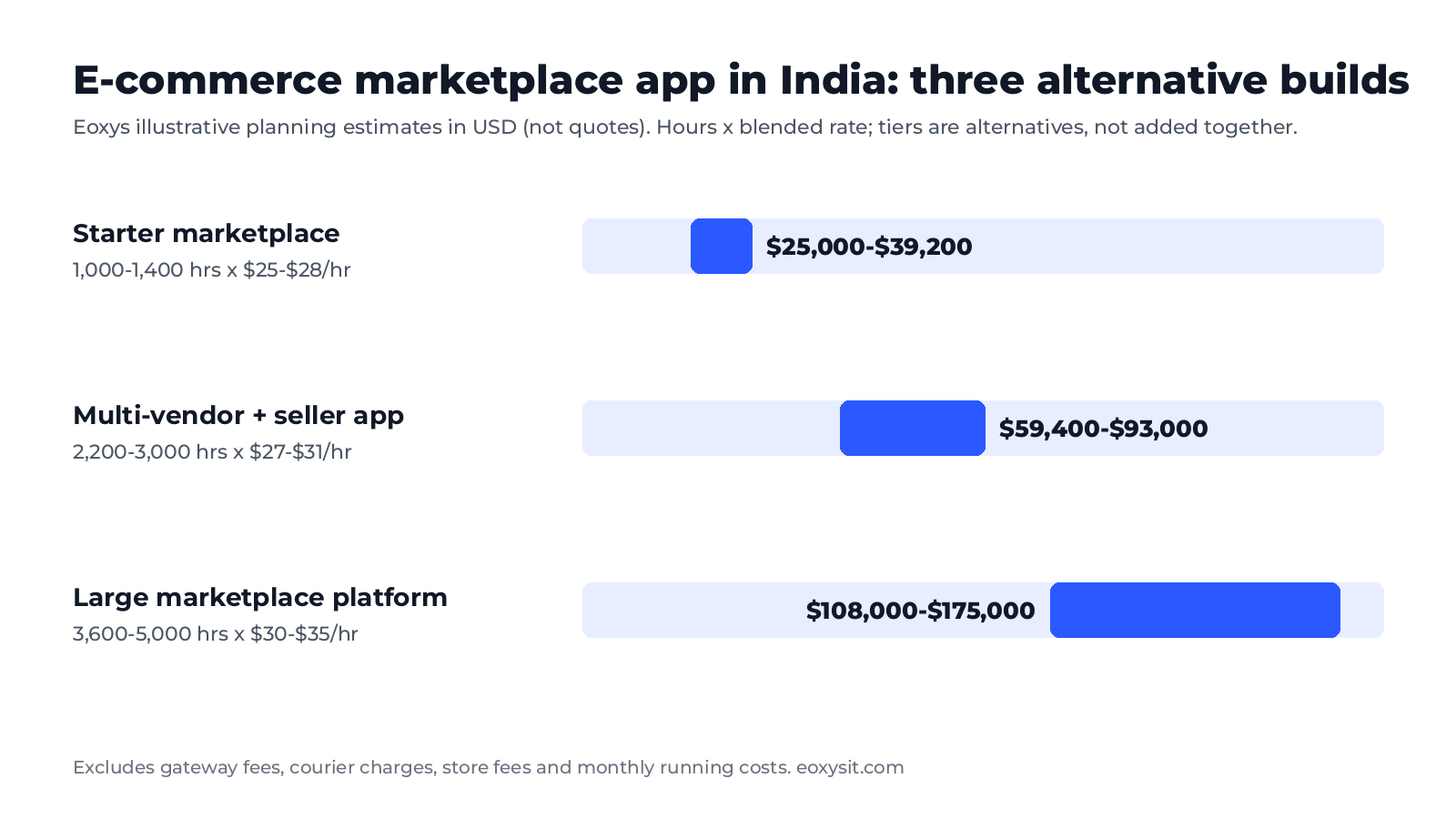
- Eoxys plans an India marketplace app at about $25,000–$39,200 for a starter marketplace, $59,400–$93,000 for a multi-vendor marketplace with a seller app and $108,000–$175,000 for a large marketplace platform. These are illustrative estimates, not quotes.
- Each tier is delivery hours × a blended rate of $25–$35 per hour, delivered from our team in Jaipur.
- Marketplaces collect GST at source (TCS) on sellers’ sales, must show seller and grievance details under the Consumer Protection (E-Commerce) Rules, 2020, and face DPDP Act duties from 13 May 2027.
- Split payments, seller payouts and returns usually cost more to build than the shopping screens.
In this guide: Quick answer · Core features and edge cases · Estimated costs and rates · Hours by module · Ongoing monthly costs · India-specific costs · What changes the budget · Keeping the first release lean · Why build with Eoxys · FAQ
Quick answer
Plan $25,000–$39,200 (about ₹23.2 lakh–₹36.4 lakh) for a starter marketplace with a buyer app, a seller web portal and an admin panel. Plan $59,400–$93,000 (about ₹55.2 lakh–₹86.4 lakh) for a multi-vendor marketplace with a seller app, split payments, commissions, courier integration and returns. Plan $108,000–$175,000 (about ₹1.00 crore–₹1.63 crore) for a large marketplace platform with ERP or warehouse integrations, several languages and advanced search. Rupee figures use the FBIL reference rate shown by the Reserve Bank of India of ₹92.9139 per US dollar on 27 Nov 2026; the rupee floats, so recheck on the day you budget. All three are Eoxys illustrative planning estimates for alternative builds. They are not quotes.
Core features and the edge cases that drive cost
Every marketplace demo looks the same. The cost difference comes from how each feature behaves when a seller, a payment or a parcel does not do what the order expected. Price these exceptions, not just the happy path.
- Seller onboarding: a seller uploads a GSTIN that does not match the business name, or a blurred bank proof. You need document checks, a review queue, rejection reasons and re-submission.
- Catalogue and variants: two sellers list the same phone in different colours and prices. Plan product matching, variant rules, a buy-box or seller choice, and bulk upload with error reports.
- Stock and pricing: an item sells out at the seller’s shop while it is in a buyer’s cart. Stock sync, reservation on checkout and a clean cancel-and-refund path all add hours.
- Payments and split settlement: a UPI payment succeeds but the app never receives the confirmation. You need webhooks, reconciliation, idempotent orders and a split of each payment between seller and platform.
- Cash on delivery and returns: the buyer refuses a COD parcel, or returns one item from a three-item order. Partial refunds, return-to-origin tracking and seller debit notes are their own module.
- Courier hand-off: the pin code is not serviceable, or the courier marks a parcel delivered that never arrived. Serviceability checks, tracking updates and a dispute flow drive the logistics budget.
- Complaints: a buyer wants the seller’s address after a bad purchase. The app needs ticket numbers, seller details on request and a grievance desk with deadlines.
Estimated development costs and rates
Every figure below is delivery hours × a blended hourly rate. The hours cover discovery, UI/UX design, Flutter or React Native apps, backend and admin, testing, release and project management. Our base developer rate for delivery from India is $25 per hour. The blend rises towards $35 as a project needs more senior architect, QA automation, security and DevOps time. Delivering from our own team in Jaipur is how we keep the rate lower than many onshore agencies. The three tiers are alternative builds, so do not add them together.
Tier 1: Starter marketplace
$25,000–$39,200, from about 1,000–1,400 hours at $25–$28 per hour. You get a buyer app for Android and iOS, a seller web portal, an admin panel, seller sign-up with document upload, categories and search, cart and checkout with UPI, cards and net banking through one gateway, order tracking, basic returns and push and SMS notifications. Seller payouts are reconciled from the admin panel. This suits a niche or regional marketplace with a few dozen sellers.
Tier 2: Multi-vendor marketplace with a seller app
$59,400–$93,000, from about 2,200–3,000 hours at $27–$31 per hour. This adds a seller app, automated split payments and payouts, commission rules by category, GST invoices per seller, TCS and settlement reports, courier integration with serviceability checks, partial returns and cash on delivery, coupons, ratings, a grievance desk with ticket numbers and reporting for sellers and admins.
Tier 3: Large marketplace platform
$108,000–$175,000, from about 3,600–5,000 hours at $30–$35 per hour. On top of Tier 2, plan for seller ERP and warehouse integrations, several courier partners, advanced search and recommendations, several Indian languages, B2B pricing or bulk orders, fraud and risk rules, fine-grained admin roles, audit logs and monitored, load-tested infrastructure for sale days. Confirm seller volumes and integration access before you fix this price.
Planning a marketplace for Indian buyers? Get a real project estimate within 24 hours. NDA on request.
Hours by module (Tier 2 example)
Ask every bidder for hours by module. It is the quickest way to see whether a low quote has left out the seller app, split payments or returns. Here is how a Tier 2 marketplace breaks down in our planning.
| Module | Hours (estimate) | What is included |
|---|---|---|
| Discovery and UI/UX | 160–220 | Buyer, seller and admin flows, clickable prototype, acceptance tests |
| Buyer app (Android and iOS) | 450–600 | Sign-up, search, product pages, cart, checkout, orders, returns, reviews |
| Seller app and web portal | 330–450 | Onboarding, KYC documents, catalogue, stock, orders, payouts, reports |
| Catalogue, search and variants | 250–340 | Categories, attributes, variants, bulk upload, search and filters |
| Checkout, payments and refunds | 220–300 | UPI, cards, net banking, COD, webhooks, reconciliation, partial refunds |
| Split settlement, commissions and tax reports | 240–330 | Commission rules, seller payouts, GST invoices per seller, TCS and settlement reports |
| Orders, courier integration and returns | 200–270 | Serviceability, shipping labels, tracking, return-to-origin, return pickups |
| Admin, disputes and grievance desk | 170–230 | Seller approval, ticket numbers, deadlines, seller details on request, audit views |
| Languages and notifications | 60–80 | Hindi and English screens, SMS, push and email templates |
| QA, security, DevOps and release | 120–180 | Payment and device testing, access controls, CI/CD, store submissions |
| Total | 2,200–3,000 | × $27–$31 per hour = $59,400–$93,000 |
Ongoing monthly costs
As a working allowance, plan $600–$3,000 per month for software operations at launch volumes: cloud hosting and database, image storage and CDN for product photos, search, backups, monitoring, SMS and push notifications. This is an Eoxys planning estimate. Image storage and search grow with the size of your catalogue, so this line rises with sellers and products. It does not include payment fees, courier charges or marketing.
- Payment gateway: Razorpay’s standard domestic pricing is a 2% platform fee per successful payment plus 18% GST on that fee, including on UPI, which carries zero bank MDR. Negotiated rates are possible at higher volumes. Split payouts to sellers use a separate product such as Razorpay Route; check its terms when you choose a gateway.
- Maps and address search: usage-based. See Google Maps Platform pricing; many marketplaces only need pin-code checks, not live maps.
- Courier charges: set by your logistics partners per parcel and weight. Get written rate cards before you design shipping fees.
- App stores: the Apple Developer Program costs $99 a year and a Google Play developer account is a one-time $25.
- Support retainer (optional): if you want Eoxys to handle fixes, updates and small changes, 20 hours a month at $30 per hour is $600, or 40 hours is $1,200.
India-specific costs to plan for
Currency and GST collected at source
The rupee floats, so quote and budget in one currency and recheck the reference rate published on the RBI website before you sign. On tax, an e-commerce operator that collects payment for sellers’ sales must collect tax at source under section 52 of the CGST Act. Notification No. 15/2024–Central Tax cut the CGST part to 0.25% from 10 July 2024, which makes 0.5% in total with the state or integrated share. The build needs each seller’s GSTIN, a per-seller tax ledger, TCS deducted from payouts and monthly statements your accountant can file from. Confirm the filing details with a GST practitioner.
Consumer Protection (E-Commerce) Rules, 2020
The Consumer Protection (E-Commerce) Rules, 2020 apply to marketplace and inventory models alike. A marketplace must show sellers’ names, addresses, customer care numbers and ratings, give every complaint a ticket number, and have a grievance officer who acknowledges complaints within 48 hours and resolves them within one month. Sellers must supply price breakups, country of origin and return and refund terms for display. The Central Consumer Protection Authority has issued an advisory reminding marketplaces to display seller details. Budget seller profile fields, a grievance desk and admin reports for these from the first release.
Personal data under the DPDP Act
The DPDP Rules, 2025 were notified on 13 November 2025 with an 18-month phase-in. Consent Manager registration started on 13 November 2026, and the duties of data fiduciaries, including notices, data principal rights, security safeguards and breach reporting, come into force on 13 May 2027. A marketplace holds buyer addresses, phone numbers and order history, and shares some of it with sellers and couriers. Budget discovery time for a data map, clear consent and notice screens, role-based access, deletion on request and a breach process. Our guide to DPDP compliance for apps covers the build items in more detail.
Foreign investment: marketplace or inventory model
If your company has or plans foreign investment, the model matters. DPIIT’s Press Note No. 3 (2026 Series) restates that FDI is permitted in B2B and marketplace e-commerce but not in inventory-based B2C e-commerce, with a new exception for exports of goods made in India. For the app, this means the platform should not own the stock it lists: sellers are the sellers of record, and invoices, stock and returns must sit with them. Take legal advice before you choose the model, because it changes the data model.
Payments: UPI, cards and the app stores
Indian buyers expect UPI, cards, net banking, wallets and often cash on delivery at checkout. One gateway can cover most of these, but COD needs its own reconciliation with couriers. Because marketplace goods are physical items used outside the app, Apple’s App Review Guidelines (3.1.3(e)) let you take payment through your gateway rather than in-app purchase, so no store commission applies to orders.
Languages and SMS
Many buyers prefer Hindi or a regional language. Flutter has built-in internationalisation support, but each language adds translated product attributes, templates and testing, so start with two and add more after the pilot. Order and OTP SMS to Indian numbers go through the registration and template rules set by the Telecom Regulatory Authority of India, so plan sender IDs and template approvals with your SMS provider before launch.
What changes the budget
- Seller model: a few curated sellers on a web portal cost far less than thousands of self-serve sellers with their own app.
- Payment flow: manual payouts are cheapest; automated split settlement, COD and partial refunds add hours.
- Logistics: one courier partner is simpler than several with rate shopping and return pickups.
- Integrations: seller ERP, inventory, accounting and warehouse systems are each a separate integration with its own testing.
- Languages and design depth: each language and each custom animation or 3D view adds design and QA time.
To compare bids fairly, send every vendor the same one-page brief and a sample sale day: 500 orders, one seller who runs out of stock mid-morning, ten COD parcels refused at the door, one partial return from a three-item order, one UPI payment that succeeds without a callback, and one buyer asking for the seller’s address. Ask each vendor to show how their build handles those cases and how many hours they have priced for each.
How to keep the first release lean
- Discovery (about 2–3 weeks): map the seller journey, payment and payout flow, tax data, returns policy and couriers, and agree on acceptance tests.
- MVP build (about 12–18 weeks for Tier 1 or 2): ship the smallest complete loop, from seller onboarding to listing, order, payment, shipping, return and payout.
- Pilot (about 4–6 weeks): launch with a small group of sellers and one city or category, and track failed payments, returns, payout errors and complaints.
- Scale: add a seller app, more couriers, languages or AI search only when pilot data shows they are needed.
Timelines are Eoxys estimates and depend on how fast gateway onboarding, seller documents and store listings are ready. If you plan an assistant for shoppers later, our guide to AI chatbots for e-commerce stores covers what is worth building.
Why build with Eoxys
- Since 2009: Eoxys IT Solution has delivered 700+ projects from Jaipur, India, with a team of 55+.
- E-commerce and marketplace work: our portfolio includes Dirise, an e-commerce website and mobile app, and we built BIDZ Marketplace, which is live on Google Play and the App Store.
- Cross-platform builds: Flutter apps from one codebase, plus seller and admin portals, through our mobile and web application development and e-commerce solution teams.
- Flexible engagement: fixed cost, a dedicated team or hourly.
- You own it: the source code, store accounts, gateway, SMS and cloud accounts stay in your company’s name.
Prefer to talk? Call us on +91 96678 22661.
FAQ
How much does an e-commerce marketplace app cost in India?
Eoxys plans about $25,000–$39,200 for a starter marketplace, $59,400–$93,000 for a multi-vendor marketplace with a seller app and $108,000–$175,000 for a large platform, roughly ₹23.2 lakh to ₹1.63 crore at the 27 Nov 2026 reference rate. These are illustrative hours × rate estimates, not quotes, and exclude running costs.
How long does it take to build a marketplace app?
Plan about 2–3 weeks of discovery and 12–18 weeks of build for Tier 1 or Tier 2, then a 4–6 week pilot with a small group of sellers. A large platform with ERP and warehouse integrations takes longer and is best delivered in phases. Gateway onboarding and store review can add weeks, so start them early.
What are the ongoing costs after launch?
Allow about $600–$3,000 a month for cloud, storage, search, SMS, push and monitoring at launch volumes, as an Eoxys planning estimate. Gateway fees are a percentage of each payment, couriers charge per parcel, Apple charges $99 a year and Google $25 once. An optional Eoxys support retainer is 20 hours for $600 a month.
Does a marketplace have to collect GST from sellers?
An e-commerce operator that collects payment for sellers’ supplies must collect tax at source under section 52 of the CGST Act, now 0.5% in total of net taxable supplies after Notification No. 15/2024. Your app needs seller GSTINs, a per-seller ledger and TCS statements. Confirm the filing process with a GST practitioner.
What does the DPDP Act mean for my marketplace?
From 13 May 2027, data fiduciaries must give clear notices, honour data principal requests, keep reasonable security safeguards and report breaches under the DPDP Act and Rules. A marketplace shares buyer data with sellers and couriers, so plan a data map, consent screens, access controls and deletion flows during discovery.
Who should own the store, gateway and cloud accounts?
Your company should. Open the Apple, Google Play, gateway, SMS and cloud accounts in your own name and invite the developer as a user. That way you keep your apps, payment history and buyer data if you ever change vendors. Eoxys works this way by default and hands over the source code.
Is a white-label marketplace script cheaper?
A script can be cheaper to start, but payouts, GST reports, returns and seller rules usually need custom work, and you may not own the code. If your model is standard, a script plus customisation can work; if your payout, seller or returns rules are your edge, a custom build is easier to grow.
How do I get an estimate for my marketplace app?
Share your categories, seller model, payment and payout flow, couriers, languages and any systems you use through our contact page. We reply with a real project estimate within 24 hours, broken down by module and hours, and we can sign an NDA before you share details.
Ready to plan your marketplace for India? Get a real project estimate within 24 hours, NDA on request, or call +91 96678 22661.
Related reading:
- Grocery Delivery App Development Cost in Saudi Arabia (2026)
- Food Delivery App Development Cost in the UAE (2026)
Sources
Checked on 28 Nov 2026 against the Reserve Bank of India, GST Council, Department of Consumer Affairs, Central Consumer Protection Authority, Gazette of India, Press Information Bureau, DPIIT, TRAI, Razorpay, Apple, Google and Flutter pages below.
- Reserve Bank of India: reference rates (source FBIL)
- GST Council: Notification No. 15/2024–Central Tax (TCS rate)
- Department of Consumer Affairs: Consumer Protection (E-Commerce) Rules, 2020
- CCPA: advisory on displaying seller information
- Gazette of India: DPDP Act commencement notification, 13 Nov 2025
- PIB: Consent Manager registration framework comes into effect
- DPIIT: Press Note No. 3 (2026 Series), FDI policy on e-commerce
- Razorpay: pricing
- Razorpay Route
- Telecom Regulatory Authority of India
- Apple: App Review Guidelines
- Flutter: Internationalizing Flutter apps
- Apple Developer Program: what’s included and fees
- Google Play Console: registration fee
- Google Maps Platform pricing

Shafeeq Khan is a web developer who creates modern, responsive, and user-friendly websites with clean code and creative design