

Most store chats are the same few questions: where is my order, will this fit, can I return it. With the holiday peak weeks away, they arrive at 2 a.m., in bulk, while your team sleeps.
An AI chatbot for an e-commerce store answers them from your own catalog, policies and order data, and hands the hard cases to a person. You can switch one on for free, rent one per conversation, or build your own. This guide compares the three, with prices checked on 18 October 2026. For AI agents that shop on a customer’s behalf, see our guide to AI shopping agents.
Key takeaways
- Shopify stores can start with the free Shopify Inbox agent; WooCommerce stores need a plugin, a SaaS tool or a custom build.
- SaaS AI agents bill per conversation or per resolution, so the bill grows with your traffic. Raw model costs for the same traffic are usually much lower, but you pay to build and run the system.
- Start with product questions and order status. Add actions such as returns or refunds only with checks and a human approval step.
- Most chatbot failures come from messy product data and vague policies, not from the model.
In this guide
- What an e-commerce AI chatbot can do
- Built-in, SaaS or custom: your three options
- The stack behind a custom chatbot
- What it costs to run and build
- How to roll it out
- Risks and limits
- FAQ
What an AI chatbot for an e-commerce store can do
A modern store chatbot reads your catalog and policies, looks up live data and takes simple actions. The useful jobs, and what each needs, look like this:
| Use case | What the bot needs | Risk level |
|---|---|---|
| Product questions and recommendations | Catalog, variants, stock, reviews, size guides | Low: read-only |
| Order status (“where is my order?”) | Order system and courier tracking, plus customer verification | Medium: personal data |
| Shipping, returns and policy answers | Up-to-date policy pages and delivery zones | Low, if policies are clear |
| Add to cart and cart recovery | Cart API and current prices | Medium: must not invent discounts |
| Start a return or exchange | Order data, return rules, returns or ERP system | High: needs checks and approval |
| Hand-off to a human | Helpdesk or live-chat inbox with full conversation history | Low, and essential |
Our post on conversational AI in e-commerce covers more customer-facing ideas.
Built-in, SaaS or custom: your three options
1. The built-in agent (Shopify Inbox)
Shopify’s Inbox app is listed as free, and it includes an opt-in Inbox agent. According to Shopify Help Center, it answers questions about products, shipping, returns, sizing and store policies using your catalog, policies, Knowledge Base and published store content, and it can personalise recommendations. Shopify’s setup page adds that it can help with order lookups and add items to a cart.
Shopify also says the agent works only in your store’s chat widget, needs new customer accounts, and Inbox is available on the Basic, Grow, Advanced and Plus plans. It is a good free start for pre-sale questions, but it will not reach your warehouse system, WhatsApp line or a custom returns process.
2. A SaaS AI support agent
Helpdesk vendors sell AI agents priced by usage. Two common e-commerce examples, as of 18 October 2026:
- Tidio Lyro: Tidio’s own pricing breakdown lists $39 a month for 50 Lyro conversations on monthly billing, up to $700 a month for 1,000. A conversation counts once Lyro replies at least once. Every account gets 50 free Lyro conversations one time only, and per Tidio Help, that free quota does not renew.
- Gorgias AI Agent: Gorgias says its AI Agent is billed per resolved interaction, $0.90 on most plans and from $1 on Starter, and you pay only when the AI resolves a conversation without a human. Overage rates apply above your plan’s allowance.
SaaS tools launch fast and include a team inbox. The trade-off is a bill that rises with every busy month, and limits on what you can connect.
3. A custom chatbot built on your stack
A custom build uses a model API with your own data and integrations. It suits WooCommerce or custom platforms, multi-store setups, and deep actions such as creating returns in an ERP. WooCommerce gives developers a head start: its agentic commerce page says WooCommerce 10.3 shipped Model Context Protocol (MCP) support with nine built-in abilities that let AI assistants read your store’s products and orders, and Woo lists its own merchant AI assistant as “coming soon”.
| Option | Pricing model (as of 18 Oct 2026) | Best for | Main limit |
|---|---|---|---|
| Shopify Inbox agent | Free app on Basic plan and above | Shopify stores starting with pre-sale chat | Website widget only; Shopify only |
| Tidio Lyro | $39/month for 50 conversations, up to $700 for 1,000 (monthly billing) | Small stores that want a ready inbox | Cost rises per conversation |
| Gorgias AI Agent | $0.90 per resolved interaction on most plans | Busy Shopify/WooCommerce support teams | Cost rises per resolution; plan fees extra |
| Custom build | One-off build cost plus model tokens and hosting | WooCommerce or custom stores, multi-channel, deep actions | You need a team to build and maintain it |
Not sure which route fits your store? Tell us your platform, monthly chat volume and the top ten questions customers ask. Get a real project estimate within 24 hours. NDA on request.
For a deeper decision framework, read custom AI agent vs off-the-shelf tools.
The stack behind a custom e-commerce chatbot
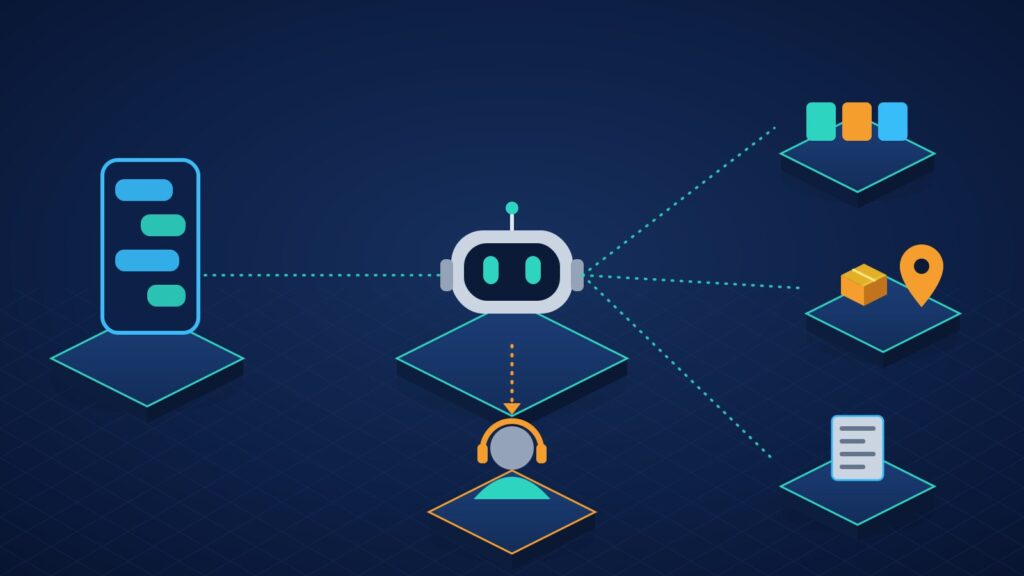
A custom store chatbot has five layers. Each one is a place where a build can go right or wrong:
- Channels: a website chat widget first, then WhatsApp, Instagram or email from the same back end.
- Model layer: a small, cheap model for routine questions and routing, with a larger model only for complex or sensitive conversations.
- Store knowledge: a search index over your catalog, size guides and policy pages, refreshed whenever prices or stock change.
- Tools and actions: calls to your platform’s APIs, such as the WooCommerce REST API, for order status, cart and returns. The customer is verified before any personal order data is shown.
- Hand-off and logging: a clean transfer to your helpdesk with the full transcript, plus logs of every model and tool call.
When a customer says the bot promised a refund, you need to see exactly what it read and said. Our AI agent observability guide explains how to trace each step.
What an e-commerce chatbot costs to run and build
Model APIs charge per million tokens (a token is roughly a short word). These are standard prices from the OpenAI pricing page and the Anthropic pricing page, as of 18 October 2026:
| Model (as of 18 Oct 2026) | Input / 1M tokens | Cached input / 1M | Output / 1M tokens |
|---|---|---|---|
| OpenAI GPT-6.1 Sol | $2.00 | $0.10 | $10.00 |
| OpenAI GPT-6 Luna | $0.10 | $0.01 | $0.50 |
| Claude Sonnet 5.5 | $2.00 | $0.10 | $10.00 |
| Claude Haiku 5.5 (prompts up to 100K tokens) | $0.10 | $0.01 | $0.50 |
Illustrative example: a store with 5,000 chats a month, four model calls per chat, 3,000 input tokens per call (2,000 of them a cached system prompt and catalog context) and 250 output tokens per call. That is 20,000 calls: 20 million fresh input tokens, 40 million cached tokens and 5 million output tokens.
- On GPT-6.1 Sol or Claude Sonnet 5.5: (20 × $2) + (40 × $0.10) + (5 × $10) = about $94 a month.
- On GPT-6 Luna or Claude Haiku 5.5: (20 × $0.10) + (40 × $0.01) + (5 × $0.50) = about $5 a month.
- For comparison, at Gorgias’s $0.90 per resolved interaction, 2,000 AI resolutions would cost $1,800 in AI fees that month, before plan fees.
This is our arithmetic on public prices, not a quote. It leaves out cache writes, hosting, monitoring and taxes.
The bigger cost of a custom chatbot is the build. Our AI agent cost guide estimates 200 to 400 hours for a single-workflow agent with one or two integrations and human hand-off, based on public rate benchmarks. Returns, extra channels and ERP links push it higher. The honest rule: SaaS is cheaper at low volume; custom pays off when volume is high, your platform is poorly supported, or you need actions SaaS tools cannot do.
How to roll out a store chatbot in five steps
- Mine your inbox. Group three months of chats and emails; the top ten question types are your first scope.
- Fix the source data. Clean product attributes, size charts and delivery zones, and rewrite vague policies.
- Launch read-only first. Product questions, policy answers and order status, with clear hand-off to a person.
- Add actions behind checks. Cart, returns and exchanges, each with rules on what the bot may do alone and what needs staff approval.
- Measure weekly. Track resolution rate, hand-off rate, customer ratings and cost per conversation, and review a sample of transcripts.
Risks and limits to plan for
- Made-up answers: a bot that invents a discount or return window creates liability. Ground answers in your own pages and test before launch.
- Prompt injection: the OWASP Top 10 for LLM Applications lists it first (LLM01). Limit what each tool can do (excessive agency is LLM06).
- Privacy: verify the customer before showing order details, mask personal data in logs, and check your model provider’s data settings.
- Indian shoppers’ data: PIB confirms the DPDP Rules were notified in November 2025, with most business duties applying from 13 May 2027. Our DPDP checklist for AI apps covers consent and retention.
- Peak-season cost: set usage caps and alerts so a traffic spike or a bot loop cannot run up your bill.
FAQ
What is the best AI chatbot for an e-commerce store?
It depends on your platform and volume. Shopify stores can start with the free Shopify Inbox agent. Small stores that want a ready inbox often use a SaaS agent such as Tidio Lyro or Gorgias. WooCommerce, custom or multi-channel stores that need deep integrations usually get more value from a custom build.
How much does an AI chatbot for an online store cost?
As of 18 October 2026, Shopify Inbox is free, Tidio lists $39 a month for 50 Lyro conversations, and Gorgias charges $0.90 per resolved interaction on most plans. A custom build has a one-off cost plus model fees; in our illustrative example, 5,000 chats a month cost about $5 to $94 in tokens.
Can an AI chatbot track orders and handle returns?
Yes, if it is connected to your order system and, for returns, your returns rules. Order tracking should only show details after the customer is verified. Returns and refunds are higher risk, so start with the bot collecting details and checking eligibility, and let staff approve the final step until the results are proven.
Does WooCommerce have a built-in AI chatbot?
Not for shoppers yet. WooCommerce says its merchant AI assistant is coming soon. WooCommerce 10.3 added Model Context Protocol support with nine built-in abilities that let AI assistants read store products and orders. Most WooCommerce stores use a chatbot plugin, a SaaS agent or a custom build on the WooCommerce REST API.
Will an AI chatbot replace my support team?
It should take the repetitive questions, not the whole job. Customers still need people for damaged orders, complaints, unusual requests and anything involving money. A good setup hands those conversations to staff with the full transcript, so your team spends its time on the conversations that keep customers loyal.
How long does it take to build a custom e-commerce chatbot?
A focused first version with product questions, order status and human hand-off is often a matter of weeks; treat that as an estimate, as timing depends on your platform, data quality and integrations. Adding returns, WhatsApp or ERP connections extends it. A short paid pilot on one workflow is the safest way to start.
How do I get an estimate from Eoxys?
Share your store platform, monthly chat volume, the systems the bot must connect to and your top customer questions. We reply with a recommended route, built-in, SaaS or custom, and a real project estimate within 24 hours, with fixed-cost, dedicated-team or hourly options. NDA on request.
Build your store chatbot with Eoxys
Eoxys IT Solution has built software from Jaipur since 2009, with 700+ projects delivered, including e-commerce and marketplace platforms such as Dirise, BIDZ and SOLD AI, and grocery and food-delivery apps such as Anad Mart, Fresh2arrive and Chickenway. You can see them on our portfolio and read client reviews, including from ZIP International’s CTO, BIDZ and DJ PlayNow, on our site.
Whether you need e-commerce development, a chatbot or AI agent developer, WooCommerce and WordPress work or a wider AI and machine learning solution, get a real project estimate within 24 hours. NDA on request.
Related reading:
- AI Shopping Agents for E-commerce: Get Your Store Ready Now
- How Much Does It Cost to Build an AI Agent in 2026?
- Custom AI Agent vs Off-the-Shelf Tools: How to Decide
Sources
Checked on 18 Oct 2026 against Shopify Help Center and the Shopify App Store listing for Inbox, WooCommerce’s agentic commerce page, Tidio’s pricing breakdown and Help Center, Gorgias’s AI Agent pricing page, the OpenAI and Anthropic API pricing pages, OWASP and PIB. Tidio’s main pricing page loads its prices with scripts, so Lyro prices were taken from Tidio’s own pricing article (updated 5 Oct 2026). Cost examples are labelled estimates.
- Shopify Help Center: Shopify Inbox
- Shopify Help Center: Assigning your Inbox agent to conversations
- Shopify App Store: Shopify Inbox
- WooCommerce: Make your store visible to AI agents
- Tidio: Chatbot pricing (updated 5 Oct 2026)
- Tidio Help Center: The Lyro AI agent limit
- Gorgias: AI Agent pricing, explained
- OpenAI: API pricing
- Anthropic: Claude API pricing
- OWASP GenAI Security Project: Top 10 for LLM Applications 2025
- PIB: DPDP Rules, 2025 notified

Shafeeq Khan is a web developer who creates modern, responsive, and user-friendly websites with clean code and creative design