
Most advice on writing content for AI search comes from tool vendors and agencies. Google and Microsoft have now published their own guidance on how AI Overviews, AI Mode and Copilot pick the pages they cite. Reading both side by side is the fastest way to cut through the hype.
This guide summarises what each company says, where they agree, where they differ, and what you can safely ignore. It ends with a checklist for your next page. Everything was checked against the original documents on 29 October 2026.
Key takeaways
- Google says SEO best practices still apply because its AI features “are rooted in our core Search ranking and quality systems” (Google).
- Original, first-hand content matters most. Google warns against “commodity content” that restates common knowledge.
- Microsoft recommends clear headings, Q&A pairs, lists and tables, and warns against hiding answers in tabs, images or PDFs (Microsoft Advertising).
- Google says you can skip llms.txt, “chunking” content and rewriting just for AI. Microsoft’s advice on structure is about clarity, not tricks.
In this guide
- What Google says
- What Microsoft says
- Where they agree and differ
- What to ignore
- A page checklist
- How to measure results
- FAQ
What Google says
Google’s guide to optimizing for generative AI search explains that AI Overviews and AI Mode use retrieval-augmented generation and “query fan-out”: the model runs several related searches and draws on pages from the normal Search index. To be eligible, a page “must be indexed and eligible to be shown in Google Search with a snippet”.
Its main content advice:
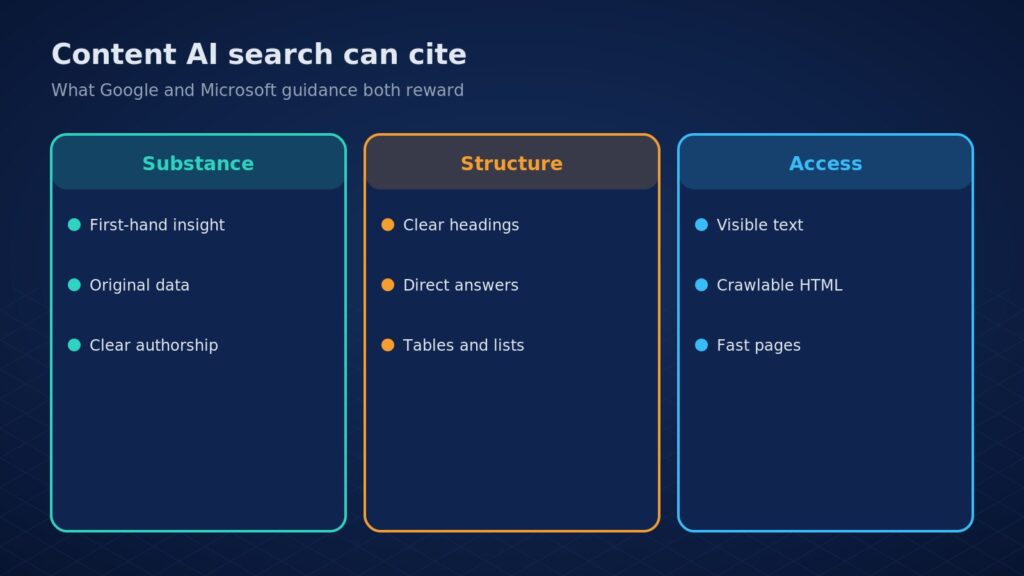
- Offer a unique point of view. Google contrasts a first-hand review with “a summary of existing content” that “simply restates information already available elsewhere”.
- Write non-commodity content. Its example: “7 Tips for First-Time Homebuyers” is commodity; a specific, experience-based story is not.
- Organise for readers. Paragraphs, sections and clear headings.
- Add good images and video where they help.
- Don’t mass-produce pages for every query variation. Google says doing this to manipulate AI responses violates its scaled content abuse spam policy.
On AEO and GEO, Google is direct: “optimizing for generative AI search is optimizing for the search experience, and thus still SEO.” Our comparison of AEO vs SEO vs GEO covers what that means for budgets.
What Microsoft says
In an October 2025 post, Microsoft Advertising explained how Copilot and other Bing-powered experiences choose content. It says assistants “break content down, a process called parsing, into smaller, structured pieces” and assemble answers from several sources. Its advice:
- Make the title, description and main heading match and describe the page clearly.
- Use specific H2 and H3 headings instead of vague ones like “Learn More”.
- Use direct Q&A pairs, which assistants “can often lift” into answers.
- Use lists and comparison tables for steps and features.
- Avoid long walls of text, answers hidden in tabs, core facts only in PDFs or images, and vague words like “innovative” without specifics.
Where they agree and differ
| Topic | Microsoft | |
|---|---|---|
| Core SEO | Still the foundation | Still essential: crawlability, metadata, internal links, backlinks |
| Content quality | Unique, non-commodity, people-first | Clear, current, specific claims |
| Structure | Helpful headings and sections; no need to “chunk” | Content is parsed into pieces; use headings, Q&A, lists, tables |
| Structured data | Not required; no special schema for AI | Helps machines interpret content |
| Special AI files | llms.txt not used by Google Search | Not covered in the post |
| Measurement | Search Console Generative AI performance report | Bing Webmaster Tools AI Performance (Bing) |
The difference on structure is smaller than it looks. Google says you don’t need to break pages into tiny pieces. Microsoft says clear sections make pages easier to parse. Both point to the same habit: one clear idea per section with a heading that says what it answers.
Want to know which of your pages AI search already cites? An Eoxys AI visibility audit checks your key pages against Google’s and Microsoft’s guidance. Get a real project estimate within 24 hours. NDA on request.
What to ignore
Google’s guide has a “mythbusting” section listing things you can ignore for Google Search:
- llms.txt and other “special” AI files or markup.
- “Chunking” content into tiny pieces.
- Rewriting content in a special style just for AI.
- Seeking inauthentic “mentions” across the web.
- Overfocusing on structured data. Google says it is “not required for generative AI search”.
It also warns to “be wary of third-party tools that promise ranking success or claim to use ‘internal’ Google metrics”.
A page checklist
Before you write
- What does your team know first-hand that others don’t: project data, process, mistakes, prices?
- Which real buyer question does this page answer?
While you write
- Answer the main question in the first two or three sentences.
- Use headings that say what each section answers.
- Put comparisons in tables and steps in numbered lists.
- Name specifics: versions, dates, prices, limits, with sources.
- Keep key facts in visible HTML text, not only in images, PDFs or tabs.
Before you publish
- Title, meta description and main heading match.
- The page is indexable and not blocked in robots.txt.
- Internal links point to related service pages and guides.
- Author and update date are visible. See Google’s helpful content guidance.
How to measure results
Google points to the Generative AI performance report in Search Console. Bing offers AI Performance in Bing Webmaster Tools, which shows how often your pages are cited in Copilot and Bing AI answers. For ChatGPT, see our guide on getting recommended by ChatGPT. Eoxys offers this work as part of its AEO services.
FAQ
Do I need to write differently for AI search?
Not in a special style. Google says you don’t need to rewrite content just for AI systems. Write clear, original pages with good headings and direct answers, which also matches Microsoft’s advice. The work that helps AI search is mostly the same work that helps classic search and readers.
Does FAQ content help with AI search?
Clear question-and-answer pairs can help. Microsoft says assistants can often lift them into answers. Google no longer shows FAQ rich results, so add FAQs for readers, not for a search feature. Keep each answer short, direct and complete on its own.
Is structured data required for AI Overviews?
No. Google says structured data isn’t required and there is no special schema for generative AI search, though it still helps with rich results. If you use it, make sure it matches the visible text on the page, and focus first on clear content and crawlable HTML.
Can Eoxys rewrite our pages for AI search?
Yes. We audit your key pages and rewrite them using Google’s and Microsoft’s published guidance, with no ranking promises. You get a prioritised fix list first, then rewrites for the pages that matter most to sales. Get a real project estimate within 24 hours, with an NDA on request.
Work with Eoxys
Eoxys IT Solution LLP has built websites, apps and AI products since 2009, with 700+ projects delivered. See the work on our portfolio, or explore our AI and machine learning solutions.
We help service businesses publish original, well-structured pages that AI search can understand and cite. Get a real project estimate within 24 hours. NDA on request. Prefer to talk? Call +91 96678 22661.
Related reading:
- AEO Services: Get Cited in ChatGPT and Google AI Overviews
- AEO vs SEO vs GEO: What’s Different and What to Pay For
- Google AI Overviews: What Businesses Need to Know in 2026
Sources
Checked on 29 Oct 2026 against Google Search Central’s generative AI optimization guide, helpful content guidance and spam policies, Microsoft Advertising’s October 2025 post, and the Bing Webmaster blog.
- Google: Optimizing your website for generative AI features on Google Search
- Google: Creating helpful, reliable, people-first content
- Google: Spam policies
- Microsoft Advertising: Optimizing your content for inclusion in AI search answers (8 Oct 2025)
- Bing Webmaster blog: AI Performance in Bing Webmaster Tools

Shafeeq Khan is a web developer who creates modern, responsive, and user-friendly websites with clean code and creative design