Every week another agency pitches “AEO”, “GEO” or “AI SEO” as a new service with a new retainer. If you run a business, the honest question is simple: is this something different from the SEO you already pay for, or the same work with a new label?
This guide answers AEO vs SEO (and GEO) in plain terms. It uses what Google, OpenAI, Perplexity and Microsoft say in their own documentation, checked on 28 October 2026, and ends with a buyer’s table of what to keep, what to add and what to ignore. No rankings or citations are promised here, because no one can honestly promise them.
Key takeaways
- Google’s own guide says optimizing for AI Overviews and AI Mode “is optimizing for the search experience, and thus still SEO” (Google Search Central).
- What does change: other answer engines (ChatGPT search, Perplexity, Copilot) use their own crawlers and their own reports, so access and measurement need extra work.
- Google says you can ignore llms.txt, “chunking” content, special AI schema and inauthentic mentions for Google Search.
- Pay for deliverables you can check (crawler access, content fixes, entity cleanup, tracking), not for an acronym or a guarantee.
In this guide
- AEO, GEO, SEO and “AI SEO” in one minute
- What Google says about AEO and GEO
- What really changes outside Google
- What to keep, add and ignore
- What it looks like by industry
- How to judge an AEO or GEO proposal
- FAQ
AEO, GEO, SEO and “AI SEO” in one minute
The four terms overlap far more than the sales decks suggest:
| Term | What people mean | Where it shows up |
|---|---|---|
| SEO (search engine optimization) | Making pages crawlable, useful and trusted so they rank and get clicked | Google, Bing classic results |
| AEO (answer engine optimization) | Getting your content quoted or linked when a tool gives a direct answer | AI Overviews, AI Mode, ChatGPT search, Perplexity, voice assistants |
| GEO (generative engine optimization) | Same goal as AEO, framed around generative AI answers and citations | Copilot, Gemini, ChatGPT, Perplexity |
| AI SEO | A marketing umbrella for both, often used in agency pricing | Everywhere |
So the labels are real, but they describe goals, not separate technologies. Microsoft even describes its Bing Webmaster Tools AI Performance report as “an early step toward Generative Engine Optimization (GEO) tooling”.
What Google says about AEO and GEO
Google answered the question directly. Its guide to optimizing for generative AI features defines both terms, then says: “From Google Search’s perspective, optimizing for generative AI search is optimizing for the search experience, and thus still SEO.” The reason it gives is that AI Overviews and AI Mode are “rooted in our core Search ranking and quality systems” and retrieve pages from the normal Search index.
The same guide lists things you can skip for Google Search:
- llms.txt and other “special” markup: Google Search does not use them. Keeping one for other systems is fine; it neither helps nor harms your Google visibility.
- “Chunking” content into tiny pieces for AI.
- Rewriting content just for AI or chasing every long-tail variation.
- Inauthentic “mentions” across the web.
- Overfocusing on structured data: there is no special AI schema, though normal structured data still helps rich results.
Google’s page on third-party SEO tools and services adds a warning that applies to AEO/GEO vendors: third-party tools “don’t have access to our internal ranking data” and “can’t guarantee performance”. To be shown in AI features at all, a page must be indexed and eligible for a snippet, as the AI features documentation explains.
What really changes outside Google
Google is only one answer engine. Three things are genuinely new work when ChatGPT, Perplexity or Copilot matter to your buyers:
1. Crawler access is separate
ChatGPT search uses OAI-SearchBot. OpenAI says sites that opt out of it “will not be shown in ChatGPT search answers”, and that it is independent of GPTBot, which relates to model training. Perplexity says PerplexityBot surfaces and links sites in its search results. A robots.txt rule, CDN bot setting or firewall that blocks these agents makes you invisible there, even if Google ranks you well.
2. Answer engines search less, and lean on official sources
In a study published in October 2026, Ahrefs analysed 66.6 million logged-out ChatGPT responses from August and September and found that 14.4% contained fan-out (background search) queries, about 1.6 per response. It also reports a shift toward brand and official sites. Ahrefs calls it a snapshot of one model, but the lesson for buyers is clear: your own service, pricing and product pages need to state facts plainly, because that is what gets fetched.
3. Measurement is new
Google’s Search Console Generative AI performance report shows how your pages perform in its AI features, and Bing’s AI Performance report shows how often your URLs are cited in Copilot and Bing AI summaries. On 15 October 2026 Google also announced more inline links in AI Mode and AI Overviews. None of this needs a new agency, but someone has to read the reports and act on them.
Not sure if AI search tools can even reach your site? Eoxys can check your crawler access, CDN rules and key service pages, and tell you what is worth fixing. Get a real project estimate within 24 hours. NDA on request.
AEO vs SEO: what to keep, add and ignore
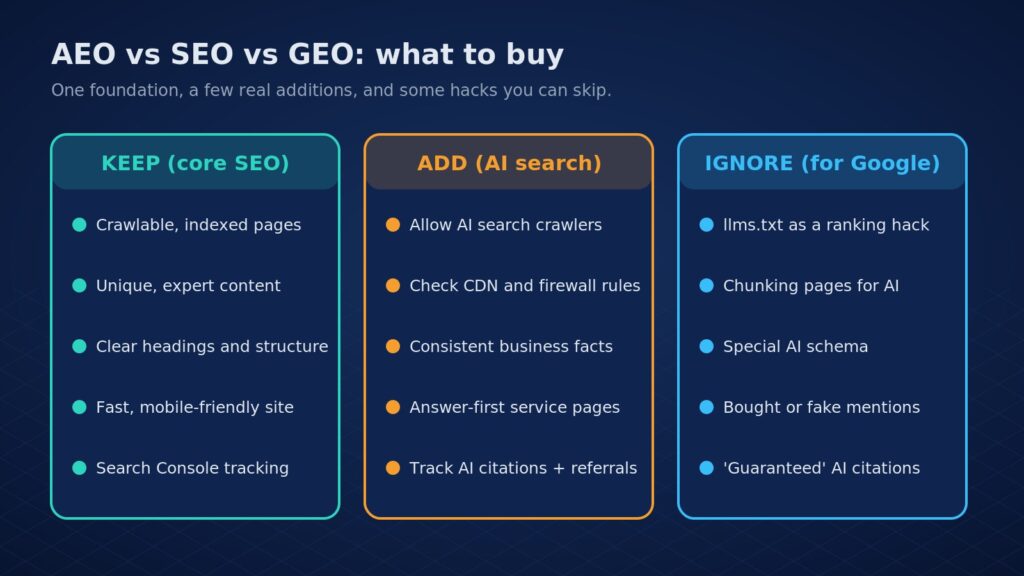
Use this table when you read an SEO, AEO or GEO proposal. Most line items should land in the first two columns:
| Keep (core SEO) | Add (AI search work) | Ignore (for Google Search) |
|---|---|---|
| Crawlable, indexed pages with clean technical setup | Allow OAI-SearchBot and PerplexityBot in robots.txt and CDN or firewall rules | llms.txt as a Google ranking tactic |
| Unique, expert content (Google calls it “non-commodity”) | Answer-first service, pricing and FAQ sections that state facts plainly | Splitting pages into AI-sized chunks |
| Clear headings, fast mobile pages, less duplicate content | Consistent business facts across your site, Google Business Profile and directories | Special “AI schema” |
| Search Console and analytics | Search Console Generative AI report, Bing AI Performance, AI referral tracking | Bought or fake mentions |
| Structured data for rich results | A repeatable prompt test for your buyer questions | Any “guaranteed” AI citation |
If your site is on WordPress or a JavaScript framework, much of the “add” column is development work, not copywriting. Eoxys handles that through our web development and WordPress teams.
What it looks like by industry
The work is the same across sectors, but the pages that matter differ:
| Business type | Pages answer engines fetch | First fixes |
|---|---|---|
| B2B services and software agencies | Service pages, pricing or engagement models, case studies | State what you build, for whom, from where, and how you price it |
| E-commerce and D2C | Product pages, returns and shipping policy, product feeds | Complete product data and Merchant Center feeds, as Google’s guide suggests |
| Clinics, salons and local services | Google Business Profile, location and service pages | Consistent name, address, phone and hours everywhere |
| SaaS and apps | Docs, feature and pricing pages, comparison pages | Plain feature lists and up-to-date pricing that a crawler can read |
How to judge an AEO or GEO proposal
Ask any provider, including us, these questions:
- Which deliverables are new compared with my current SEO contract?
- Will you check OAI-SearchBot and PerplexityBot access, including CDN and firewall settings?
- Which of Google’s “you can ignore” items are in this plan, and why?
- How will you report results: Search Console, Bing AI Performance, a prompt log, or your own tool’s score?
- Do you promise placements or citations? (Google says third parties can’t guarantee performance, so the right answer is no.)
For a deeper walkthrough, see our AEO services guide, our AI visibility audit method and how to get your business recommended by ChatGPT.
FAQ
Is AEO different from SEO?
For Google, no. Google’s generative AI guide says optimizing for AI search “is optimizing for the search experience, and thus still SEO”. AEO adds a few tasks for other answer engines: allowing their crawlers, keeping business facts consistent, and tracking AI citations. Most of the budget should still go on core SEO and useful content.
What is the difference between AEO and GEO?
Very little in practice. AEO (answer engine optimization) and GEO (generative engine optimization) both aim to get your content quoted or linked in AI answers. GEO is the term Microsoft uses for its Bing AI citation tooling. Judge a proposal by its deliverables, not by which acronym it uses.
Do I need llms.txt for AI search?
Not for Google. Google says Search ignores llms.txt and it neither helps nor harms your visibility there. Some other tools may read it, so it is fine to keep one if it is cheap to maintain. Crawler access in robots.txt and your CDN matters far more for ChatGPT search and Perplexity.
How do I get an AEO and SEO estimate from Eoxys?
Send us your site and the questions your buyers ask. We will check crawler access, key pages and tracking, then send a real project estimate within 24 hours, with an NDA on request. Eoxys has worked with clients since 2009 and has delivered 700+ projects.
Work with Eoxys
Eoxys IT Solution LLP has built websites, apps and AI products since 2009, with 700+ projects delivered and real client reviews you can read on our site. See the work on our portfolio, or explore our AI and machine learning solutions.
We fix the technical side of AI search visibility: crawler and CDN access, page structure, business facts and reporting, on WordPress or custom sites. Get a real project estimate within 24 hours. NDA on request. Prefer to talk? Call +91 96678 22661.
Related reading:
- AEO Services: Get Cited in ChatGPT and Google AI Overviews
- AI Visibility Audit: Check If ChatGPT and AI Overviews Cite You
- How to Get Your Business Recommended by ChatGPT in 2026
Sources
Checked on 28 Oct 2026 against Google Search Central (generative AI optimization guide, last updated 10 Jul 2026; third-party SEO guidance, last updated 5 Jun 2026; AI features documentation), Google Search Console Help, the Google blog (15 Oct 2026), OpenAI and Perplexity crawler documentation, the Bing Webmaster Blog and Ahrefs. The industry table is Eoxys’s working view, not a study.
- Google: Optimizing for generative AI features on Google Search
- Google: Guidance on third-party SEO tools, services and advice
- Google: AI features and your website
- Google Search Console Help: Generative AI performance report
- Google: More ways to connect with the web from Search (15 Oct 2026)
- OpenAI: Overview of OpenAI crawlers
- Perplexity: Perplexity crawlers
- Bing Webmaster Blog: AI Performance in Bing Webmaster Tools
- Ahrefs: How ChatGPT does query fan-out (Oct 2026)

Shafeeq Khan is a web developer who creates modern, responsive, and user-friendly websites with clean code and creative design