Many AEO checklists say that adding the right schema markup for AI search will get your pages quoted by ChatGPT, Gemini or Google’s AI Overviews. The real picture is more modest, and it is worth knowing before you spend developer time on it.
This guide sets out what Google’s documentation actually says, which schema.org types are still worth adding, what changed with FAQ rich results in 2026, and a checklist you can give to your web team. All Google statements below were checked against Google Search Central on 29 October 2026.
Key takeaways
- Google says there is “no special schema.org structured data” needed to appear in AI Overviews or AI Mode (Google Search Central).
- Structured data still helps search engines understand who you are and what a page is about, and Google asks that it matches the visible text.
- Google stopped showing FAQ rich results from 7 May 2026 and later removed the FAQ documentation (Search Central updates).
- Focus on Organization, Article, BreadcrumbList and, where relevant, LocalBusiness or Product. Validate every change.
In this guide
- What Google says about schema and AI features
- Why structured data still matters
- Schema types worth keeping
- What changed with FAQ markup
- A five-step checklist
- Common mistakes
- FAQ
What Google says about schema and AI features
Google’s page on AI features and your website is direct. It says the usual SEO best practices apply, that there are “no additional requirements” to appear in AI Overviews or AI Mode, and that you do not need to create “new machine readable files, AI text files, or markup” to appear. It adds: “There’s also no special schema.org structured data that you need to add.”
The same page lists structured data among the SEO basics that are still worthwhile, with one condition: make sure your structured data matches the visible text on the page. To be shown as a supporting link, a page must be indexed and eligible to show with a snippet.
So schema is not a shortcut into AI answers. It is part of the technical hygiene that keeps your pages easy to understand.
Why structured data still matters
Google describes structured data as “a standardized format for providing information about a page and classifying the page content” in its introduction to structured data. That helps in three practical ways:
- Clear entities. Organization markup tells search engines your official name, logo, URL and profiles, which supports consistent brand information.
- Rich results that still exist. Many features in Google’s search gallery, such as breadcrumbs, articles, products and local business details, depend on markup.
- Consistency across systems. Schema.org is a shared vocabulary, so the same markup can be read by other search engines and tools. How each AI assistant uses it is not documented in detail, so treat any effect there as unproven.
The wider goal of AEO is to be the clearest, most citable source on your topic. Our AEO services guide and AEO vs SEO vs GEO explain where schema fits next to content, links and brand mentions.
Schema types worth keeping
| Schema type | Use it on | Why it helps | Google documentation |
|---|---|---|---|
| Organization | Home or About page | Official name, logo, contact details and profiles | Organization |
| Article / BlogPosting | Blog posts and guides | Headline, author, dates and images | Article |
| BreadcrumbList | All inner pages | Shows where a page sits in your site | Breadcrumb |
| LocalBusiness | Location or contact pages | Address, hours and contact for local queries | Local business |
| Product / merchant listing | Product pages | Price, availability and shipping details | Merchant listing guide |
| FAQPage | Real Q&A sections | No Google rich result since May 2026; keep only if accurate and useful to other systems | Search Central updates |
What changed with FAQ markup
FAQ markup was once a popular way to win extra space in results. Google’s Search Central changelog records that it added a deprecation notice in May 2026 because the FAQ rich result would “no longer appear in Google Search starting May 7, 2026”, and later removed the FAQ rich result documentation because the feature is no longer shown.
What this means in practice:
- FAQPage markup will not create an FAQ rich result in Google any more.
- A clear, honest FAQ section still helps readers, and question-and-answer text is easy for any system to quote.
- If you keep FAQPage JSON-LD, make sure every question and answer is visible on the page. Remove markup for content that is hidden or invented.
Not sure what your site’s schema says about you? Eoxys can audit your markup, fix errors and align it with your content as part of an AEO review. Get a real project estimate within 24 hours. NDA on request.
A five-step checklist
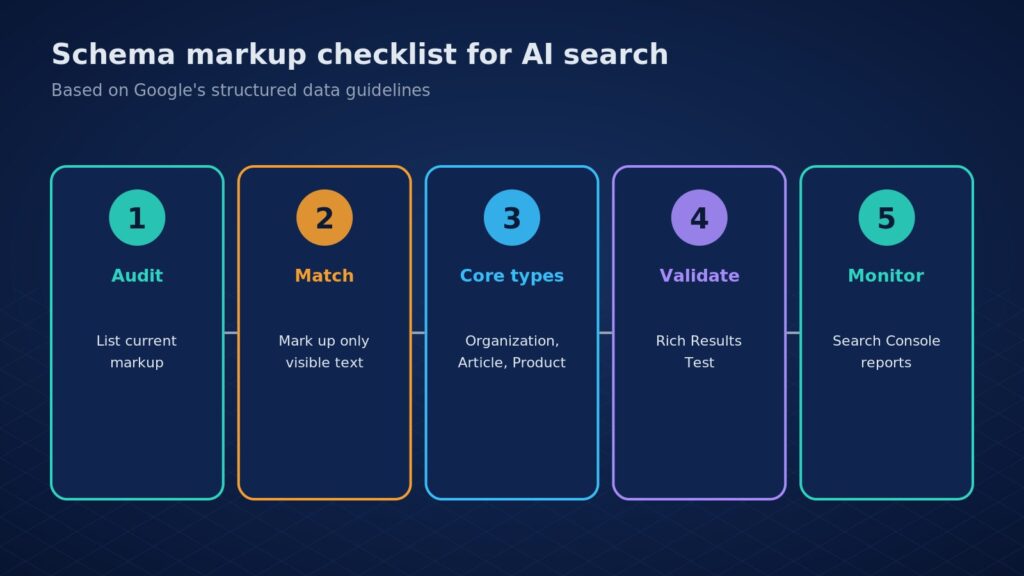
1. Audit what you have
Run key templates (home, service, blog, product) through Google’s Rich Results Test and the Schema Markup Validator. Note duplicate or conflicting markup, which is common when a theme and several plugins all add schema.
2. Match the visible text
Google’s structured data general guidelines warn against markup that is not representative of the page content. Names, prices, dates and ratings in JSON-LD should match what a visitor sees.
3. Add the core types
Start with Organization on the home page, Article on posts and BreadcrumbList site-wide. Add LocalBusiness or Product only where the page really is about a location or a product. Google recommends JSON-LD.
4. Validate and deploy
Test on a staging copy first, then deploy. On WordPress, choose one SEO plugin as the source of schema and turn off overlaps. Our WordPress development team handles this regularly.
5. Monitor
Watch Search Console’s enhancement reports for errors after each release, and repeat your AI visibility audit to see whether citations change. Expect schema to be one small factor among many.
Common mistakes
- Marking up reviews or ratings that are not shown on the page.
- Adding FAQPage markup to every page with copied questions.
- Leaving old schema from a previous theme or plugin, so two Organization records disagree.
- Expecting schema alone to fix weak content or a site that AI crawlers cannot reach.
- Ignoring the basics that matter more for AI answers: clear, sourced content and a consistent brand across the web, as covered in how to get recommended by ChatGPT.
FAQ
Does schema markup help with AI search?
It helps search engines understand your pages and brand, but Google says no special schema is required to appear in AI Overviews or AI Mode. Treat it as technical hygiene that supports clear content, not as a ranking trick or a shortcut into AI answers.
Which schema type is best for AI search?
There is no single best type. Start with Organization, Article and BreadcrumbList, then add LocalBusiness or Product where they fit. The markup must match the visible content of the page, and every required property should be filled. Validate it with Google’s Rich Results Test after each change.
Is FAQ schema still worth adding in 2026?
Not for Google rich results, which stopped appearing from 7 May 2026. A real FAQ section is still useful for readers. If you keep FAQPage markup, keep it accurate and limited to questions shown on the page, so it never describes content readers cannot see.
Can Eoxys fix the schema on my WordPress site?
Yes. We audit existing markup, remove conflicts, add the right types and validate them as part of our AEO and WordPress work, with a backup before any change and a short report of what we fixed. Get a real project estimate within 24 hours, with an NDA on request.
Work with Eoxys
Eoxys IT Solution LLP has built websites, apps and AI products since 2009, with 700+ projects delivered. See the work on our portfolio, or explore our AI and machine learning solutions.
Our AEO work combines content, technical fixes such as schema and crawler access, and AI visibility tracking. Get a real project estimate within 24 hours. NDA on request. Prefer to talk? Call +91 96678 22661.
Related reading:
- AEO Services: Get Cited in ChatGPT and Google AI Overviews
- AEO vs SEO vs GEO: What’s Different and What to Pay For
- AI Visibility Audit: Check If ChatGPT and AI Overviews Cite You
Sources
Checked on 29 Oct 2026 against Google Search Central documentation and its changelog. Statements about how individual AI assistants use schema are not documented by those vendors and are marked as unproven.
- Google: AI features and your website
- Google Search Central: Latest updates (FAQ rich result changes)
- Google: Introduction to structured data
- Google: Structured data general guidelines
- Google: Organization structured data
- Google Rich Results Test
- Schema Markup Validator

Shafeeq Khan is a web developer who creates modern, responsive, and user-friendly websites with clean code and creative design